


Reward and affective regulation in depression-prone smokers
- PMID: 24947541
- PMCID: PMC4186900
- DOI: 10.1016/j.biopsych.2014.04.018
Reward and affective regulation in depression-prone smokers
Abstract
Background: There is a disproportionately high smoking prevalence among individuals who are prone to depression. While depression has been conceptualized as a disorder of dysregulated positive affect and disrupted reward processing, little research has been conducted to determine the role of smoking in these processes among depression-prone smokers.
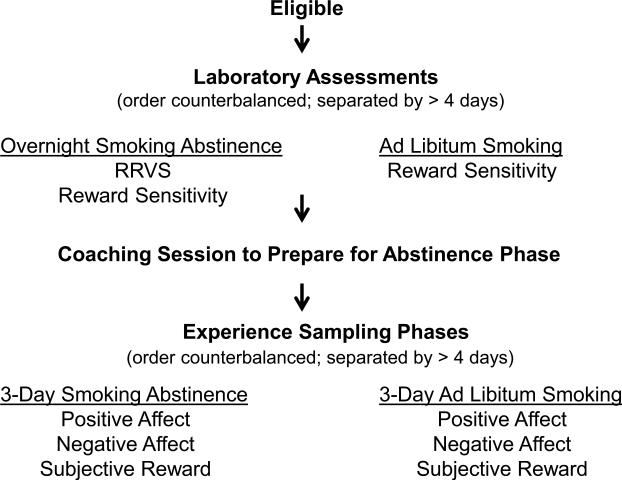
Methods: Depression-prone smokers (DP+; n = 34) and smokers not depression-prone (DP-; n = 49) underwent two laboratory sessions, one while smoking abstinent and one while smoking ad libitum, to assess the relative reinforcing value of smoking and reward sensitivity. Using experience sampling methods, participants completed self-report measures of subjective reward, positive affect, and negative affect across 3 days while smoking as usual and 3 days while smoking abstinent.
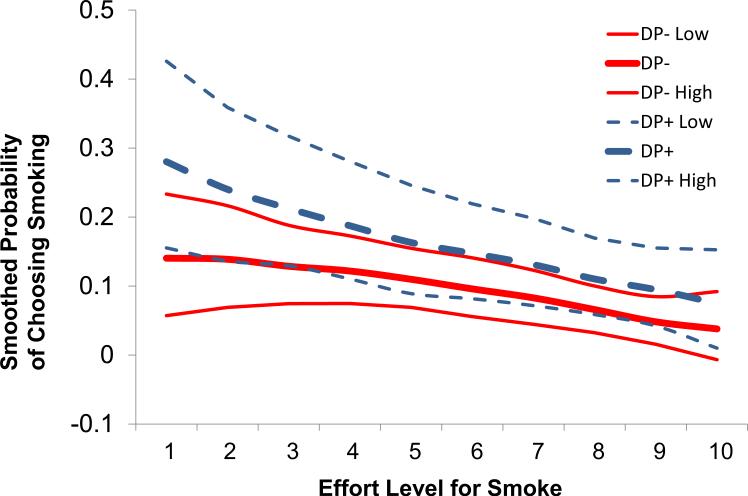
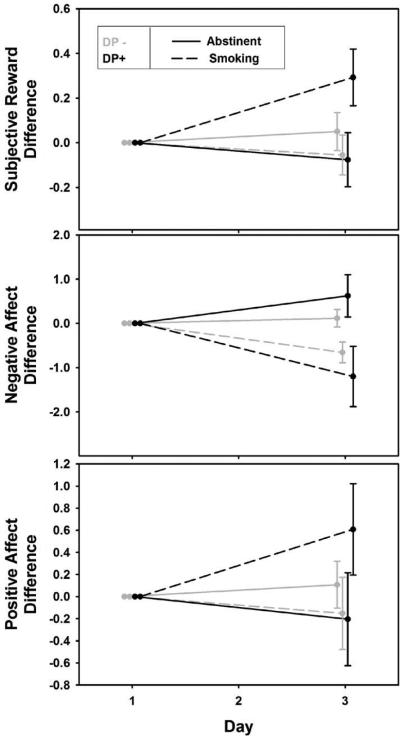
Results: DP+ were two times more likely to work for cigarette puffs versus money in a progressive ratio, choice task (odds ratio 2.05; 95% confidence interval 1.04 to 4.06, p = .039) compared with DP-. Reward sensitivity as measured by the signal detection task did not yield any significant findings. Mixed models regressions revealed a three-way interaction (depression group, smoking phase, and time) for subjective reward, negative affect, and positive affect. For all three of these outcomes, the slopes for DP- and DP+ differed significantly from each other (ps < .05) and the effect of smoking (versus abstinence) over time was greater for DP+ than DP- smokers (ps < .05).
Conclusions: These findings indicate that the effects of smoking on reward and positive affect regulation are specific to DP+ smokers and highlight novel targets for smoking cessation treatment in this population.
Keywords: Depression; negative affect; positive affect; reward regulation; reward sensitivity; smoking.
Copyright © 2014 Society of Biological Psychiatry. Published by Elsevier Inc. All rights reserved.
Figures
References
-
- Cinciripini PM, Tsoh JY, Wetter DW, Lam C, de Moor C, Cinciripini L, Baile W, Anderson C, et al. Combined effects of venlafaxine, nicotine replacement, and brief counseling on smoking cessation. Exp Clin Psychopharmacol. 2005;13:282–292. - PubMed
-
- Ginsberg D, Hall SM, Reus VI, Munoz RF. Mood and depression diagnosis in smoking cessation. Experimental and Clinical Psychopharmacology. 1995;3:389–395.
-
- Glassman AH, Stetner F, Walsh BT, Raizman PS, Fleiss JL, Cooper TB, Covey LS. Heavy smokers, smoking cessation, and clonidine. Results of a double-blind, randomized trial. JAMA. 1988;259:2863–2866. - PubMed
-
- Hall SM, Munoz RF, Reus VI. Cognitive-behavioral intervention increases abstinence rates for depressive-history smokers. J Consult Clin Psychol. 1994;62:141–146. - PubMed
-
- Hall SM, Reus VI, Munoz RF, Sees KL, Humfleet G, Hartz DT, Frederick S, Triffleman E. Nortriptyline and cognitive-behavioral therapy in the treatment of cigarette smoking. Arch Gen Psychiatry. 1998;55:683–690. - PubMed
Publication types
MeSH terms
Grants and funding
LinkOut - more resources
Full Text Sources
Other Literature Sources
Medical
