


Screening for cardiac dysfunction in anthracycline-exposed childhood cancer survivors
- PMID: 24947931
- PMCID: PMC4268342
- DOI: 10.1158/1078-0432.CCR-13-3490
Screening for cardiac dysfunction in anthracycline-exposed childhood cancer survivors
Abstract
Purpose: To examine the utility and reliability of obtaining early echocardiographic measurements of left ventricular (LV) remodeling as well as blood biomarkers of cardiac injury in asymptomatic childhood cancer survivors at risk for LV dysfunction and congestive heart failure due to past exposure to anthracycline chemotherapy.
Experimental design: Using a cross-sectional design, anthracycline-exposed childhood cancer survivors with preserved ejection fraction (EF; ≥50%) were evaluated using early echocardiographic indices and blood biomarkers of LV dysfunction. Survivors treated with ≥300 mg/m(2) anthracyclines [high risk (HR): n = 100] were compared with those treated with <300 mg/m(2) anthracyclines [low risk (LR): n = 50] and matched healthy controls (HC: n = 50). All echocardiograms were interpreted by an institutional cardiologist and a study cardiologist blinded to risk status.
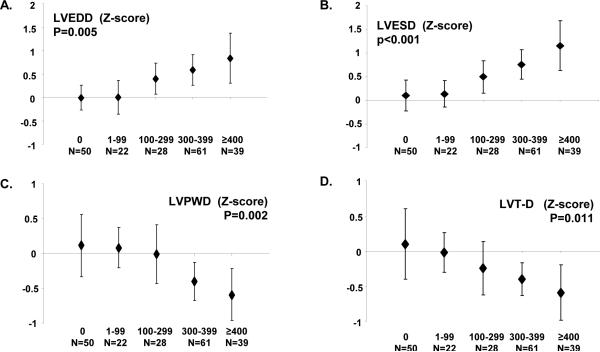
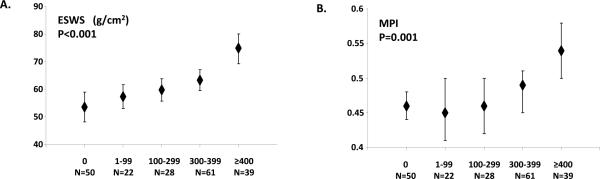
Results: Time from diagnosis was comparable for HR (12.0 years) and LR (13.2 years, P = 0.8) survivors. Echocardiograms: HR had lower LV thickness-dimension ratio (Z-score: HR: -0.62, LR: -0.03, HC: -0.02; P < 0.001), increased LV wall stress (HR: 66.7 g/cm(2), LR: 56.6 g/cm(2), HC: 54.2 g/cm(2); P < 0.01), and higher myocardial performance index (HR: 0.51, LR: 0.46, HC: 0.46; P < 0.01). Interobserver correlation (clinical/blinded reading) for all echocardiographic indices was excellent (range: R = 0.76-0.97, P < 0.001). Blood biomarkers: With the exception of NT-proBNP (r = 0.28, P < 0.01), there was no correlation between blood biomarkers (B-type natriuretic peptide, Troponin-T, ST-2, Galectin-3) and LV dysfunction.
Conclusion: Childhood cancer survivors with preserved EF 10+ years from anthracycline exposure had dose-dependent changes in echocardiographic markers of LV dysfunction.
©2014 American Association for Cancer Research.
Figures
References
-
- Lipshultz SE, Adams MJ, Colan SD, Constine LS, Herman EH, Hsu DT, et al. Long-term Cardiovascular Toxicity in Children, Adolescents, and Young Adults Who Receive Cancer Therapy: Pathophysiology, Course, Monitoring, Management, Prevention, and Research Directions: A Scientific Statement From the American Heart Association. Circulation. 2013;128:1927–95. - PubMed
-
- Lipshultz SE, Lipsitz SR, Sallan SE, Dalton VM, Mone SM, Gelber RD, et al. Chronic progressive cardiac dysfunction years after doxorubicin therapy for childhood acute lymphoblastic leukemia. J Clin Oncol. 2005;23:2629–36. - PubMed
-
- Lipshultz SE, Lipsitz SR, Mone SM, Goorin AM, Sallan SE, Sanders SP, et al. Female sex and drug dose as risk factors for late cardiotoxic effects of doxorubicin therapy for childhood cancer. The New England journal of medicine. 1995;332:1738–43. - PubMed
-
- Adams MJ, Lipshultz SE. Pathophysiology of anthracycline- and radiation-associated cardiomyopathies: implications for screening and prevention. Pediatric blood & cancer. 2005;44:600–6. - PubMed
-
- van Dalen EC, van der Pal HJ, Kok WE, Caron HN, Kremer LC. Clinical heart failure in a cohort of children treated with anthracyclines: a long-term follow-up study. Eur J Cancer. 2006;42:3191–8. - PubMed
Publication types
MeSH terms
Substances
Grants and funding
LinkOut - more resources
Full Text Sources
Other Literature Sources
Medical
Research Materials
Miscellaneous
