. 2014 Jun 20;344(6190):1405-10.
doi: 10.1126/science.1253823.

Molecular basis for disruption of E-cadherin adhesion by botulinum neurotoxin A complex

Affiliations

Molecular basis for disruption of E-cadherin adhesion by botulinum neurotoxin A complex

Kwangkook Lee et al. Science. .

Abstract

How botulinum neurotoxins (BoNTs) cross the host intestinal epithelial barrier in foodborne botulism is poorly understood. Here, we present the crystal structure of a clostridial hemagglutinin (HA) complex of serotype BoNT/A bound to the cell adhesion protein E-cadherin at 2.4 angstroms. The HA complex recognizes E-cadherin with high specificity involving extensive intermolecular interactions and also binds to carbohydrates on the cell surface. Binding of the HA complex sequesters E-cadherin in the monomeric state, compromising the E-cadherin-mediated intercellular barrier and facilitating paracellular absorption of BoNT/A. We reconstituted the complete 14-subunit BoNT/A complex using recombinantly produced components and demonstrated that abolishing either E-cadherin- or carbohydrate-binding of the HA complex drastically reduces oral toxicity of BoNT/A complex in vivo. Together, these studies establish the molecular mechanism of how HAs contribute to the oral toxicity of BoNT/A.


Figures

Fig. 1
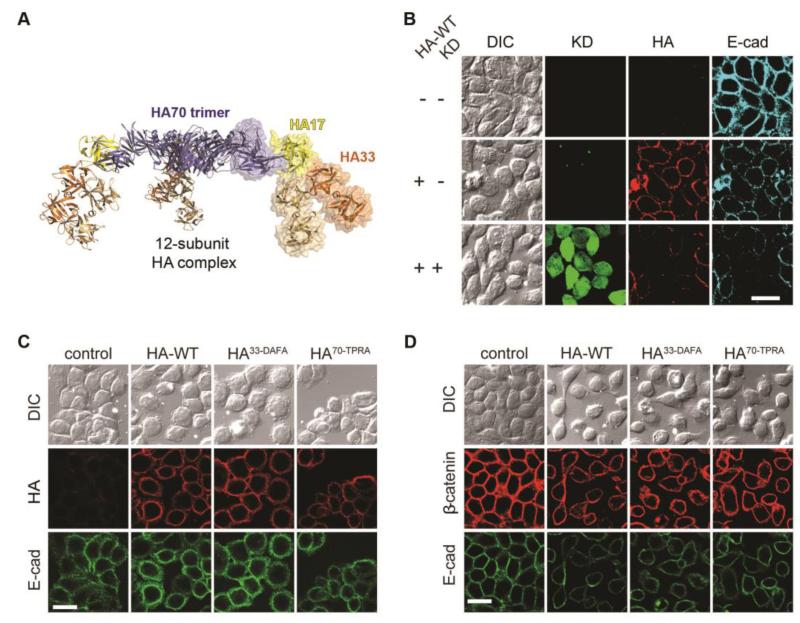
Fig. 1. The HA complex binds to E-cadherin and disrupts cell-cell adhesion
(A) Structural presentation of the HA complex comprising three HA70 (blue), three HA17 (yellow), and six HA33 (orange) (9). The moiety of the mini-HA complex is shown as a transparent surface representation. (B) Knocking down (KD) E-cadherin (E-cad) in HT29 cells via a lenti-virus mediated shRNA expression reduced cell binding of the HA complex (25 nM, 90 min). Lenti-shRNA infected cells were marked with GFP. (C) Binding of HA-WT, HA33-DAFA, and HA70-TPRA complexes to HT29 cells (10 nM, 30 min). (D) HA-WT, HA33-DAFA, and HA70-TPRA all disrupted cell-cell adhesion in HT29 cells (10 nM, 24 hrs), marked by the separation of cells in both DIC images (upper panel) and immunofluorescence images of E-cadherin (lower panel) and β-catenin (middle panel). Scale bar: 20 μm.
Fig. 2
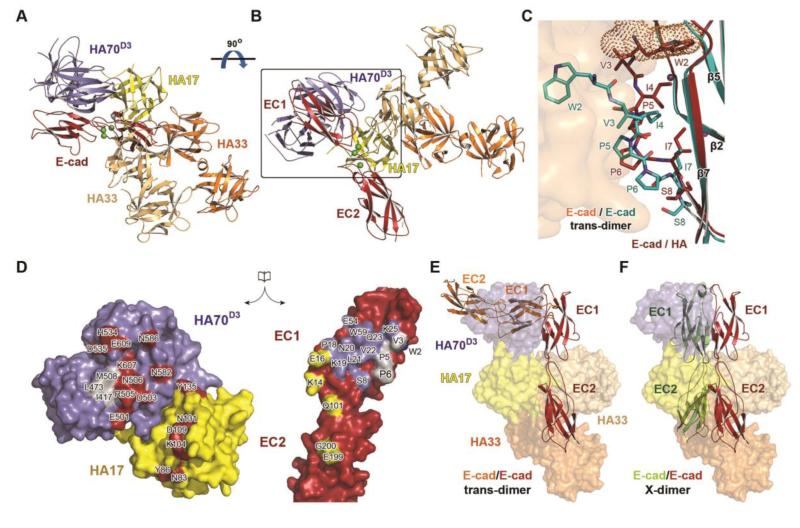
Fig. 2. Structure of the HA–E-cadherin complex
(A) Structure of EC1–2 (red) bound to the mini-HA complex. Three E-cadherin-bound calcium atoms are depicted as green balls. The view direction is similar to that shown in Fig. 1A. (B) A 90° rotation of the complex about a horizontal axis. (C) The HA-bound E-cadherin (red) is superimposed with an E-cadherin (cyan) in the context of a trans dimer (its binding partner is shown as a surface representation). Large conformational changes are observed in the N-terminus of EC1 (residues 2–8 are shown as sticks). The residue Trp2 of the HA-bound E-cadherin occupies a pocket that otherwise accommodates the swapped Trp2 (dots representation) of its dimeric binding partner. (D) An open-book view of the HA70D3/HA17–E-cadherin interface highlighted in the box in panel B. HA33 is omitted for clarity. Residues on HA70/17 that form hydrogen bonds or salt bridges with E-cadherin are red, whereas the E-cadherin residues that bind to HA70 and HA17 are blue and yellow, respectively. Residues involved in hydrophobic interaction are in gray. (E–F) The mini-HA complex is shown as a transparent surface representation. When an E-cadherin molecule is modeled to form a trans dimer (orange ribbon in panel E) or an X-dimer (green ribbon in panel F) with a HA-bound E-cadherin (red ribbon), it severely clashes with the HA complex.
Fig. 3
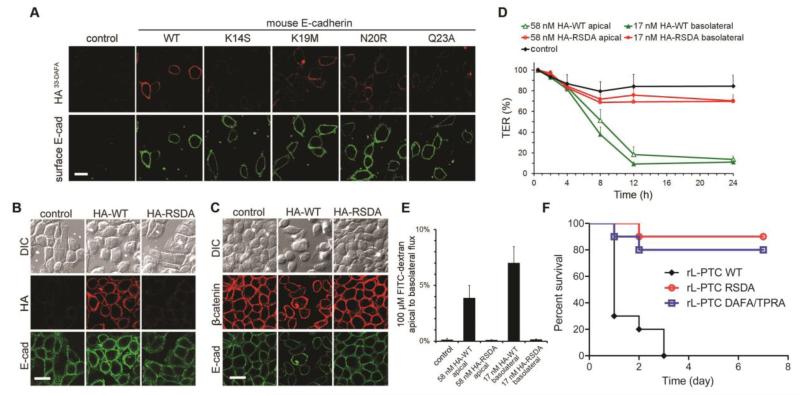
Fig. 3. The HA complex recognizes E-cadherin with high specificity to disrupt cell-cell adhesion
(A) Binding of the HA33-DAFA complex to the surface of CHO cells over-expressing WT or mutant E-cadherin as indicated. (B) Binding of HA-WT or HA-RSDA to HT29 cells (10 nM, 30 min). (C) HA-RSDA failed to disrupt cell-cell adhesions (10 nM, 24 hrs). Scale bar: 20 μm. (D) TER of polarized Caco-2 monolayers was measured after application of HA-WT or HA-RSDA (n≥3 +SD). (E) In contrast to HA-WT, HA-RSDA could not facilitate the flux of FITC-dextran from apical to basolateral compartment (n≥3 +SD). (F) Survival of mice (n=10, combination of two experiments with 5 mice each) after being given by intragastric gavage the reconstituted wild-type L-PTC (rL-PTC WT), rL-PTC RSDA that contains the E-cadherin-binding deficient HAs, or rL-PTC DAFA/TPRA that contains the carbohydrate-binding deficient HAs.
Fig. 4
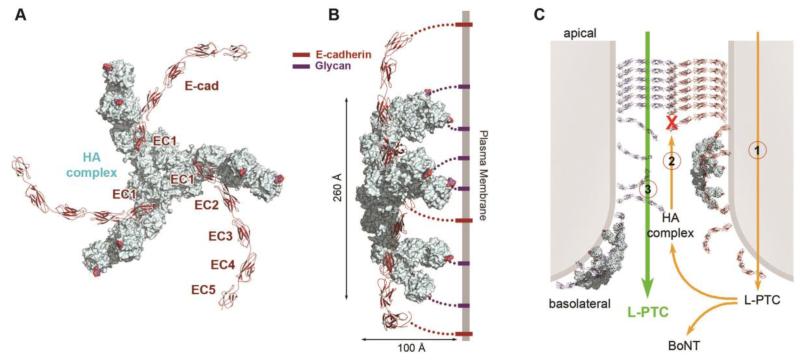
Fig. 4. The HA complex disrupts the ordered assembly of E-cadherin in the adherens junctions
(A) Structural model of the HA complex (pale cyan) bound with three E-cadherin ectodomains (red). The lactose molecules bound to HA33 are in sphere models (9). (B) Proposed binding mode of the HA complex on the cell surface in adherens junctions, viewed along the proposed plane of the membrane. The HA complex could simultaneously bind to membrane-anchored E-cadherin and carbohydrates. (C) Proposed model for transepithelial delivery of the L-PTC. A small amount of L-PTC first crosses epithelial cells by transcytosis (1). On basolateral side, the HA complex binds to E-cadherin and carbohydrates and disrupts cell-to-cell adhesion (2). Finally, more L-PTCs are absorbed via the paracellular route (3).

References

    1. Collins MD, East AK. J Appl Microbiol. 1998;84:5–17. - PubMed
    1. Hill KK, Smith TJ. Curr Top Microbiol Immunol. 2013;364:1–20. - PubMed
    1. Gu S, et al. Science. 2012;335:977–981. - PMC - PubMed
    1. Ohishi I, Sugii S, Sakaguchi G. Infect Immun. 1977;16:107–109. - PMC - PubMed
    1. Ohishi I. Infect Immun. 1984;43:487–490. - PMC - PubMed

Publication types

Associated data