How male sound pressure level influences phonotaxis in virgin female Jamaican field crickets (Gryllus assimilis)
- PMID: 24949249
- PMCID: PMC4060022
- DOI: 10.7717/peerj.437
How male sound pressure level influences phonotaxis in virgin female Jamaican field crickets (Gryllus assimilis)
Abstract
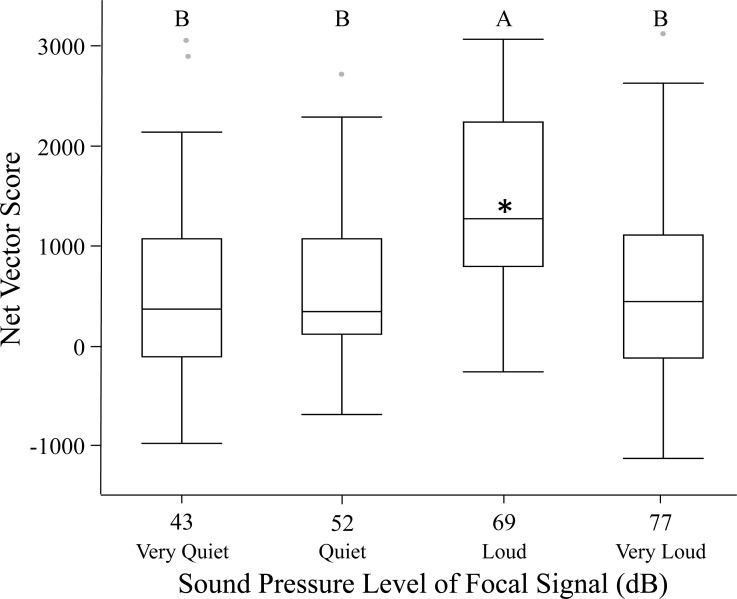
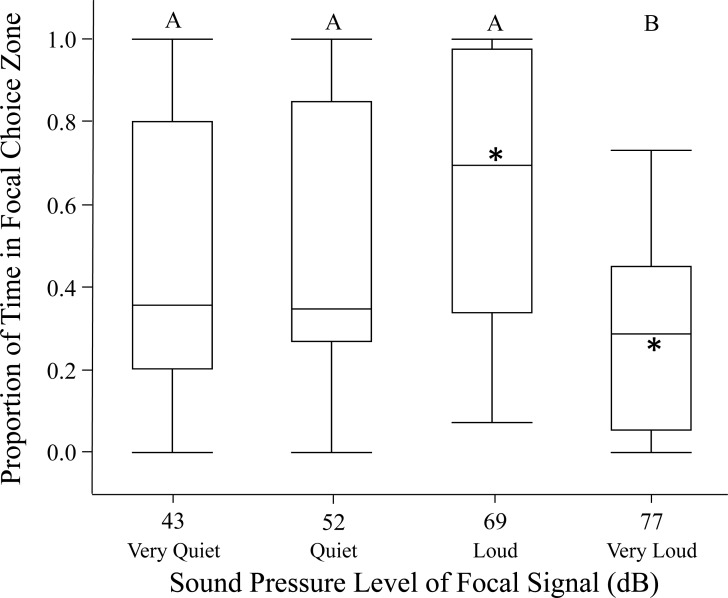
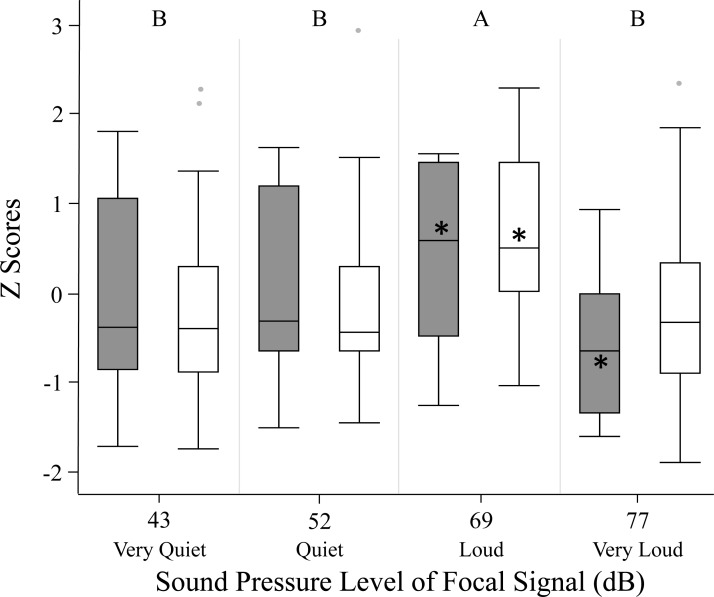
Understanding female mate preference is important for determining the strength and direction of sexual trait evolution. The sound pressure level (SPL) acoustic signalers use is often an important predictor of mating success because higher sound pressure levels are detectable at greater distances. If females are more attracted to signals produced at higher sound pressure levels, then the potential fitness impacts of signalling at higher sound pressure levels should be elevated beyond what would be expected from detection distance alone. Here we manipulated the sound pressure level of cricket mate attraction signals to determine how female phonotaxis was influenced. We examined female phonotaxis using two common experimental methods: spherical treadmills and open arenas. Both methods showed similar results, with females exhibiting greatest phonotaxis towards loud sound pressure levels relative to the standard signal (69 vs. 60 dB SPL) but showing reduced phonotaxis towards very loud sound pressure level signals relative to the standard (77 vs. 60 dB SPL). Reduced female phonotaxis towards supernormal stimuli may signify an acoustic startle response, an absence of other required sensory cues, or perceived increases in predation risk.
Keywords: Age; Amplitude; Female preference; Gryllus assimilis; Kramer spherical treadmill; Locomotion compensator; Loudness; Phonotaxis; Teleogryllus; Trackball.
Figures
References
-
- Alexander RD. Evolutionary change in cricket acoustical communication. Evolution. 1962;16:443–467. doi: 10.2307/2406178. - DOI
-
- Alexander RD. Natural selection and specialized chorusing behavior in acoustical insects. In: Pimentel D, editor. Insects, science and society. New York: Academic Press; 1975.
-
- Arak A. Female mate selection in the natterjack toad: active choice or passive attraction? Behavioural Ecology and Sociobiology. 1988;22:317–327.
-
- Bailey NW. Love will tear you apart: different components of female choice exert contrasting selection pressures on male field crickets. Behavioral Ecology. 2008;19:960–966. doi: 10.1093/beheco/arn054. - DOI
LinkOut - more resources
Full Text Sources
Other Literature Sources
Miscellaneous