Heparin compared with normal saline to maintain patency of permanent double lumen hemodialysis catheters: A randomized controlled trial
- PMID: 24949292
- PMCID: PMC4063117
- DOI: 10.4103/2277-9175.133192
Heparin compared with normal saline to maintain patency of permanent double lumen hemodialysis catheters: A randomized controlled trial
Abstract
Background: Heparin has long been used to prevent thrombosis in the permanent central venous hemodialysis catheters (PermCath). Other alternatives for heparin with fewer side-effects have recently been considered. We compared normal saline (0.9%) with heparin for flushing PermCath with regards to catheter patency and prevention of heparin complications.
Materials and methods: Chronic kidney disease patients who were candidate of PermCath placement were randomly assigned into two groups of heparin and saline. In the heparin group, the PermCath was flushed with heparin (1000 IU), and in the saline group, it was flushed with saline 0.9%. Patients were followed for 24 hours, and outcomes included catheter thrombosis, maneuver needed to maintain catheter patency, and bleeding from catheter site.
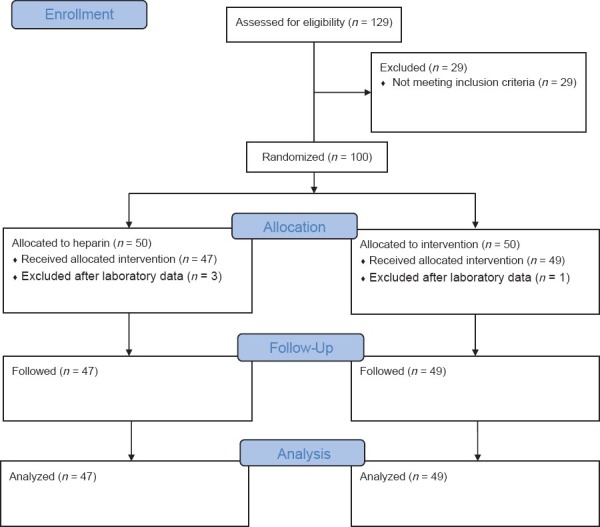
Results: Ninety six patients were included (age = 63.1 ± 11.2 years, 54.2% male). No one experienced catheter thrombosis. Two patient (4.2%) in the heparin and three ones (6.1%) in the saline group required catheter manipulation (P = 0.520). Four patients (8.5%) in the heparin and three ones (6.1%) in the saline group experienced bleeding (P = 0.476); differences between heparin and saline groups in the amount of bleeding (225.0 ± 62.4 vs. 200.0 ± 113.5 cc, P = 0.721) and bleeding time (6.5 ± 1.2 vs. 5.3 ± 1.5 min, P = 0.322) were not significant. In the heparin group, no significant increase was observed in PTT over time; baseline 30.9 ± 3.4, 12 h 31.8 ± 3.4, 24 h 31.2 ± 6.6 (P = 0.628).
Conclusions: Flushing PermCath with normal saline 0.9% is as effective as heparin in maintaining patency of the catheter, while it may reduce the risks associated with heparin.
Keywords: Central venous catheters; hemorrhage; heparin; thrombosis.
Conflict of interest statement
References
-
- NKF-DOQI clinical practice guidelines for vascular access. National Kidney Foundation-Dialysis Outcomes Quality Initiative. Am J Kidney Dis. 1997;30:S150–91. - PubMed
-
- Trerotola SO. Hemodialysis catheter placement and management. Radiology. 2000;215:651–8. - PubMed
-
- Liangos O, Gul A, Madias NE, Jaber BL. Long-term management of the tunneled venous catheter. Semin Dial. 2006;19:158–64. - PubMed
-
- Moran JE, Ash SR. Locking solutions for hemodialysis catheters; heparin and citrate-a position paper by ASDIN. Semin Dial. 2008;21:490–2. - PubMed
-
- Dreyer G, Lawton P, Jose M. Heparin leak from a hemodialysis catheter causing major bleeding, ultimately leading to transplant rejection and death. Hemodial Int. 2008;12:431–3. - PubMed
LinkOut - more resources
Full Text Sources
Other Literature Sources
Medical