


Socioeconomic status and trajectory of overweight from birth to mid-childhood: the Early Childhood Longitudinal Study-Birth Cohort
- PMID: 24950056
- PMCID: PMC4065031
- DOI: 10.1371/journal.pone.0100181
Socioeconomic status and trajectory of overweight from birth to mid-childhood: the Early Childhood Longitudinal Study-Birth Cohort
Abstract
Objective: Our objective was to use longitudinal data from a US birth cohort to test whether the probability of overweight or obesity during the first 6 years of life varied according to socioeconomic status.
Design and methods: Using six waves of longitudinal data from full-term children in the Early Childhood Longitudinal Study-Birth Cohort (2001-2007; n≈4,950), we examined the prevalence of overweight or obesity (Body Mass Index (BMI)>2 standard deviations above age- and sex- specific WHO Childhood Growth Standard reference mean; henceforth, "overweight/obesity") according to age, socioeconomic status, and race/ethnicity using generalized estimating equation models.
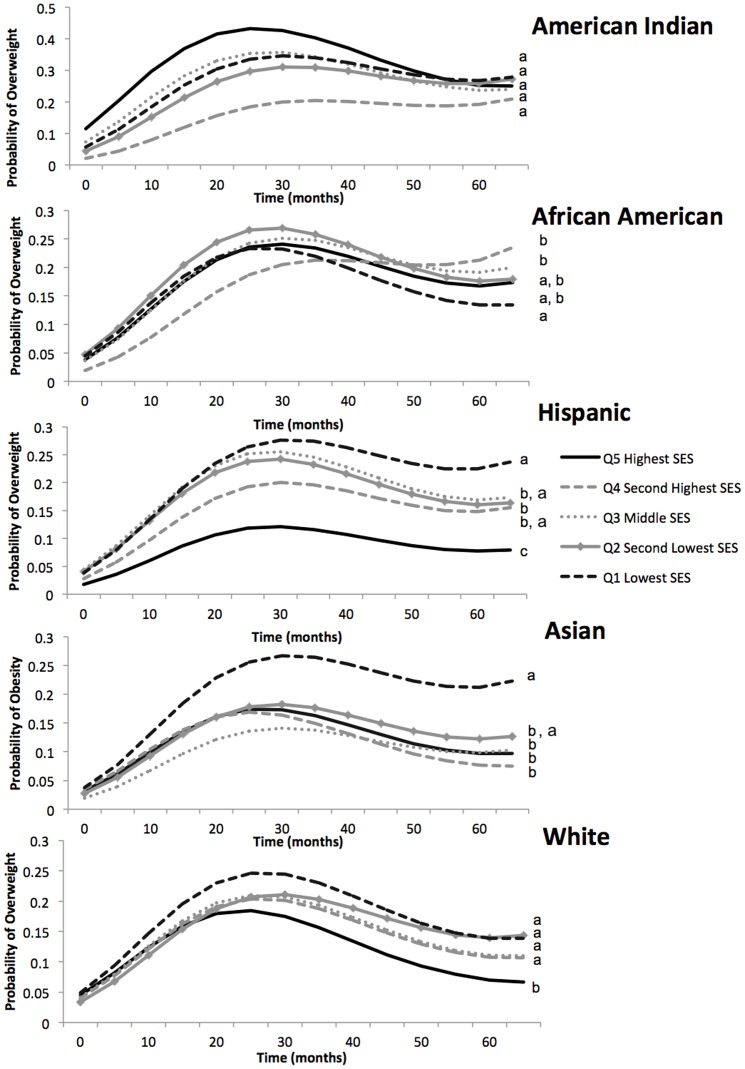
Results: The association between socioeconomic status and overweight/obesity varied significantly by race/ethnicity, but not by sex. Overweight/obesity was significantly associated with socioeconomic status among whites, Hispanics and Asians; the adjusted odds of overweight/obesity began to diverge according to SES after the first 9 months of life. By approximately 4 years, children with the highest SES had a significantly lower odds of overweight/obesity. SES was not significantly related to overweight/obesity among African Americans and American Indians during early childhood.
Conclusions: Few studies have assessed the associations between SES and overweight/obesity within racial/ethnic groups in the US. We find that in contemporary, US-born children, SES was inversely associated with overweight/obesity among more racial/ethnic groups (whites, Hispanics, and Asians) than previously reported.
Conflict of interest statement
Figures
References
-
- Flegal KM, Carroll MD, Ogden CL, Curtin LR (2010) Prevalence and trends in obesity among US adults, 1999–2008. JAMA 303: 235–241. - PubMed
-
- (2011) CDC Health Disparities and Inequalitites Report—United States. Centers for Disease Control and Prevention.
-
- Anderson SE, Whitaker RC (2009) Prevalence of obesity among US preschool children in different racial and ethnic groups. Arch Pediatr Adolesc Med 163: 344–348. - PubMed
-
- Miech RA, Kumanyika SK, Stettler N, Link BG, Phelan JC, et al. (2006) Trends in the association of poverty with overweight among US adolescents, 1971–2004. JAMA 295: 2385–2393. - PubMed
Publication types
MeSH terms
Grants and funding
LinkOut - more resources
Full Text Sources
Other Literature Sources
