. 2014 Jun 19;40(6):815-23.
doi: 10.1016/j.immuni.2014.05.012.

Mining the human gut microbiota for effector strains that shape the immune system

Affiliations

Mining the human gut microbiota for effector strains that shape the immune system

Philip P Ahern et al. Immunity. .

Abstract

The gut microbiota codevelops with the immune system beginning at birth. Mining the microbiota for bacterial strains responsible for shaping the structure and dynamic operations of the innate and adaptive arms of the immune system represents a formidable combinatorial problem but one that needs to be overcome to advance mechanistic understanding of microbial community and immune system coregulation and to develop new diagnostic and therapeutic approaches that promote health. Here, we discuss a scalable, less biased approach for identifying effector strains in complex microbial communities that impact immune function. The approach begins by identifying uncultured human fecal microbiota samples that transmit immune phenotypes to germ-free mice. Clonally arrayed sequenced collections of bacterial strains are constructed from representative donor microbiota. If the collection transmits phenotypes, effector strains are identified by testing randomly generated subsets with overlapping membership in individually housed germ-free animals. Detailed mechanistic studies of effector strain-host interactions can then be performed.


Conflict of interest statement

Conflict of Interest – P. P.A and J.J.F declare no conflicts. J.I.G. is the co-founder of Matutu, Inc, a company that is characterizing the role of diet-by-microbiota interactions in defining health.

Figures

Figure 1
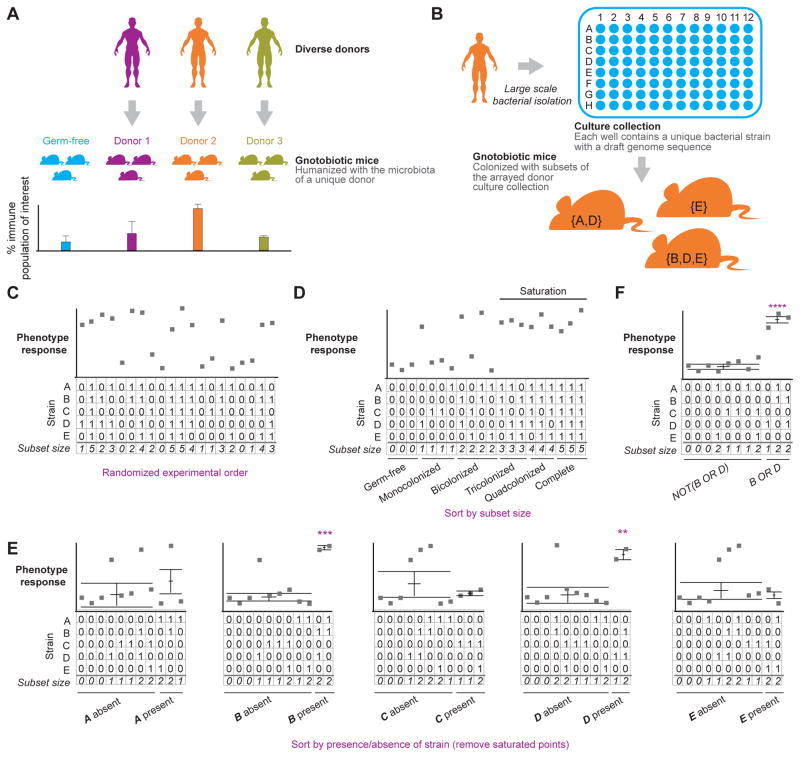
Figure 1. An experimental pipeline for dissecting the interactions of effector strains present in complex microbial communities with the host immune system
(A) The first step involves transplanting intact uncultured fecal microbiota from human donors to test the capacity of their gut microbial communities to impact immune phenotypes in recipient germ-free mice. In the case shown, the effects of different donor microbiota on the percent representation of an immune cell type of interest within a population of immune cells recovered from recipient gnotobiotic mice is plotted. Note that in principle, the approach can be applied to any phenotype of interest. (B) A representative human donor microbiota, nominated from the initial screen, is used to prepare a clonally arrayed culture collection in a multi-well plate, and the genome of each cultured member is sequenced. Subsets of members of this community are generated: subsets are either rationally designed, or cultured strains are randomly assigned to subsets. Subsets (defined consortia) are then administered to recipient gnotobiotic mice. (C) The order the subsets are introduced into different mice is randomized to minimize batch effects and biases, and the phenotype of interest is assayed. (D) Sorting the tested subsets by their size (i.e., the total number of strains in the subset) enables estimation of the phenotype’s saturation point, if there is one. In the situation depicted, one can begin to observe phenotype saturation with subset sizes of three, while higher variation is observed in community sizes smaller than this. Therefore, using mice that are mono- or bi-colonized would be an effective strategy for identifying which strains modulate this phenotype. (E) In cases where few members contribute to the phenotypic variation, effector strains can be identified by sorting the subsets based on the presence or absence of each strain individually, with p-values determined using a t-test. In the example shown, strains A, C and E have little effect on the phenotype being measured whether they are present or absent, while strains B and D are present in most cases where the phenotype is observed. (F) More complex interactions involving multiple effector strains can be more accurately inferred with model-based approaches that consider the combined influence of all community members on the phenotype. In the example shown, feature selection can be used to demonstrate that the phenotype is manifest in cases where strain B or D are present and absent in all cases where B and D are absent, thus identifying the strains B or D as key effector strains for this phenotype. In E and F, the central horizontal bars show the mean value and the error bars represent the SEM. Each point represents a hypothetical response measured in an individual recipient mouse.
Fig. 2
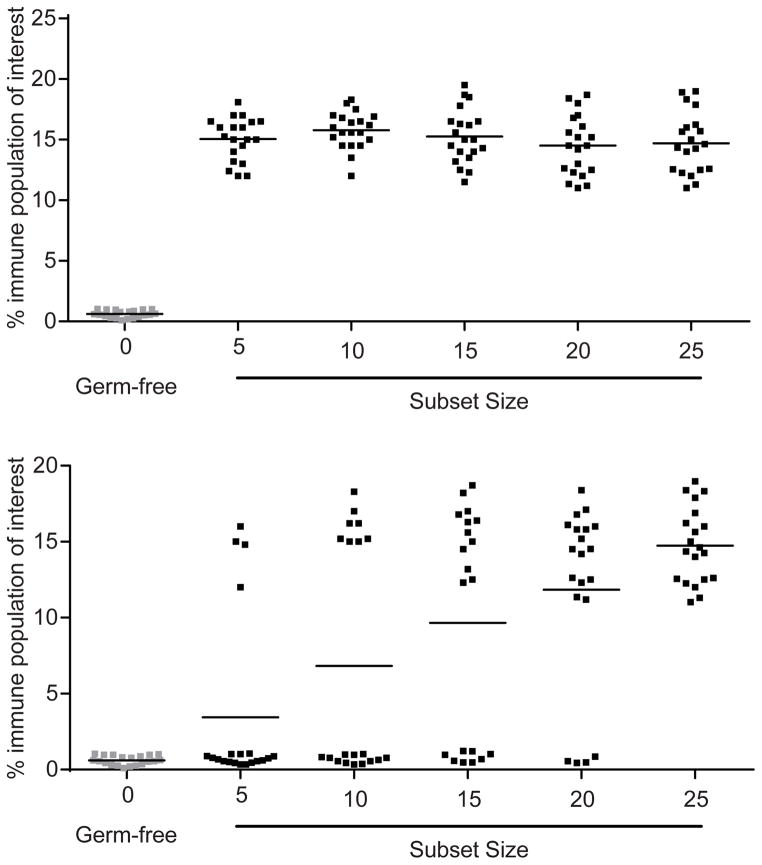
Fig. 2. Outline of how random subsetting can identify immunogenic effector strains in a hypothetical gut community composed of 25 members
The figure shows hypothetical results of the induction of an immune cell type being studied, in order to illustrate the process by which random subsetting of clonally arrayed collections of cultured bacteria can be used to identify effector strains. (A) If all or many members of a community are capable of eliciting a phenotype, then recipients of all subset sizes will manifest the response. Despite each subset having different composition, no information is gained as to which strains are responsible, as there is low variation in the response and it already saturates at subset sizes as low as five bacteria (see text for further discussion of saturation). (B) If the ability to modify a phenotype is rare or restricted or just a single community member, then the value of the approach becomes evident. In the graph, there is a bimodal distribution in the response. By comparing the membership of consortia that promote induction a population of interest to those that completely lack such populations one can obtain a catalogue of all strains that are (i) always present when the response is observed and (ii) always absent when the response is not manifest. In the example shown in (B), although many communities elicit induction of the immune cell population of interest, there is only one effector strain common to all subsets. Follow-up colonizations with reduced size subsets can be used to confirm that the approach has indeed identified the correct effector strain, and whether additional membership explains the capacity of a strain to imprint the phenotype. Horizontal lines represent mean values; each point depicts the immune cell response in an individual recipient mouse.

References

    1. Arpaia N, Campbell C, Fan X, Dikiy S, van der Veeken J, deRoos P, Liu H, Cross JR, Pfeffer K, Coffer PJ, et al. Metabolites produced by commensal bacteria promote peripheral regulatory T-cell generation. Nature. 2013;504:451–455. - PMC - PubMed
    1. Arthur JC, Perez-Chanona E, Muhlbauer M, Tomkovich S, Uronis JM, Fan TJ, Campbell BJ, Abujamel T, Dogan B, Rogers AB, et al. Intestinal inflammation targets cancer-inducing activity of the microbiota. Science. 2012;338:120–123. - PMC - PubMed
    1. Atarashi K, Tanoue T, Oshima K, Suda W, Nagano Y, Nishikawa H, Fukuda S, Saito T, Narushima S, Hase K, et al. Treg induction by a rationally selected mixture of Clostridia strains from the human microbiota. Nature. 2013;500:232–236. - PubMed
    1. Atarashi K, Tanoue T, Shima T, Imaoka A, Kuwahara T, Momose Y, Cheng G, Yamasaki S, Saito T, Ohba Y, et al. Induction of colonic regulatory T cells by indigenous Clostridium species. Science. 2011;331:337–341. - PMC - PubMed
    1. Bilate AB, Lafaille JJ. It takes two to tango. Immunity. 2011;35:6–8. - PubMed

Publication types