


Perihepatic abscess secondary to retained appendicolith: A rare complication managed laparoscopically
- PMID: 24950544
- PMCID: PMC3649197
- DOI: 10.1093/jscr/2011.1.6
Perihepatic abscess secondary to retained appendicolith: A rare complication managed laparoscopically
Abstract
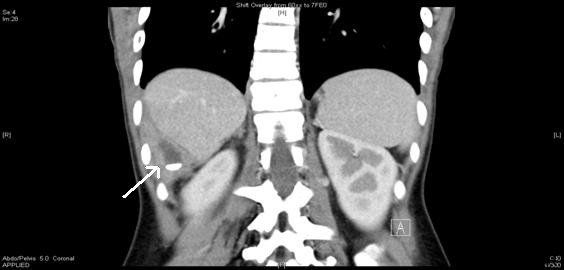
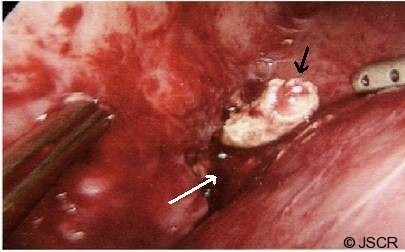
Appendicectomy is one of the commonest emergency operations performed worldwide. In cases of perforated appendicitis, the prevalence of post-operative abscess formation is up to 20 per cent (1). Most cases can be managed with drainage and antibiotics. However, a minority of these will leave a retained appendicolith. We present a case of a 17 year old female patient who presented 1 year after laparoscopic appendicectomy for perforated appendicitis, with right upper quadrant pain and sepsis. Computed tomography (CT) of the abdomen was performed and revealed a retained appendicolith with perihepatic abscess formation in the right upper quadrant. She underwent laparoscopic drainage of this perihepatic abscess and removal of the faecolith. She was discharged home the following day and remains well.
© JSCR.
Figures
References
-
- Buckley O, Geoghegan T, Ridgeway P, et al. The usefulness of CT guided drainage of abscesses caused by retained appendicoliths. Eur J Radiol 2006; 60:80–3 - PubMed
-
- Newrhee K, William PR, Maher A, Douglas SK. CT identification of abscesses after dropped appendicoliths during laparoscopic appendectomy. AJR 2004; 182:1203–1205 - PubMed
-
- Strathern DW, Jones BT. Retained fecalith after laparoscopic appendectomy. Surg Endosc 1999; 12:287–289 - PubMed
-
- Lee SW, Lim JS, Hyung WJ, et al. Laparoscopic ultrasonography for localization of a retained appendicolith after appendectomy. J Ultrasound Med 2006; 25:1361–3 - PubMed
-
- Rasuli P, Friedlich MS, Mahoney JE. Percutaneous retrieval of a retained appendicolith. Cardiovasc Intervent Radiol 2007; 30:342–4 - PubMed
LinkOut - more resources
Full Text Sources
