


Proposed new clinicopathological surrogate definitions of luminal A and luminal B (HER2-negative) intrinsic breast cancer subtypes
- PMID: 24951027
- PMCID: PMC4095689
- DOI: 10.1186/bcr3679
Proposed new clinicopathological surrogate definitions of luminal A and luminal B (HER2-negative) intrinsic breast cancer subtypes
Abstract
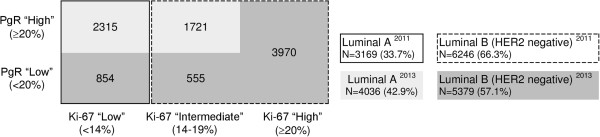
Introduction: The St Gallen International Expert Consensus on the Primary Therapy of Early Breast Cancer 2013 recognized substantial progress in the pathological characterization of breast cancer subtypes. A useful surrogate definition was developed to distinguish luminal A-like breast cancer from luminal B-like disease based on a combination of estrogen receptor (ER), progesterone receptor (PgR) and Ki-67 status, without a requirement for molecular diagnostics. Differences depend upon the choice of the threshold value for Ki-67 and the requirement for substantial PgR positivity. We aimed to verify the suitability of the new surrogate definitions of luminal subtypes in terms of distant disease control in a large series of patients.
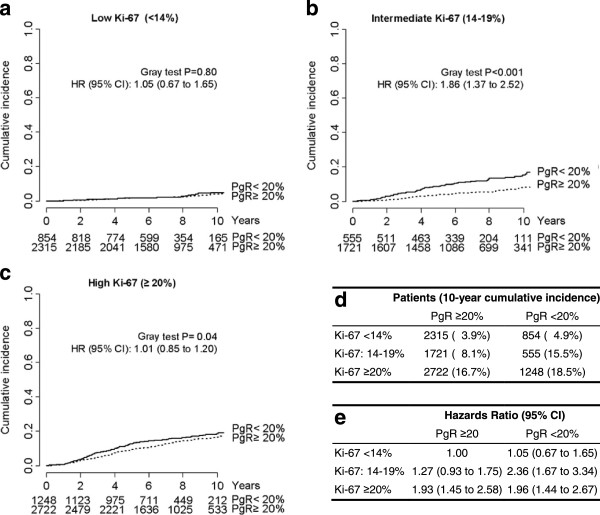
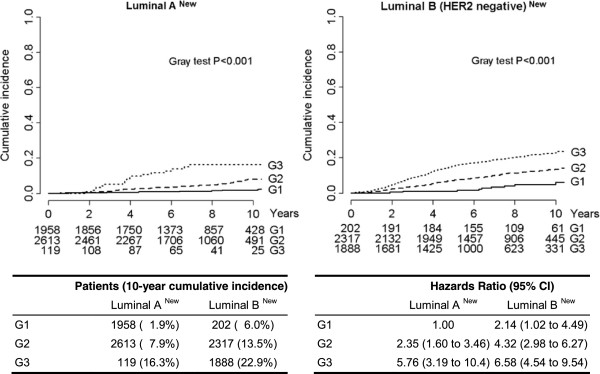
Methods: We studied 9,415 women with a median follow-up of 8.1 years who (1) had ER-positive, human epidermal growth factor receptor 2 (HER2)-negative early breast cancer and (2) had undergone surgery at the European Institute of Oncology between 1994 and 2006. We evaluated distant disease-free survival of patients with "low" (<14%), "intermediate" (14% to 19%) or "high" (≥20%) Ki-67 positivity stratified by PgR expression (negative or low versus high). We calculated the cumulative incidence of distant events, considered competing events and performed multivariable analysis adjusted for pathologic tumor stage, pathologic node stage, tumor grade, peritumoral vascular invasion and menopausal status.
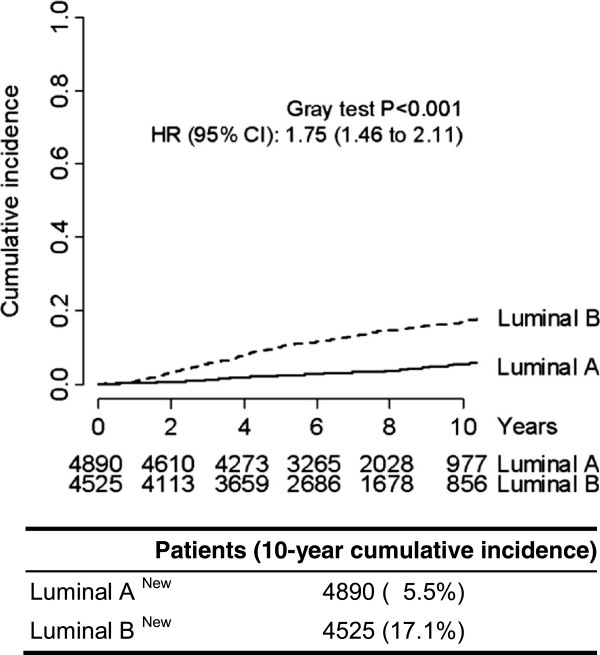
Results: Lack of substantial PgR positivity was associated with poorer outcomes only for patients with an intermediate Ki-67 level (P<0.001). The 4,890 patients (51.9%) with low Ki-67 level (any PgR expression level) or with intermediate Ki-67 level but substantial PgR positivity had comparably good outcomes and thus may represent a most advantageous grouping of those with luminal A-like disease.
Conclusions: The updated pathological definition of intrinsic molecular subtypes may maximize the number of patients classified as having the luminal A-like intrinsic subtype of breast cancer and for whom the use of cytotoxic drugs could mostly be avoided.
Figures
References
-
- Goldhirsch A, Winer EP, Coates AS, Gelber RD, Piccart-Gebhart M, Thürlimann B, Senn HJ. Panel members. Personalizing the treatment of women with early breast cancer: highlights of the St Gallen International Expert Consensus on the Primary Therapy of Early Breast Cancer 2013. Ann Oncol. 2013;24:2206–2223. doi: 10.1093/annonc/mdt303. - DOI - PMC - PubMed
-
- Prat A, Cheang MC, Martín M, Parker JS, Carrasco E, Caballero R, Tyldesley S, Gelmon K, Bernard PS, Nielsen TO, Perou CM. Prognostic significance of progesterone receptor–positive tumor cells within immunohistochemically defined luminal A breast cancer. J Clin Oncol. 2013;31:203–209. doi: 10.1200/JCO.2012.43.4134. - DOI - PMC - PubMed
-
- Goldhirsch A, Wood WC, Coates AS, Gelber RD, Thürlimann B, Senn HJ. Panel members. Strategies for subtypes—dealing with the diversity of breast cancer: highlights of the St. Gallen International Expert Consensus on the Primary Therapy of Early Breast Cancer. Ann Oncol. 2011;22:1736–1747. doi: 10.1093/annonc/mdr304. - DOI - PMC - PubMed
-
- Rosen PP, Oberman H. Tumors of the Mammary Gland. Washington, DC: Armed Forces Institute of Pathology; 1993.
Publication types
MeSH terms
Substances
LinkOut - more resources
Full Text Sources
Other Literature Sources
Medical
Research Materials
Miscellaneous
