Review
. 2014 Aug;13(8):950-7.
doi: 10.1128/EC.00093-14. Epub 2014 Jun 20.

Interplay between Candida albicans and the antimicrobial peptide armory

Affiliations
Review

Interplay between Candida albicans and the antimicrobial peptide armory

Marc Swidergall et al. Eukaryot Cell. 2014 Aug.

Abstract

Antimicrobial peptides (AMPs) are key elements of innate immunity, which can directly kill multiple bacterial, viral, and fungal pathogens. The medically important fungus Candida albicans colonizes different host niches as part of the normal human microbiota. Proliferation of C. albicans is regulated through a complex balance of host immune defense mechanisms and fungal responses. Expression of AMPs against pathogenic fungi is differentially regulated and initiated by interactions of a variety of fungal pathogen-associated molecular patterns (PAMPs) with pattern recognition receptors (PRRs) on human cells. Inflammatory signaling and other environmental stimuli are also essential to control fungal proliferation and to prevent parasitism. To persist in the host, C. albicans has developed a three-phase AMP evasion strategy, including secretion of peptide effectors, AMP efflux pumps, and regulation of signaling pathways. These mechanisms prevent C. albicans from the antifungal activity of the major AMP classes, including cathelicidins, histatins, and defensins leading to a basal resistance. This minireview summarizes human AMP attack and C. albicans resistance mechanisms and current developments in the use of AMPs as antifungal agents.


Figures

FIG 1
FIG 1
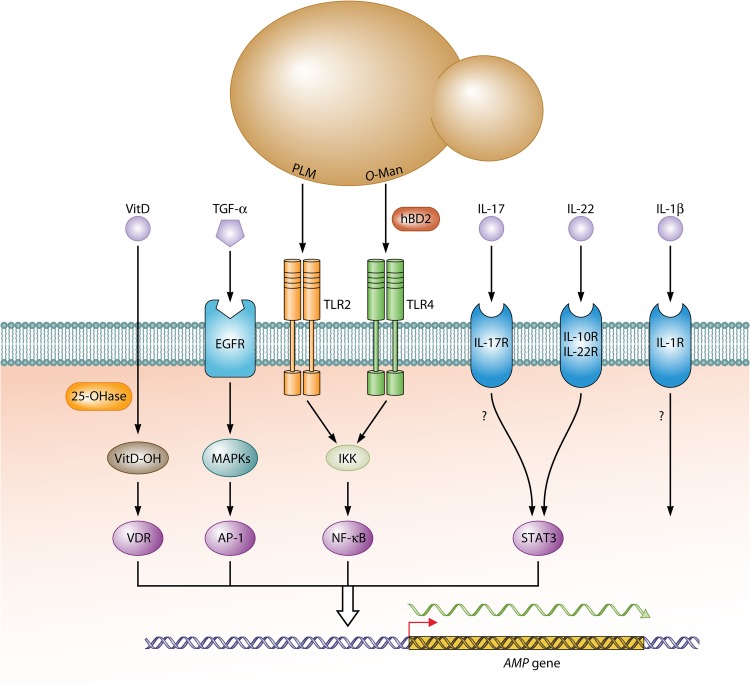
Epithelial signaling pathways directing AMP gene expression. Binding of C. albicans PAMPs phospholipomannan (PLM) and O-mannan (O-Man) to epithelial TLR2/4 proteins leads initially to activation of NF-κB via IkB kinase (IKK). Epithelial proinflammatory lymphokines including IL-1β, IL-6, and IL-8 secreted by epithelial cells trigger cohabiting immune cells to produce IL-1β, IL-17, IL-22, and TNF-α, which boost immune responses of epithelial cells by binding to their dedicated surface receptors IL-1R (IL-1 receptor), IL-17R, IL10R/IL-22R, and EGFR, respectively. MAP kinases (MAPKs) ERK/JNK activate AP-1, which binds with NF-κB and STAT3 transcription factors to promoters of AMP genes to enhance their expression. Production and binding of hBD2, as well as of IL-1β, generates positive-feedback loops in epithelial cells that further increase immune responses. Nutritional input for AMP gene expression is provided by vitamin D (VitD), which is modified by 1α-hydroxylase (25-OHase) to its hydroxylated form (VitD-OH) that binds and activates the promoter of the LL-37-encoding gene.
FIG 2
FIG 2
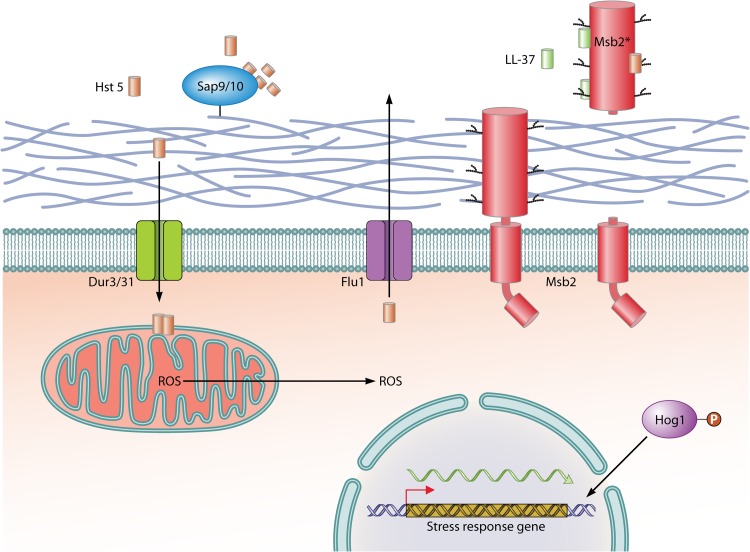
C. albicans mechanisms to evade AMP responses. Histatin 5 (Hst 5) is taken up by the C. albicans influx transporters Dur3 and Dur31 and induces the formation of reactive oxygen species (ROS); in addition, Hst 5 acts by promoting the efflux of ions and ATP. The Hog1 MAP kinase pathway is activated during AMP stress and upregulates antioxidative and other response mechanisms to overcome AMP activity. The toxicity of Hst 5 is decreased further by its extrusion from fungal cells via the polyamine efflux transporter Flu1. The cell wall-anchored protease Sap9 cleaves and inactivates Hst 5 on the outside of fungal cells. In addition, the shed exodomain fragment of the Msb2 membrane sensor (Msb2*) binds several AMPs extracellularly to provide broad-range protection against AMPs. P, phosphate.

References

    1. Cheng SC, Joosten LA, Kullberg BJ, Netea MG. 2012. Interplay between Candida albicans and the mammalian innate host defense. Infect. Immun. 80:1304–1313. 10.1128/IAI.06146-11 - DOI - PMC - PubMed
    1. Hube B. 2004. From commensal to pathogen: stage- and tissue-specific gene expression of Candida albicans. Curr. Opin. Microbiol. 7:336–341. 10.1016/j.mib.2004.06.003 - DOI - PubMed
    1. Vandamme D, Landuyt B, Luyten W, Schoofs L. 2012. A comprehensive summary of LL-37, the factotum human cathelicidin peptide. Cell. Immunol. 280:22–35. 10.1016/j.cellimm.2012.11.009 - DOI - PubMed
    1. Lehrer RI, Ganz T. 1999. Antimicrobial peptides in mammalian and insect host defence. Curr. Opin. Immunol. 11:23–27. 10.1016/S0952-7915(99)80005-3 - DOI - PubMed
    1. Peschel A, Sahl HG. 2006. The co-evolution of host cationic antimicrobial peptides and microbial resistance. Nat. Rev. Microbiol. 4:529–536. 10.1038/nrmicro1441 - DOI - PubMed

Publication types

Substances

LinkOut - more resources