


Alzheimer's disease risk genes and mechanisms of disease pathogenesis
- PMID: 24951455
- PMCID: PMC4234692
- DOI: 10.1016/j.biopsych.2014.05.006
Alzheimer's disease risk genes and mechanisms of disease pathogenesis
Abstract
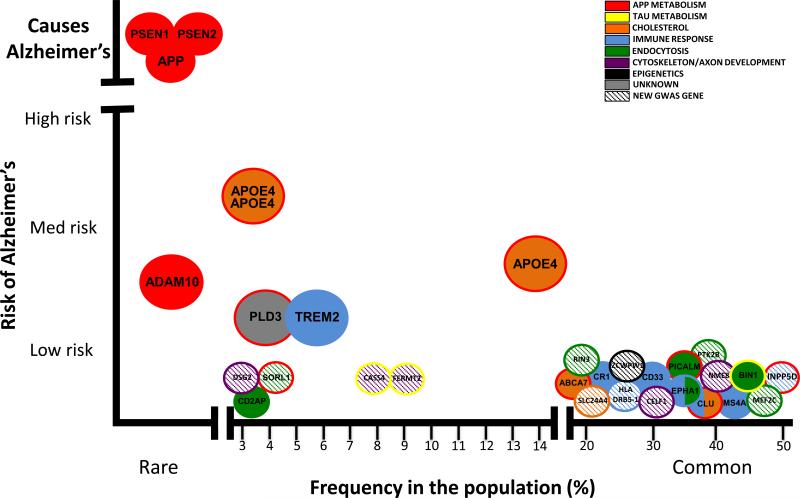
We review the genetic risk factors for late-onset Alzheimer's disease (AD) and their role in AD pathogenesis. More recent advances in understanding of the human genome-technologic advances in methods to analyze millions of polymorphisms in thousands of subjects-have revealed new genes associated with AD risk, including ABCA7, BIN1, CASS4, CD33, CD2AP, CELF1, CLU, CR1, DSG2, EPHA1, FERMT2, HLA-DRB5-DBR1, INPP5D, MS4A, MEF2C, NME8, PICALM, PTK2B, SLC24H4-RIN3, SORL1, and ZCWPW1. Emerging technologies to analyze the entire genome in large data sets have also revealed coding variants that increase AD risk: PLD3 and TREM2. We review the relationship between these AD risk genes and the cellular and neuropathologic features of AD. Understanding the mechanisms underlying the association of these genes with risk for disease will provide the most meaningful targets for therapeutic development to date.
Keywords: Alzheimer’s Disease; Amyloid Precursor Protein; Cholesterol Metabolism; Endocytosis; Genome-Wide Association Studies; Immune Response.
Copyright © 2015 Society of Biological Psychiatry. Published by Elsevier Inc. All rights reserved.
Figures
References
-
- Hardy J, Selkoe DJ. The amyloid hypothesis of Alzheimer's disease: progress and problems on the road to therapeutics. Science. 2002;297:353–356. - PubMed
Publication types
MeSH terms
Substances
Grants and funding
LinkOut - more resources
Full Text Sources
Other Literature Sources
Medical
Molecular Biology Databases
Research Materials
Miscellaneous
