Using physiologically-based pharmacokinetic-guided "body-on-a-chip" systems to predict mammalian response to drug and chemical exposure
- PMID: 24951471
- PMCID: PMC4156540
- DOI: 10.1177/1535370214529397
Using physiologically-based pharmacokinetic-guided "body-on-a-chip" systems to predict mammalian response to drug and chemical exposure
Abstract
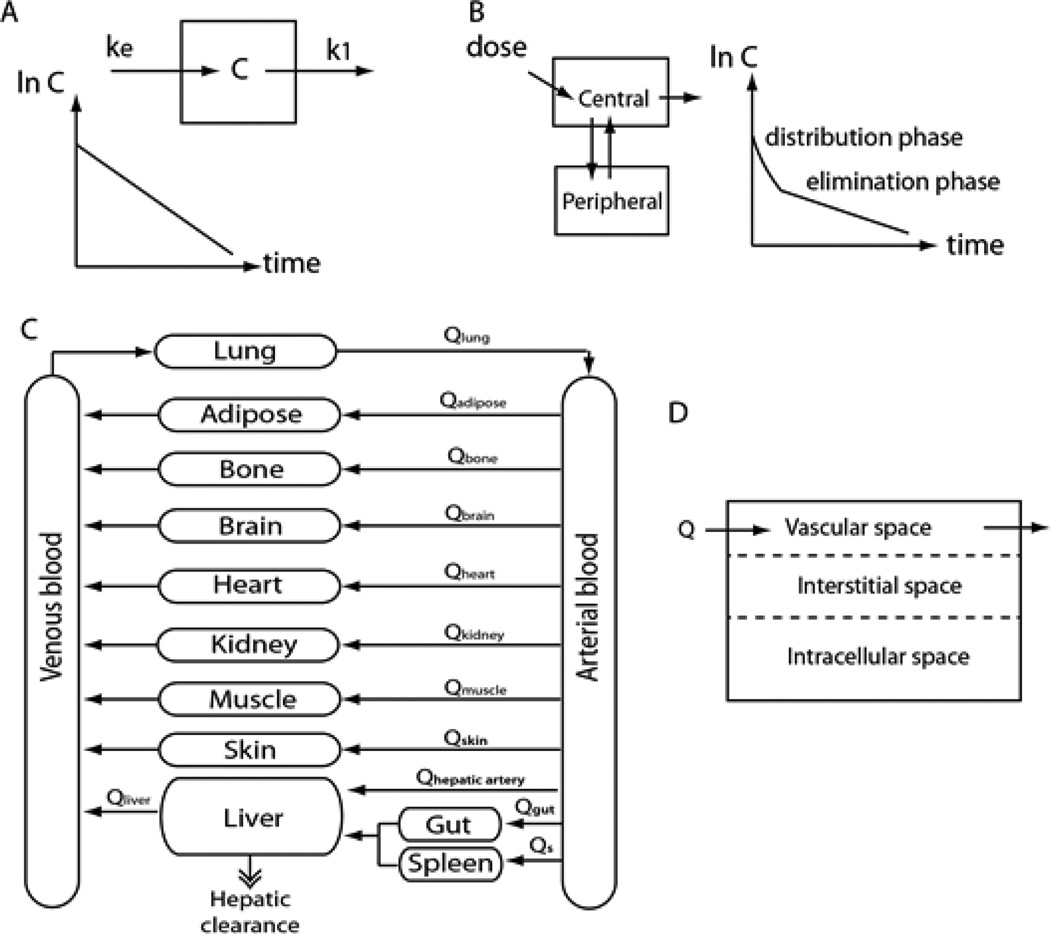
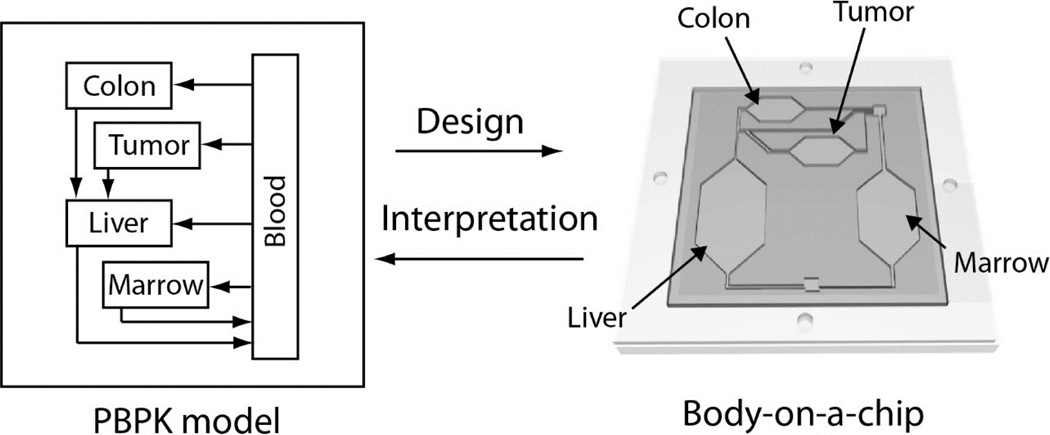
The continued development of in vitro systems that accurately emulate human response to drugs or chemical agents will impact drug development, our understanding of chemical toxicity, and enhance our ability to respond to threats from chemical or biological agents. A promising technology is to build microscale replicas of humans that capture essential elements of physiology, pharmacology, and/or toxicology (microphysiological systems). Here, we review progress on systems for microscale models of mammalian systems that include two or more integrated cellular components. These systems are described as a "body-on-a-chip", and utilize the concept of physiologically-based pharmacokinetic (PBPK) modeling in the design. These microscale systems can also be used as model systems to predict whole-body responses to drugs as well as study the mechanism of action of drugs using PBPK analysis. In this review, we provide examples of various approaches to construct such systems with a focus on their physiological usefulness and various approaches to measure responses (e.g. chemical, electrical, or mechanical force and cellular viability and morphology). While the goal is to predict human response, other mammalian cell types can be utilized with the same principle to predict animal response. These systems will be evaluated on their potential to be physiologically accurate, to provide effective and efficient platform for analytics with accessibility to a wide range of users, for ease of incorporation of analytics, functional for weeks to months, and the ability to replicate previously observed human responses.
Keywords: Microphysiological system; PBPK models; chemical analysis; electrical analysis; mechanical analysis; microfabrication.
© 2014 by the Society for Experimental Biology and Medicine.
Figures
References
-
- Lau YY, Chen YH, Liu TT, Li C, Cui X, White RE, Cheng KC. Evaluation of a novel in vitro Caco-hepatocyte hybrid system for predicting in vivo oral bioavailability. Drug Metab Dispos. 2004;32:937–942. - PubMed
-
- Li AP, Bode C, Sakai Y. A novel in vitro system, the integrated discrete multiple organ cell culture (IdMOC) system, for the evaluation of human drug toxicity: comparative cytotoxicity of tamoxifen towards normal human cells from five major organs and MCF-7 adenocarcinoma breast cancer cells. Chem Biol Interact. 2004;150:129–136. - PubMed
-
- Lotito SB, Frei B. Consumption of flavonoid-rich foods and increased plasma antioxidant capacity in humans: cause, consequence, or epiphenomenon? Free Radic Biol Med. 2006;41:1727–1746. - PubMed
-
- Sung JH, Esch MB, Shuler ML. Integration of in silico and in vitro platforms for pharmacokinetic-pharmacodynamic modeling. Expert Opin Drug Metab Toxicol. 2010;6:1063–1081. - PubMed
Publication types
MeSH terms
Grants and funding
LinkOut - more resources
Full Text Sources
Other Literature Sources