. 2014 Sep;80(17):5349-58.
doi: 10.1128/AEM.01370-14. Epub 2014 Jun 20.

LacR is a repressor of lacABCD and LacT is an activator of lacTFEG, constituting the lac gene cluster in Streptococcus pneumoniae

Affiliations

LacR is a repressor of lacABCD and LacT is an activator of lacTFEG, constituting the lac gene cluster in Streptococcus pneumoniae

Muhammad Afzal et al. Appl Environ Microbiol. 2014 Sep.

Abstract

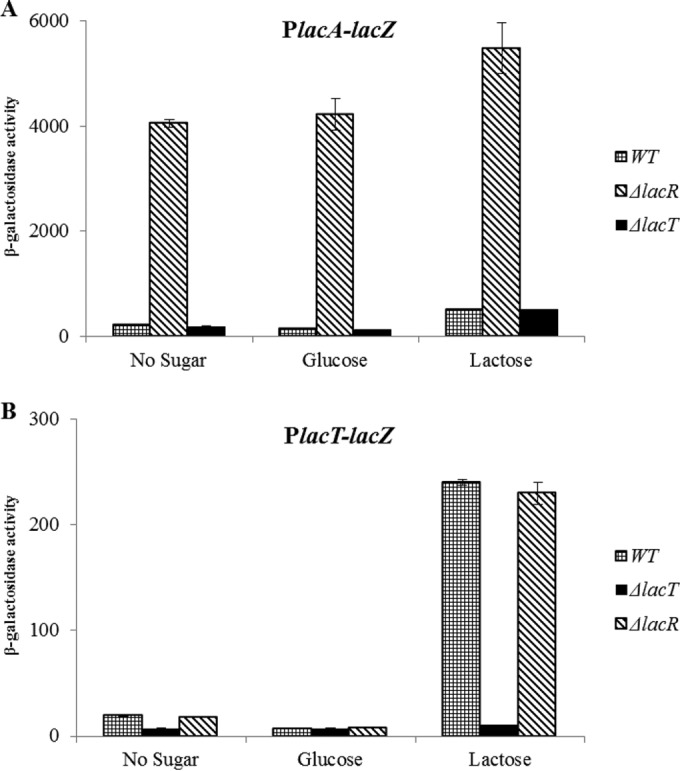
Comparison of the transcriptome of Streptococcus pneumoniae strain D39 grown in the presence of either lactose or galactose with that of the strain grown in the presence of glucose revealed the elevated expression of various genes and operons, including the lac gene cluster, which is organized into two operons, i.e., lac operon I (lacABCD) and lac operon II (lacTFEG). Deletion of the DeoR family transcriptional regulator lacR that is present downstream of the lac gene cluster revealed elevated expression of lac operon I even in the absence of lactose. This suggests a function of LacR as a transcriptional repressor of lac operon I, which encodes enzymes involved in the phosphorylated tagatose pathway in the absence of lactose or galactose. Deletion of lacR did not affect the expression of lac operon II, which encodes a lactose-specific phosphotransferase. This finding was further confirmed by β-galactosidase assays with PlacA-lacZ and PlacT-lacZ in the presence of either lactose or glucose as the sole carbon source in the medium. This suggests the involvement of another transcriptional regulator in the regulation of lac operon II, which is the BglG-family transcriptional antiterminator LacT. We demonstrate the role of LacT as a transcriptional activator of lac operon II in the presence of lactose and CcpA-independent regulation of the lac gene cluster in S. pneumoniae.


Figures

FIG 1
FIG 1
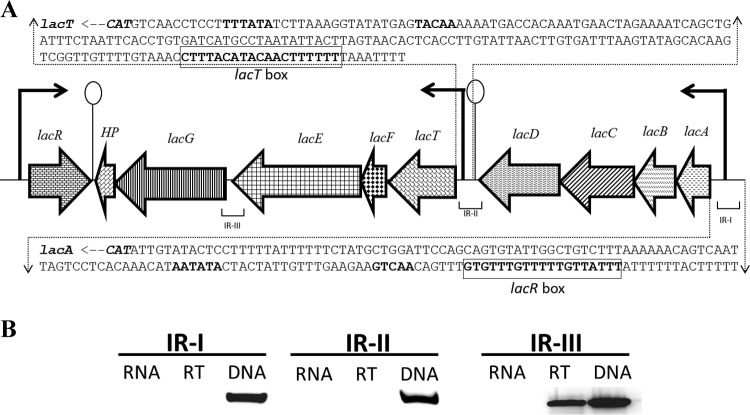
(A) Organization of the lac gene cluster in S. pneumoniae D39. Lollipop structures, the transcriptional terminators; black arrows, promoter regions. See the text for further details. Nucleotides in bold indicate the putative core promoter sequences, and bold and boxed nucleotides indicate the putative regulatory consensus sequences. Here, 1 kb is equal to 1.25 cm. (B) Reverse transcription-PCR analysis to confirm the polycistronic nature of the S. pneumoniae lac operons I and II. Reverse transcription-PCR was performed on total RNA isolated from the D39 wild type grown in LM17 medium with reverse transcriptase (RT) and without reverse transcriptase (RNA) treatment using primer pairs specific for the IR-I, IR-II, and IR-III intergenic regions. DNA was used as a positive control.
FIG 2
FIG 2
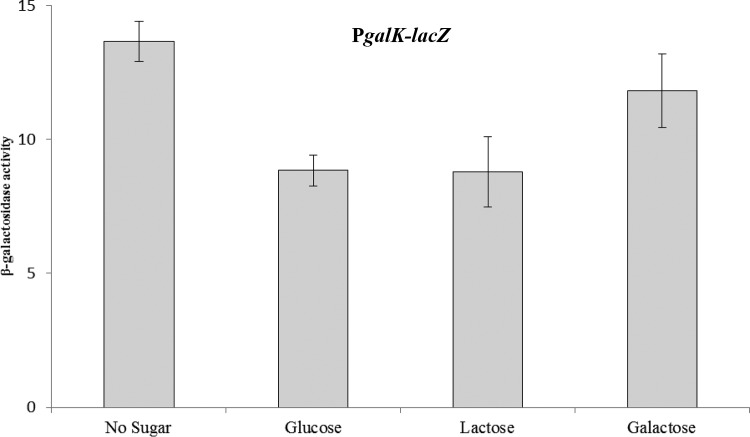
Expression levels (in Miller units) of PgalK-lacZ in the D39 wild type grown in M17 (without any sugar), GM17, LM17, and GalM17 media. The standard deviations from three independent experiments or replicates are indicated by bars.
FIG 3
FIG 3
Levels (in Miller units) of PlacA-lacZ (A) and PlacT-lacZ (B) expression in the D39 wild-type, D39 ΔlacR, and D39 ΔlacT strains grown in M17 (without any sugar), GM17, and LM17 media. The standard deviations from three independent experiments or replicates are indicated by bars.

References

    1. Stulke J, Hillen W. 1998. Coupling physiology and gene regulation in bacteria: the phosphotransferase sugar uptake system delivers the signals. Naturwissenschaften 85:583–592. 10.1007/s001140050555 - DOI - PubMed
    1. Titgemeyer F, Hillen W. 2002. Global control of sugar metabolism: a gram-positive solution. Antonie Van Leeuwenhoek 82:59–71. 10.1023/A:1020628909429 - DOI - PubMed
    1. Carvalho SM, Kloosterman TG, Kuipers OP, Neves AR. 2011. CcpA ensures optimal metabolic fitness of Streptococcus pneumoniae D39. PLoS One 6:e26707. 10.1371/journal.pone.0026707 - DOI - PMC - PubMed
    1. Lulko AT, Buist G, Kok J, Kuipers OP. 2007. Transcriptome analysis of temporal regulation of carbon metabolism by CcpA in Bacillus subtilis reveals additional target genes. J. Mol. Microbiol. Biotechnol. 12:82–95. 10.1159/000096463 - DOI - PubMed
    1. Gorke B, Stulke J. 2008. Carbon catabolite repression in bacteria: many ways to make the most out of nutrients. Nat. Rev. Microbiol. 6:613–624. 10.1038/nrmicro1932 - DOI - PubMed

Publication types