. 2014 Jun 23:4:5406.
doi: 10.1038/srep05406.

3'UTR shortening identifies high-risk cancers with targeted dysregulation of the ceRNA network

Affiliations

3'UTR shortening identifies high-risk cancers with targeted dysregulation of the ceRNA network

Li Li et al. Sci Rep. .

Abstract

Competing endogenous RNA (ceRNA) interactions form a multilayered network that regulates gene expression in various biological pathways. Recent studies have demonstrated novel roles of ceRNA interactions in tumorigenesis, but the dynamics of the ceRNA network in cancer remain unexplored. Here, we examine ceRNA network dynamics in prostate cancer from the perspective of alternative cleavage and polyadenylation (APA) and reveal the principles of such changes. Analysis of exon array data revealed that both shortened and lengthened 3'UTRs are abundant. Consensus clustering with APA data stratified cancers into groups with differing risks of biochemical relapse and revealed that a ceRNA subnetwork enriched with cancer genes was specifically dysregulated in high-risk cancers. The novel connection between 3'UTR shortening and ceRNA network dysregulation was supported by the unusually high number of microRNA response elements (MREs) shared by the dysregulated ceRNA interactions and the significantly altered 3'UTRs. The dysregulation followed a fundamental principle in that ceRNA interactions connecting genes that show opposite trends in expression change are preferentially dysregulated. This targeted dysregulation is responsible for the majority of the observed expression changes in genes with significant ceRNA dysregulation and represents a novel mechanism underlying aberrant oncogenic expression.


Figures
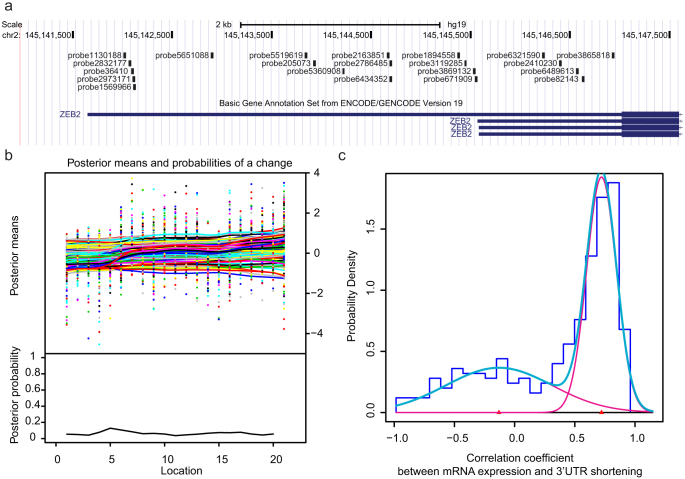
Figure 1
Figure 1. Bayesian change point approach for APA analysis with exon array data.
(a) Mapping of exon array probes to ZEB2 3′UTR. (b) BCP analysis results. The upper panel shows the input probe intensities (dots) and posterior probe mean intensities (solid lines) for all samples. The lower panel shows the posterior change point probabilities for the probes. (c) The correlation coefficient between gene expression and 3′UTR shortening follows a bimodal distribution. The histogram represents the distribution of the correlation coefficient (blue). The estimated densities are shown for individual (magenta) and combined (turquoise) distributions.
Figure 2
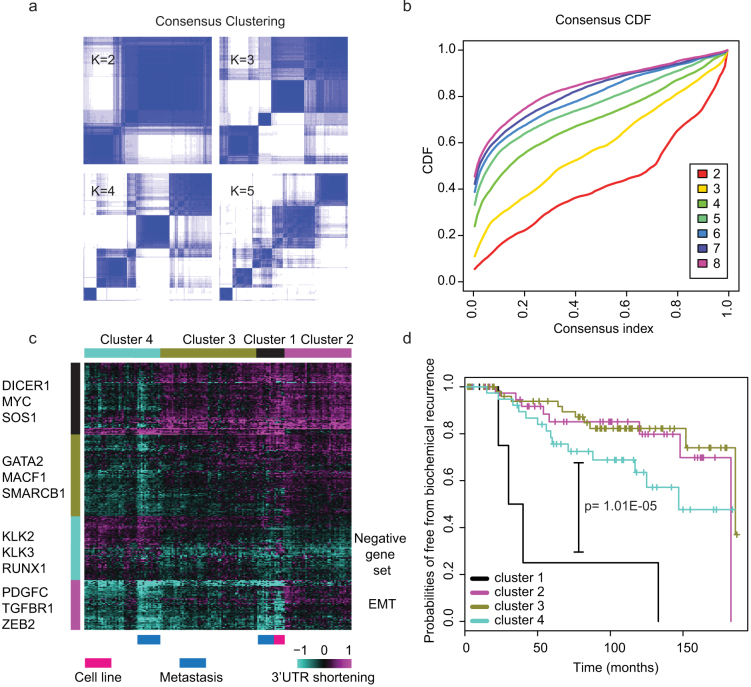
Figure 2. APA dynamics defines stable clusters with differing risks of biochemical relapse.
(a) Consensus clustering matrix of prostate cancer samples for k = 2 to k = 5. (b) Consensus clustering CDF for k = 2 to k = 5. (c) Heatmap of the clustering result. (d) Survival analysis using classifications generated from consensus clustering. Cluster 1 displays a significantly higher probability of relapse.
Figure 3
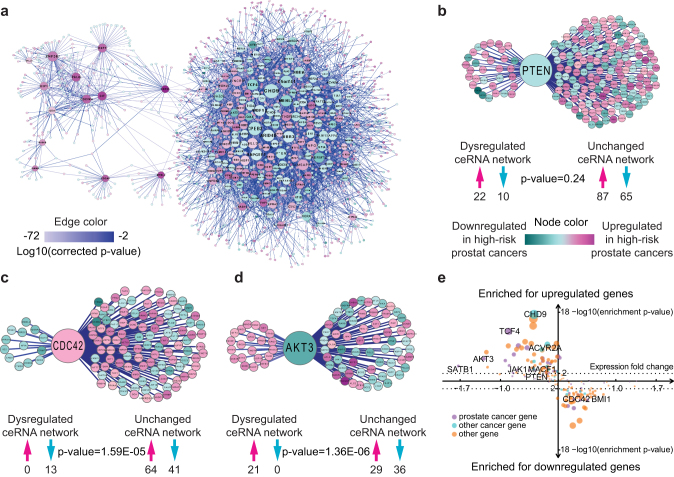
Figure 3. Targeted dysregulation of the ceRNA network.
(a) The dysregulated ceRNA network in high-risk prostate cancers with 5,185 dysregulated ceRNA interactions. Node colors represent expression changes, and edge colors represent the significance of ΔMI. The node sizes of the 182 significantly dysregulated genes are proportional to the number of dysregulated ceRNA interactions. The node sizes for the non-significant genes are set to a small value to allow visual separation between significant and non-significant genes. (b, c and d) Enrichment of genes displaying opposite expression change in dysregulated ceRNA interactions for PTEN (b), CDC42 (c) and AKT3 (d). Only genes with significant expression change between high-risk and low-risk cancer samples were considered (SAM q-value < 0.05). Numbers under arrows indicate the counts for upregulated (upward facing arrows, magenta) and downregulated (downward facing arrows, turquoise) genes. (e) Expression changes of dysregulated genes display a strong correlation with the enrichment of genes with opposite directions of expression change in their dysregulated ceRNA interactions. The size of each dysregulated gene is proportional to its -log10(enrichment p-value). The dotted line represents the cutoff for significant enrichment (p-value = 0.01).

References

    1. Bartel D. P. MicroRNAs: target recognition and regulatory functions. Cell 136, 215–233, 10.1016/j.cell.2009.01.002 (2009). - PMC - PubMed
    1. Vasudevan S., Tong Y. & Steitz J. A. Switching from repression to activation: microRNAs can up-regulate translation. Science 318, 1931–1934, 10.1126/science.1149460 (2007). - PubMed
    1. Guo H., Ingolia N. T., Weissman J. S. & Bartel D. P. Mammalian microRNAs predominantly act to decrease target mRNA levels. Nature 466, 835–840, 10.1038/nature09267 (2010). - PMC - PubMed
    1. Tay Y., Rinn J. & Pandolfi P. P. The multilayered complexity of ceRNA crosstalk and competition. Nature 505, 344–352, 10.1038/nature12986 (2014). - PMC - PubMed
    1. Salmena L., Poliseno L., Tay Y., Kats L. & Pandolfi P. P. A ceRNA hypothesis: the Rosetta Stone of a hidden RNA language.? Cell 146, 353–358, 10.1016/j.cell.2011.07.014 (2011). - PMC - PubMed

Publication types