Review
. 2014 Aug 9;384(9942):532-44.
doi: 10.1016/S0140-6736(14)60041-6. Epub 2014 Jun 18.

Imaging insights into basal ganglia function, Parkinson's disease, and dystonia

Affiliations
Review

Imaging insights into basal ganglia function, Parkinson's disease, and dystonia

A Jon Stoessl et al. Lancet. .

Abstract

Recent advances in structural and functional imaging have greatly improved our ability to assess normal functions of the basal ganglia, diagnose parkinsonian syndromes, understand the pathophysiology of parkinsonism and other movement disorders, and detect and monitor disease progression. Radionuclide imaging is the best way to detect and monitor dopamine deficiency, and will probably continue to be the best biomarker for assessment of the effects of disease-modifying therapies. However, advances in magnetic resonance enable the separation of patients with Parkinson's disease from healthy controls, and show great promise for differentiation between Parkinson's disease and other akinetic-rigid syndromes. Radionuclide imaging is useful to show the dopaminergic basis for both motor and behavioural complications of Parkinson's disease and its treatment, and alterations in non-dopaminergic systems. Both PET and MRI can be used to study patterns of functional connectivity in the brain, which is disrupted in Parkinson's disease and in association with its complications, and in other basal-ganglia disorders such as dystonia, in which an anatomical substrate is not otherwise apparent. Functional imaging is increasingly used to assess underlying pathological processes such as neuroinflammation and abnormal protein deposition. This imaging is another promising approach to assess the effects of treatments designed to slow disease progression.


Conflict of interest statement

Declaration of interests

We declare no competing interests.

Figures
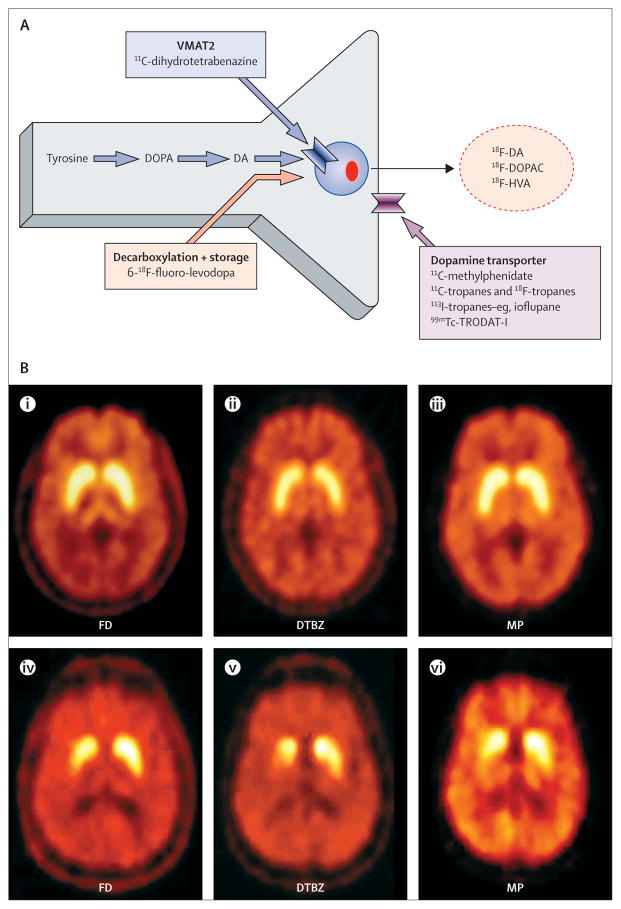
Figure 1
Figure 1. Dopaminergic nerve terminal and various approaches to the assessment of its integrity (A); composite showing PET images from a healthy control individual (B; i–iii) and a patient with mild Parkinson’s disease (B; iv–vi)
FD=6-18F-fluoro-levodopa. DTBZ=11C-dihydrotetrabenazine. MP=11C-d-threo-methylphenidate. VMAT2= vesicular monoamine transporter type 2. DOPA=dihydroxyphenylalanine. DA=dopamine. DOPAC=dihydroxyphenylacetic acid. HVA=homovanillic acid.
Figure 2
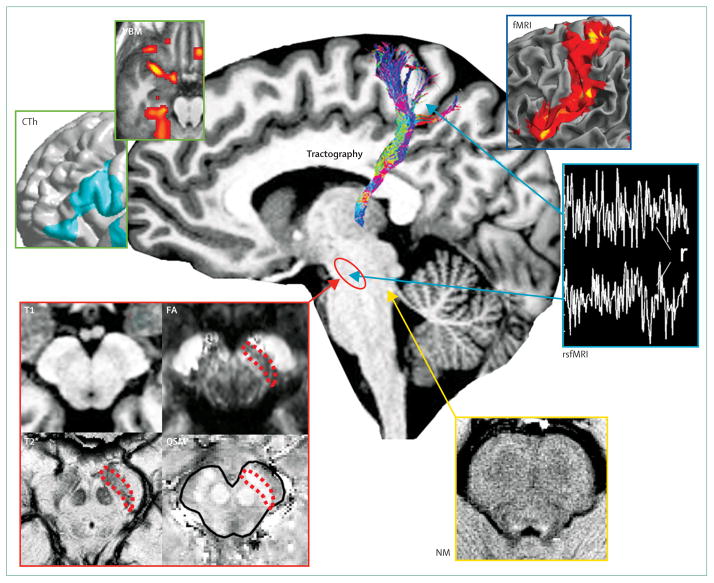
Figure 2. Main MRI methods used to study Parkinson’s disease
In the cortex, changes in cortical thickness (CTh) and grey matter volume or density (VBM) were reported (green boxes). Functional MRI (fMRI) was used to assess changes in brain activation levels during task performance (dark blue box). Changes in structural connectivity were evidenced using diffusion-based tractography and in functional connectivity at rest with resting state fMRI, which assesses correlation (r) between signal fluctuations in distant brain regions (light blue box). In the substantia nigra (red shape), increased iron load was assessed with T2* mapping (T2*) and more recently with quantitative susceptibility mapping (QSM), and microstructural changes with fractional anisotropy, which is decreased (red box). Neuromelanin imaging was used to study the locus coeruleus area (white arrow, yellow box). rsfMRI=resting state fMRI. NM=neuromelanin imaging. FA=fractional anisotropy. T1=T1-weighted. T2*=gradient echo T2 mapping.
Figure 3
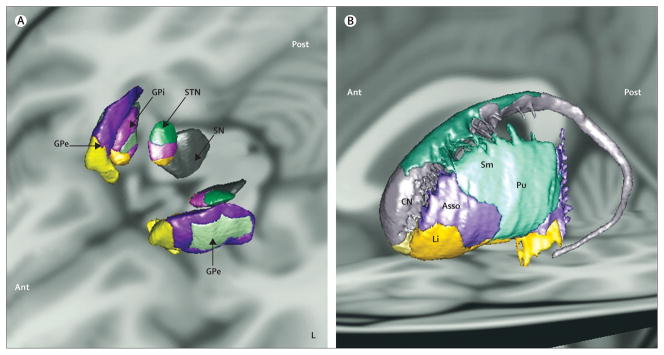
Figure 3. Three-dimensional representations of the sensorimotor (green), associative (pink/purple) and limbic (yellow) territories of the basal ganglia superimposed on a multiplanar T1-weighted image
Oblique superior view of the internal and external segments of the globus pallidus, subthalamic nucleus, and substantia nigra (A). Oblique lateral external view of the territories of the striatum (B). The territories are represented using postmortem atlas coregistered to the T1-weighted image of the brain of a control patient as described in Bardinet and colleagues. Territories in the substantia nigra are not represented (grey). GPi=internal part of the globus pallidus. STN=subthalamic nucleus. SN=substantia nigra. GPe=external part of the globus pallidus. CN=caudate nucleus. Asso=associative. Sm=sensorimotor. Pu=putamen. Li=limbic. Ant=anterior. L=left. Post=posterior. R=right. Courtesy of Eric Bardinet, Plateforme Stim, Centre de Neuro-Imagerie de Recherche, l’Institut du Cerveau et de la Moelle épinière, Paris, France.
Figure 4
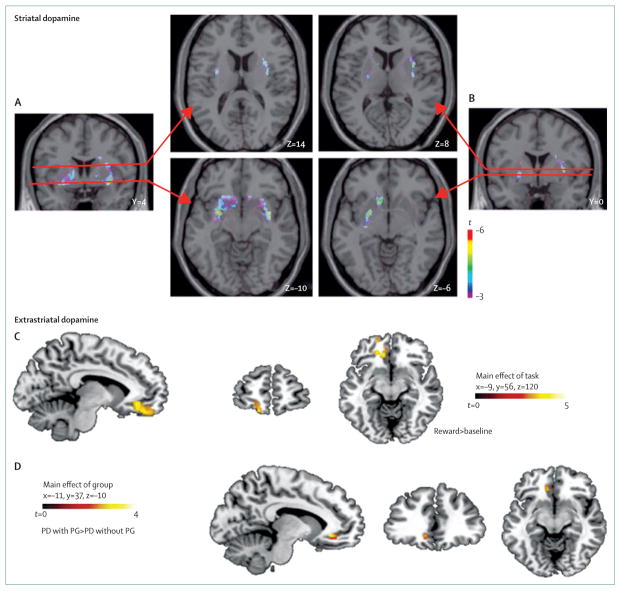
Figure 4. Striatal dopamine
The top figures show the significant areas of striatal dopamine release during gambling compared with control task in patients with Parkinson’s disease (PD) with pathological gambling (PG; A) and without pathological gambling (B) in the ventral striatum (lower figure) and dorsal striatum (upper figure). Dopamine receptor binding is higher in the left orbitofrontal and anterior cingular cortex during a reward-based task (C) and higher in anterior cingular cortex of patients with PD with PG compared with patients with PD without PG (D).

References

    1. Niethammer M, Eidelberg D. Metabolic brain networks in translational neurology: concepts and applications. Ann Neurol. 2012;72:635–47. - PMC - PubMed
    1. Kwon DH, Kim JM, Oh SH, et al. Seven-Tesla magnetic resonance images of the substantia nigra in Parkinson disease. Ann Neurol. 2012;71:267–77. - PubMed
    1. Martin WR, Wieler M, Gee M. Midbrain iron content in early Parkinson disease: a potential biomarker of disease status. Neurology. 2008;70:1411–17. - PubMed
    1. Péran P, Cherubini A, Assogna F, et al. Magnetic resonance imaging markers of Parkinson’s disease nigrostriatal signature. Brain. 2010;133:3423–33. - PubMed
    1. Menke RA, Scholz J, Miller KL, et al. MRI characteristics of the substantia nigra in Parkinson’s disease: a combined quantitative T1 and DTI study. Neuroimage. 2009;47:435–41. - PubMed

Publication types

MeSH terms