


Procedural and clinical utility of transulnar approach for coronary procedures following failure of radial route: Single centre experience
- PMID: 24954986
- PMCID: PMC4062755
- DOI: 10.1016/j.jsha.2014.01.003
Procedural and clinical utility of transulnar approach for coronary procedures following failure of radial route: Single centre experience
Abstract
Objectives: To assess the feasibility and safety of transulnar approach whenever transradial access fails.
Background: Radial access for coronary procedures has gained sound recognition. However, the method is not always successful.
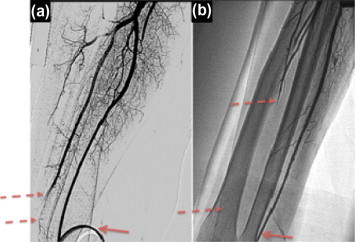
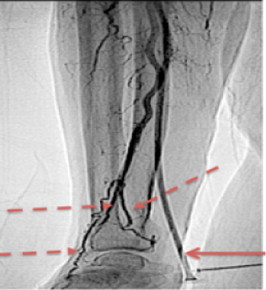
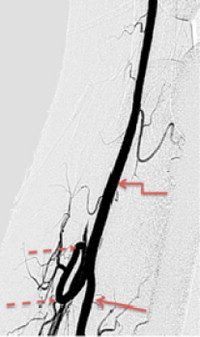
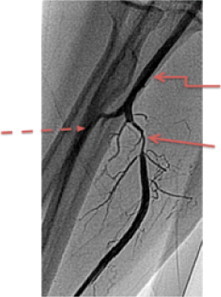
Methods: Between January 2010 and June 2013, diagnostic with or without percutaneous coronary intervention (PCI) was attempted in 2804 patients via the radial approach. Transradial approach was unsuccessful in 173 patients (6.2%) requiring crossover to either femoral (128 patients, 4.6%) or ulnar approach (45 patients, 1.6%). Patients who had undergone ulnar approach constituted our study population. Selective forearm angiography was performed after ulnar sheath placement. We documented procedural characteristics and major adverse cardio-cerebrovascular events.
Results: Radial artery spasm was the most common cause of crossover to the ulnar approach (64.4%) followed by failure to puncture the radial artery (33.4%). Out of 45 patients (82.2%), 37 underwent successful ulnar approach. The eight failed cases (17.8%) were mainly due to absent or weak ulnar pulse (75%). PCI was performed in 17 cases (37.8%), of which 8 patients underwent emergency interventions. Complications included transient numbness, non-significant hematoma, ulnar artery perforation, and minor stroke in 15.5%, 13.3%, 2.2% and 2.2%, respectively. No major cardiac-cerebrovascular events or hand ischemia were noted.
Conclusion: Ulnar approach for coronary diagnostic or intervention procedures is a feasible alternative whenever radial route fails. It circumvents crossover to the femoral approach. Our study confirms satisfactory success rate of ulnar access in the presence of adequate ulnar pulse intensity and within acceptable rates of complications.
Keywords: Alternative; Coronary procedures; Feasible; Femoral approach; MACCE; Radial; Ulnar.
Figures

References
-
- Jolly S.S., Yusuf S., Cairns J., Niemelä K., Xavier D., Widimsky P. Radial versus femoral access for coronary angiography and intervention in patients with acute coronary syndromes (RIVAL): a randomized, parallel group, multicenter trial. Lancet. 2011;377(9775):1409–1420. - PubMed
-
- Kiemeneij F., Laarman G.J., Odekerken D., Slagboom T., van der Wieken R. A randomized comparison of percutaneous transluminal coronary angioplasty by the radial, brachial and femoral approaches: the access study. J Am Coll Cardiol. 1997;29(6):1269–1275. - PubMed
-
- Louvard Y., Lefèvre T., Allain A., Morice M. Coronary angiography through the radial or the femoral approach: the CARAFE study. Catheter Cardiovasc Interv. 2001;52(2):181–187. - PubMed
-
- Biondi-Zoccai G., Sciahbasi A., Bodí V., Fernández-Portales J., Kanei Y., Romagnoli E. Right versus left radial artery access for coronary procedures: an international collaborative systematic review and meta-analysis including 5 randomized trials and 3210 patients. Int J Cardiol. 2013;166(3):621–626. - PubMed
-
- Valsecchi O., Vassileva A., Musumeci G., Rossini R., Tespili M., Guagliumi G. Failure of transradial approach during coronary interventions: anatomic considerations. Catheter Cardiovasc Interv. 2006;67(6):870–878. - PubMed
LinkOut - more resources
Full Text Sources
Other Literature Sources
Miscellaneous
