


How children perceive fractals: hierarchical self-similarity and cognitive development
- PMID: 24955884
- PMCID: PMC4148595
- DOI: 10.1016/j.cognition.2014.05.010
How children perceive fractals: hierarchical self-similarity and cognitive development
Abstract
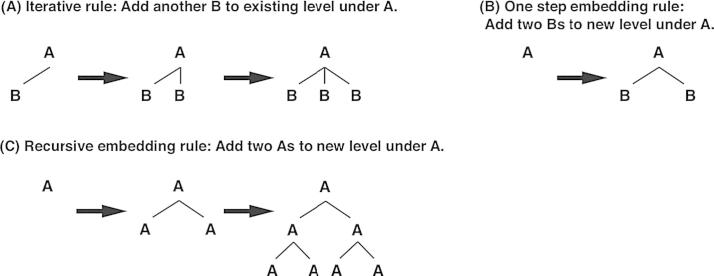
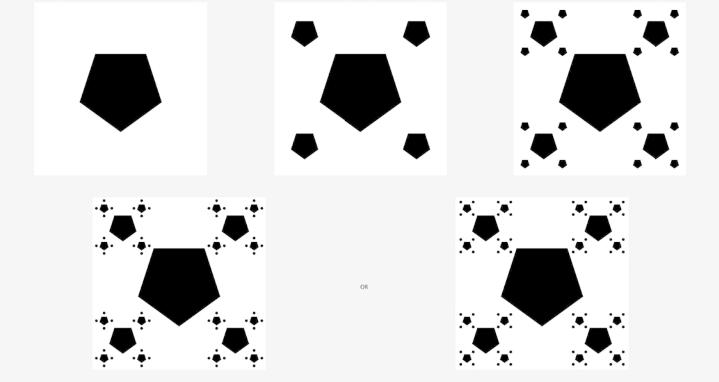
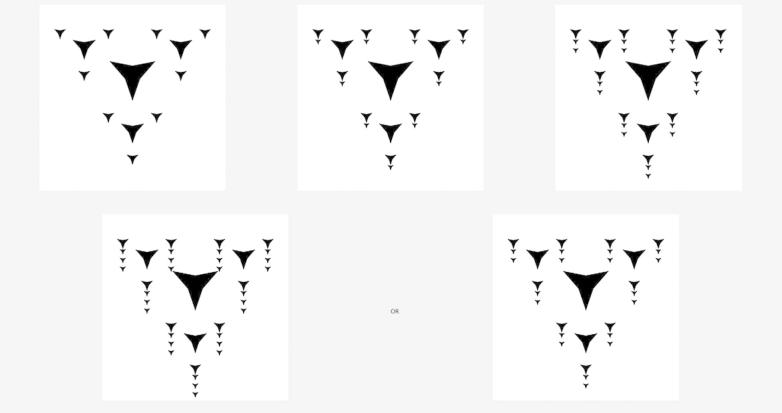
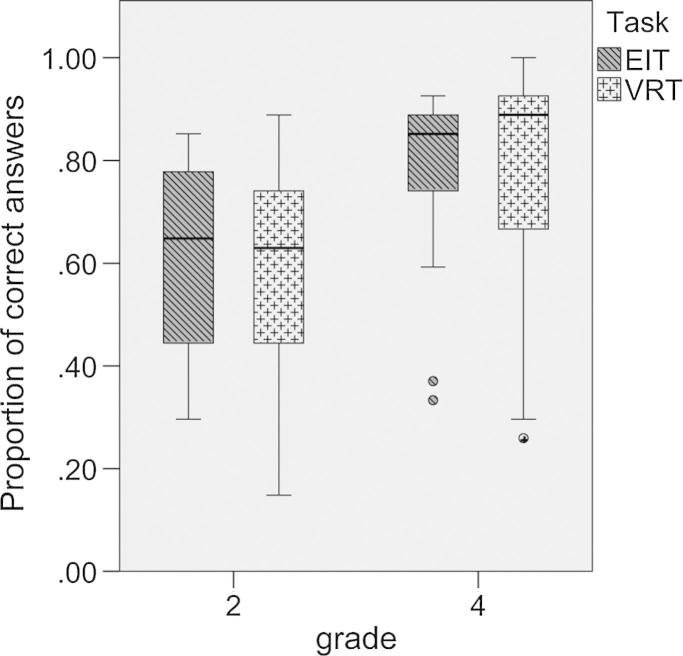
The ability to understand and generate hierarchical structures is a crucial component of human cognition, available in language, music, mathematics and problem solving. Recursion is a particularly useful mechanism for generating complex hierarchies by means of self-embedding rules. In the visual domain, fractals are recursive structures in which simple transformation rules generate hierarchies of infinite depth. Research on how children acquire these rules can provide valuable insight into the cognitive requirements and learning constraints of recursion. Here, we used fractals to investigate the acquisition of recursion in the visual domain, and probed for correlations with grammar comprehension and general intelligence. We compared second (n=26) and fourth graders (n=26) in their ability to represent two types of rules for generating hierarchical structures: Recursive rules, on the one hand, which generate new hierarchical levels; and iterative rules, on the other hand, which merely insert items within hierarchies without generating new levels. We found that the majority of fourth graders, but not second graders, were able to represent both recursive and iterative rules. This difference was partially accounted by second graders' impairment in detecting hierarchical mistakes, and correlated with between-grade differences in grammar comprehension tasks. Empirically, recursion and iteration also differed in at least one crucial aspect: While the ability to learn recursive rules seemed to depend on the previous acquisition of simple iterative representations, the opposite was not true, i.e., children were able to acquire iterative rules before they acquired recursive representations. These results suggest that the acquisition of recursion in vision follows learning constraints similar to the acquisition of recursion in language, and that both domains share cognitive resources involved in hierarchical processing.
Keywords: Development; Hierarchy; Iteration; Language evolution; Recursion; Visuo-spatial.
Copyright © 2014 The Authors. Published by Elsevier B.V. All rights reserved.
Figures




References
-
- Alegre M.A., Gordon P. Red rats eater exposes recursion in children’s word formation. Cognition. 1996;60:65–82. - PubMed
-
- Alvarez G.A. Representing multiple objects as an ensemble enhances visual cognition. Trends in Cognitive Sciences. 2011;15(3):122–131. - PubMed
-
- Berwick R.C., Pietroski P., Yankama B., Chomsky N. Poverty of the stimulus revisited. Cognitive Science. 2011;35(7):1207–1242. - PubMed
-
- Bishop D.V.M. Pearson Assessment; London: 2003. The test for reception of grammar, version 2 (trog-2)
Publication types
MeSH terms
Grants and funding
LinkOut - more resources
Full Text Sources
Other Literature Sources
Medical
