Review
. 2014 Sep;140(5):1281-302.
doi: 10.1037/a0037004. Epub 2014 Jun 23.

A meta-analysis and review of holistic face processing

Affiliations
Review

A meta-analysis and review of holistic face processing

Jennifer J Richler et al. Psychol Bull. 2014 Sep.

Abstract

The concept of holistic processing is a cornerstone of face recognition research, yet central questions related to holistic processing remain unanswered, and debates have thus far failed to reach a resolution despite accumulating empirical evidence. We argue that a considerable source of confusion in this literature stems from a methodological problem. Specifically, 2 measures of holistic processing based on the composite paradigm (complete design and partial design) are used in the literature, but they often lead to qualitatively different results. First, we present a comprehensive review of the work that directly compares the 2 designs, and which clearly favors the complete design over the partial design. Second, we report a meta-analysis of holistic face processing according to both designs and use this as further evidence for one design over the other. The meta-analysis effect size of holistic processing in the complete design is nearly 3 times that of the partial design. Effect sizes were not correlated between measures, consistent with the suggestion that they do not measure the same thing. Our meta-analysis also examines the correlation between conditions in the complete design of the composite task, and suggests that in an individual differences context, little is gained by including a misaligned baseline. Finally, we offer a comprehensive review of the state of knowledge about holistic processing based on evidence gathered from the measure we favor based on the 1st sections of our review-the complete design-and outline outstanding research questions in that new context.


Figures

Figure 1
Figure 1
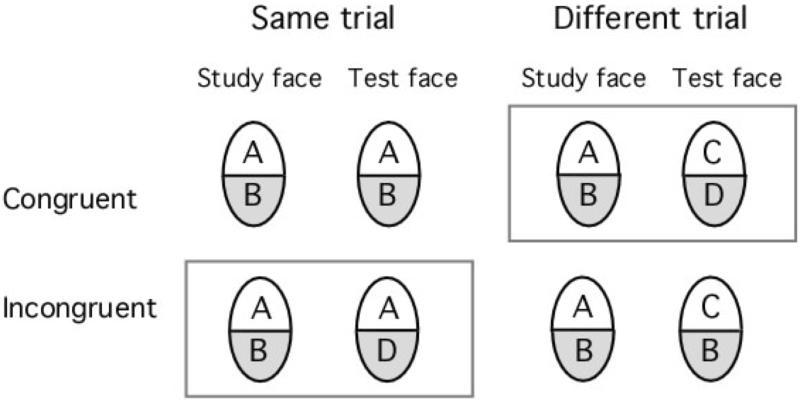
Design of the composite task for aligned trials. Letters represent facial identities. Task-relevant (target) face halves are shown in white. Task-irrelevant (distractor) halves are shown in gray. In same trials, target halves of the study and different test faces are the same; in same trials, target halves are different. In congruent trials, the irrelevant halves of the study and test faces are the same; in incongruent same trials, the irrelevant halves are different. In congruent different trials, the irrelevant halves of the study and test faces are different; in incongruent different trials, the irrelevant halves are the same. In the partial-design version of this task, only the trial types outlined in the gray boxes are presented. In the complete design, all trial types are presented. In both designs face halves can be aligned or misaligned.
Figure 2
Figure 2
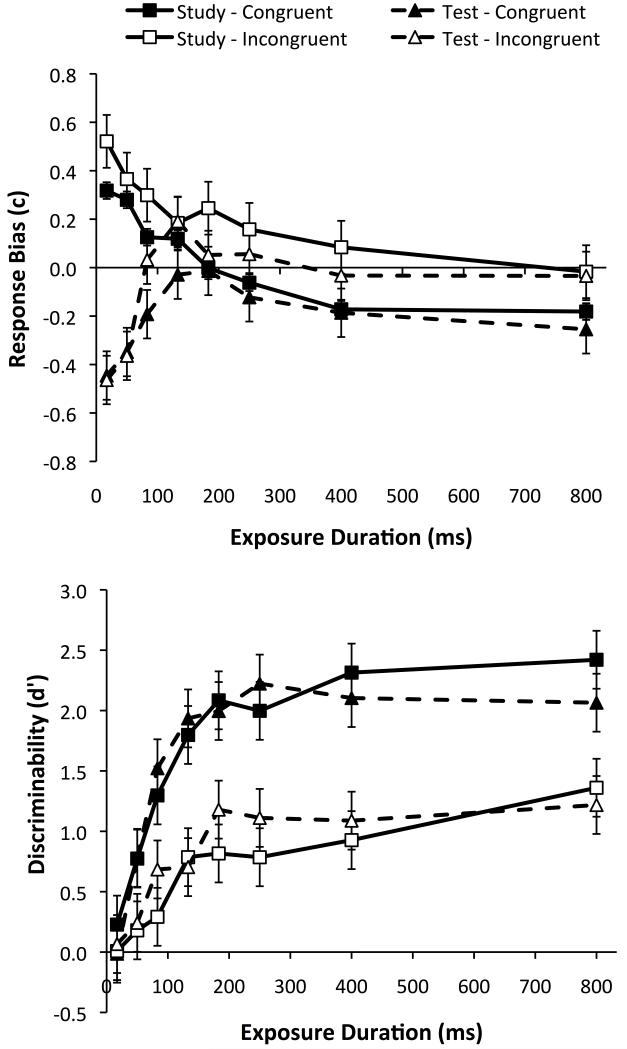
Response bias (top panel) and discriminability (bottom panel) from Richler, Mack, et al. (2009). Congruent trials are shown as black markers, incongruent trials are shown as white markers. Squares indicate conditions where presentation times for study faces were manipulated, and triangles indicate conditions where presentations times of test faces were manipulated. For rapid exposure durations, response bias is sensitive to whether presentation time for the study or test face is manipulated. Whether presentation time for the study or test face is manipulated does not influence discriminability.
Figure 3
Figure 3
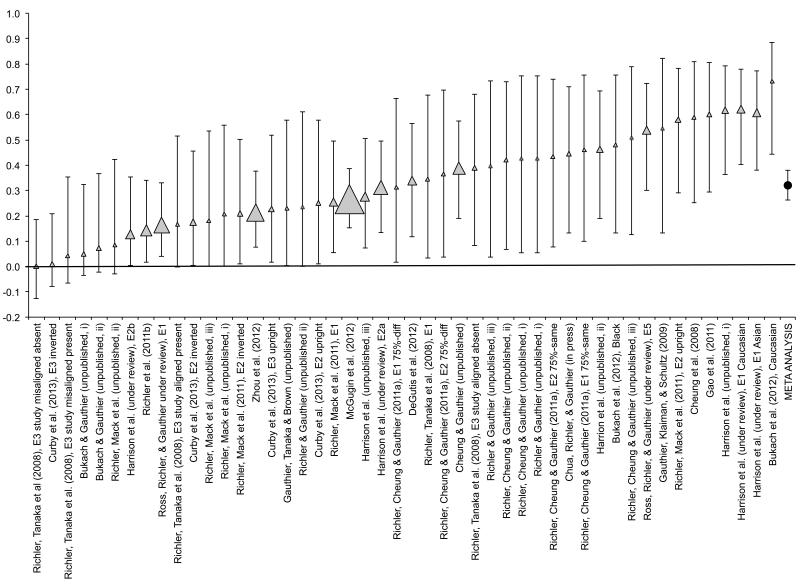
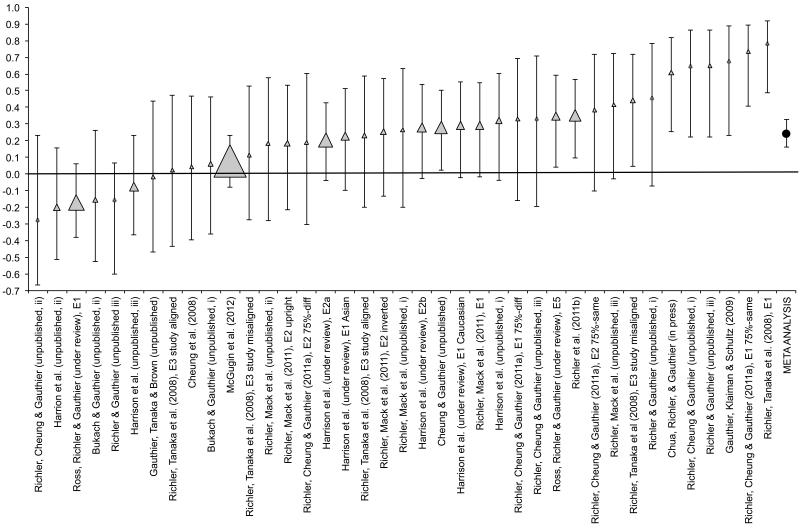
Effect size (η2p) of holistic processing in the complete design (congruency × alignment interaction in d’). The size of the triangle markers are scaled by sample size. The black circle is the mean weighted effect size from the meta-analysis. Error bars show 95% confidence intervals.
Figure 4
Figure 4
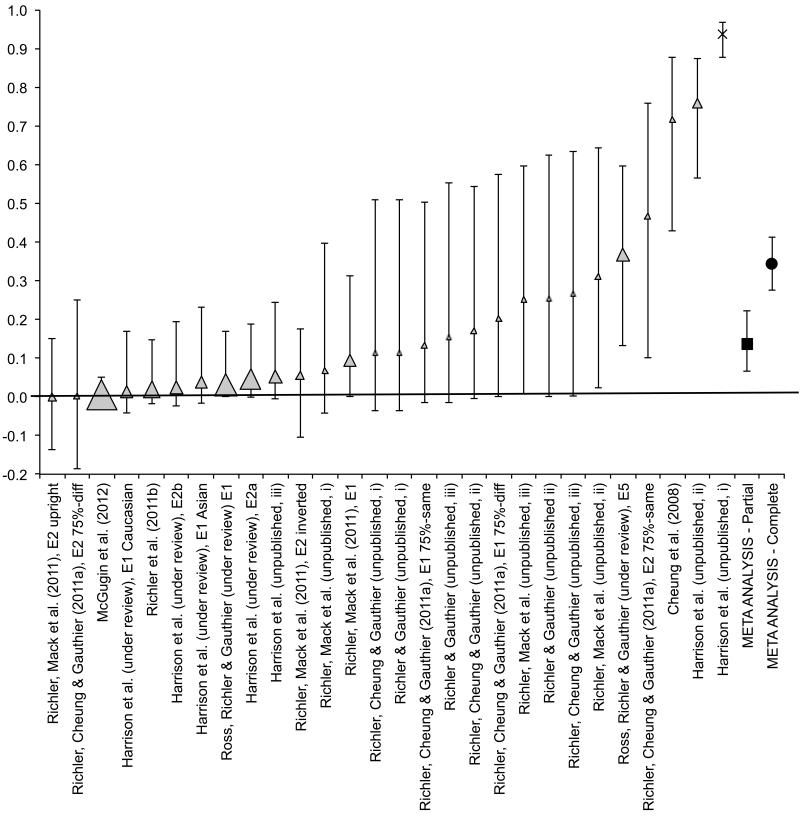
Effect size (η2p) of holistic in the partial design (alignment effect in hit rate on same-incongruent trials) calculated from a subset of trials run in the context of the complete design. The size of the triangle markers are scaled for sample size. The black square is the mean weighted effect size for holistic processing in the partial design from the meta-analysis. The black circle is the mean weighted effect size for holistic processing in the complete design for this subset of studies. Error bars show 95% confidence intervals
Figure 5
Figure 5
Effect size of the correlation (r)between the congruency effect-aligned and congruency effect-misaligned. The size of the triangle markers are scaled for sample size. The black circle shows the mean-weighted effect size. Error bars show 95% confidence intervals.
Figure 6
Figure 6
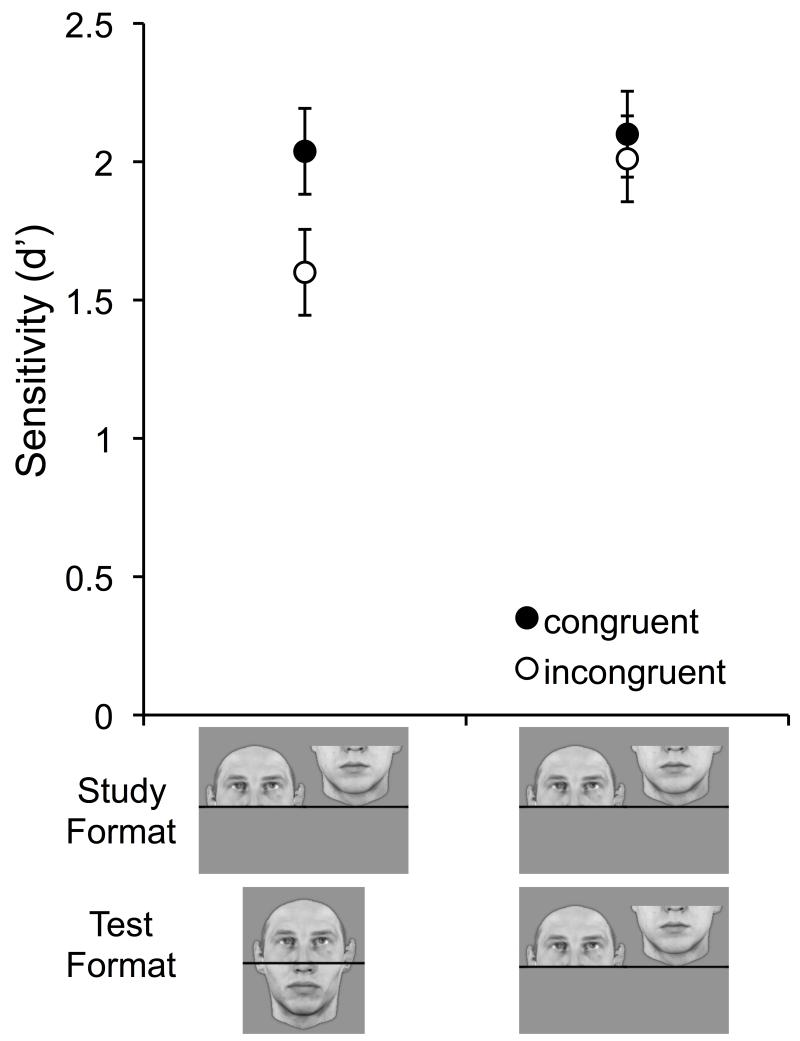
Re-plotted data from Richler, Tanaka, Brown & Gauthier (2008), Experiment 2. In this version of the composite task, the study face was always presented in an adjacent format, where the top and bottom face halves were presented side-by-side. The test face could be either aligned or adjacent. A congruency effect was observed when the test face was aligned, even though the study face was presented in an unusual configuration that could not be encoded to fit a face template.

References

    1. Avidan G, Tanzer M, Behrmann M. Impaired holistic processing in congenital prosopagnosia. Neuropsychologia. 2011;49:2541–2552. doi:10.1016/j.neuropsychologia.2011.05.002. - PMC - PubMed
    1. Basso MR, Schefft BK, Ris MD, Dember WN. Mood and global-local visual processing. Journal of the International Neuropsychological Society. 1996;2:249–255. http://dx.doi.org/10.1017/S1355617700001193. - DOI - PubMed
    1. Behrmann M, Marotta J, Gauthier I, Tarr MJ, McKeeff TJ. Behavioral change and its neural correlates in visual agnosia after expertise training. Journal of Cognitive Neuroscience. 2005;17(4):554–568. doi:10.1162/0898929053467613. - PubMed
    1. Bentin S, Allison T, Puce A, Perez A, McCarthy G. Electrophysiological studies of face perception in humans. Journal of Cognitive Neuroscience. 1996;8:551–565. doi:10.1162/jocn.1996.8.6.551. - PMC - PubMed
    1. Bilalic M, Langner R, Ulrich R, Wolfgang G. Many faces of expertise: Fusiform face area in chess experts and novices. The Journal of Neuroscience. 2011;31:10206–10214. doi:10.1523/JNEUROSCI.5727-10.2011. - PMC - PubMed

Publication types