Review
. 2014 Sep;37(9):637-43.
doi: 10.14348/molcells.2014.0150. Epub 2014 Jun 24.

Regulation of wound healing and fibrosis by hypoxia and hypoxia-inducible factor-1

Affiliations
Review

Regulation of wound healing and fibrosis by hypoxia and hypoxia-inducible factor-1

Robin J Ruthenborg et al. Mol Cells. 2014 Sep.

Abstract

Wound healing is a complex multi-step process that requires spatial and temporal orchestration of cellular and non-cellular components. Hypoxia is one of the prominent microenvironmental factors in tissue injury and wound healing. Hypoxic responses, mainly mediated by a master transcription factor of oxygen homeostasis, hypoxia-inducible factor-1 (HIF-1), have been shown to be critically involved in virtually all processes of wound healing and remodeling. Yet, mechanisms underlying hypoxic regulation of wound healing are still poorly understood. Better understanding of how the wound healing process is regulated by the hypoxic microenvironment and HIF-1 signaling pathway will provide insight into the development of a novel therapeutic strategy for impaired wound healing conditions such as diabetic wound and fibrosis. In this review, we will discuss recent studies illuminating the roles of HIF-1 in physiologic and pathologic wound repair and further, the therapeutic potentials of HIF-1 stabilization or inhibition.

Keywords: fibrosis; hypoxia; hypoxia-inducible factor-1; oxygen; wound healing.


Figures
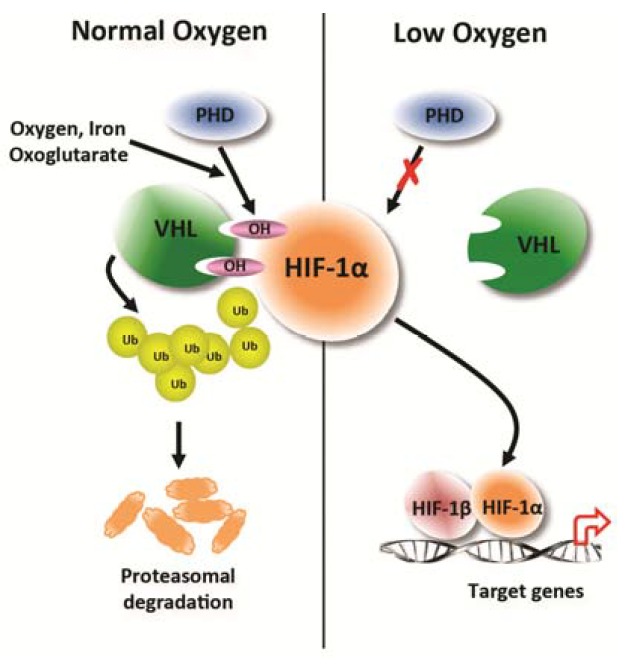
Fig. 1.
Fig. 1.
Post-transcriptional regulation of HIF-1α by cellular O2 level. In normal oxygen tension level conditions, proline residues in the oxygen-dependent domain (ODD) of the HIF-1α subunit are hydroxylated by prolyl hydroxylases (PHDs) that require oxygen, iron, and 2-oxoglutarate as substrates. Von Hippel-Lindau tumor suppressor protein (VHL) recognizes and binds the hydroxylated HIF-1α subunit targeting it for polyubiquitination and proteasomal degradation. In low oxygen tension level conditions, hydroxylation of HIF-1α subunits by PHDs is inhibited, stabilizing HIF-1α and allowing translocation to the nucleus where with binding partner HIF-1β, the HIF-1 complex binds to hypoxia-response elements (HREs) in the promoter of target genes that are involved in hypoxic adaptation and survival processes.
Fig. 2.
Fig. 2.
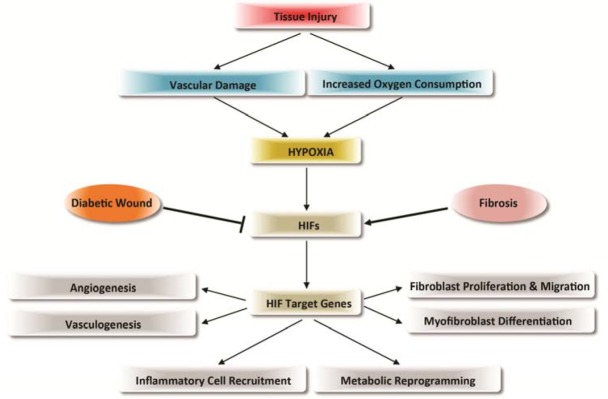
Regulation of wound healing and fibrosis by hypoxia and HIF-1. In tissue injury, vascular damage and increased oxygen consumption result in a hypoxic microenvironment that leads to the induction of HIFs. HIFs activate target genes that contribute to the processes of wound healing and remodeling; including angiogenesis, vasculogenesis, fibroblast proliferation and migration, myofibroblast differentiation, inflammatory cell recruitment, and metabolic reprogramming. The induction of HIF-1 is repressed in diabetic wounds resulting in delayed healing. In contrast, fibrosis is promoted by HIFs and hypoxia, aggravating the pathogenic progression of fibrotic disorders.

References

    1. Ahluwalia A, Tarnawski AS. Critical role of hypoxia sensor–HIF-1alpha in VEGF gene activation. Implications for angiogenesis and tissue injury healing. Curr Med Chem. 2012;19:90–97. - PubMed
    1. Andrikopoulou E, Zhang X, Sebastian R, Marti G, Liu L, Milner SM, Harmon JW. Current Insights into the role of HIF-1 in cutaneous wound healing. Curr Mol Med. 2011;11:218–235. - PubMed
    1. Asada N, Takase M, Nakamura J, Oguchi A, Asada M, Suzuki N, Yamamura K, Nagoshi N, Shibata S, Rao TN, et al. Dysfunction of fibroblasts of extrarenal origin underlies renal fibrosis and renal anemia in mice. J Clin Invest. 2011;121:3981–3990. - PMC - PubMed
    1. Barriga EH, Maxwell PH, Reyes AE, Mayor R. The hypoxia factor Hif-1alpha controls neural crest chemotaxis and epithelial to mesenchymal transition. J Cell Biol. 2013;201:759–776. - PMC - PubMed
    1. Basu RK, Hubchak S, Hayashida T, Runyan CE, Schumacker PT, Schnaper HW. Interdependence of HIF-1alpha and TGF-beta/Smad3 signaling in normoxic and hypoxic renal epithelial cell collagen expression. Am J Physiol Renal Physiol. 2011;300:F898–905. - PMC - PubMed

Publication types

Substances