


A literature review of indirect costs associated with stroke
- PMID: 24957313
- PMCID: PMC4383399
- DOI: 10.1016/j.jstrokecerebrovasdis.2014.02.017
A literature review of indirect costs associated with stroke
Abstract
Background: Stroke is a leading cause of mortality and long-term disability. However, the indirect costs of stroke, such as productivity loss and costs of informal care, have not been well studied. To better understand this, we conducted a literature review of the indirect costs of stroke.
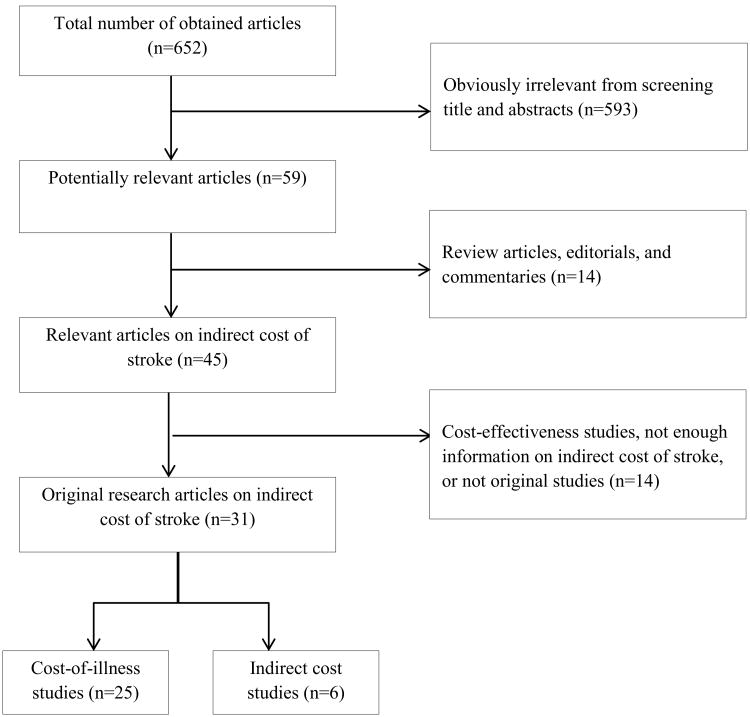
Methods: A literature search using PubMed, MEDLINE, and EconLit, with the key words stroke, cerebrovascular disease, subarachnoid hemorrhage, intracerebral hemorrhage, cost-of-illness, productivity loss, indirect cost, economic burden, and informal caregiving was conducted. We identified original research articles published during 1990-2012 in English-language peer-reviewed journals. We summarized indirect costs by study type, cost categories, and study settings.
Results: We found 31 original research articles that investigated the indirect cost of stroke. Six of these investigated indirect costs only; the other 25 studies were cost-of-illness studies that included indirect costs as a component. Of the 31 articles, 6 examined indirect costs in the United States, with 2 of these focused solely on indirect costs. Because of diverse methods, kinds of data, and definitions of cost used in the studies, the literature indicated a very wide range internationally in the proportion of the total cost of stroke that is represented by indirect costs (from 3% to 71%).
Conclusions: Most of the literature indicates that indirect costs account for a significant portion of the economic burden of stroke, and there is a pressing need to develop proper approaches to analyze these costs and to make better use of relevant data sources for such studies or establish new ones.
Keywords: Stroke; cost of informal care; economic burden; indirect cost; productivity loss.
Published by Elsevier Inc.
Figures
References
-
- World Health Organization. The world health report 2002. Midwifery. 2003;19:72–73. - PubMed
-
- Redon J, Olsen MH, Cooper RS, Zurriaga O, Martinez-Beneito MA, Laurent S, et al. Stroke mortality and trends from 1990 to 2006 in 39 countries from europe and central asia: Implications for control of high blood pressure. European Heart Journal. 2011;32:1424–1431. - PubMed
-
- Kunst AE, Amiri M, Janssen F. The decline in stroke mortality: Exploration of future trends in 7 western european countries. Stroke. 2011;42:2126–2130. - PubMed
-
- Chiu L, Shyu WC, Chen TR. A cost-effectiveness analysis of home care and community-based nursing homes for stroke patients and their families. Journal of Advanced Nursing. 1997;26:872–878. - PubMed
Publication types
MeSH terms
Grants and funding
LinkOut - more resources
Full Text Sources
Other Literature Sources
Medical
