Case Reports
doi: 10.1136/bcr-2014-203725.
Acute three-vessel cervical arterial occlusion due to spontaneous quadruple cervical artery dissection
Affiliations
- PMID: 24957585
- PMCID: PMC4069629
- DOI: 10.1136/bcr-2014-203725
Item in Clipboard
Case Reports
Acute three-vessel cervical arterial occlusion due to spontaneous quadruple cervical artery dissection
BMJ Case Rep.
.
Abstract
Cervical artery dissection (CAD) is one of the most frequent causes (14.5%) of stroke in young adults. Cases with involvement of more than two arteries are rare. Arnold et al described 11 cases (1.5%) with triple CAD of a reported 740 patients and just a single (0.1%) quadruple case in the same population. Simultaneous dissection of the four principal vessels is extremely rare. According to Papagiannaki et al, the incidence of simultaneous three or four CADs is 1-3/million in the general population. To the best of our knowledge, there are only three published cases of spontaneous quadruple CAD.
2014 BMJ Publishing Group Ltd.
Figures
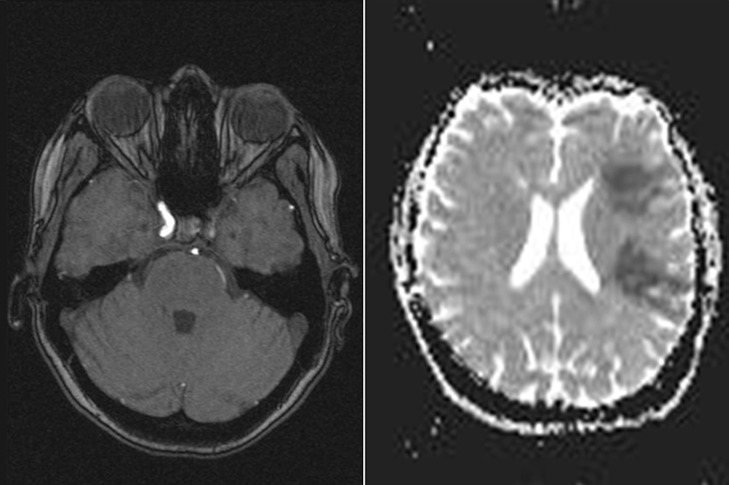
Initial MRI at admission. Left: T1-weighted gadolinium-enhanced image showing no enhancement from left internal carotid artery. Right: diffusion-weighted image, showing focal acute ischaemia in the left hemisphere.
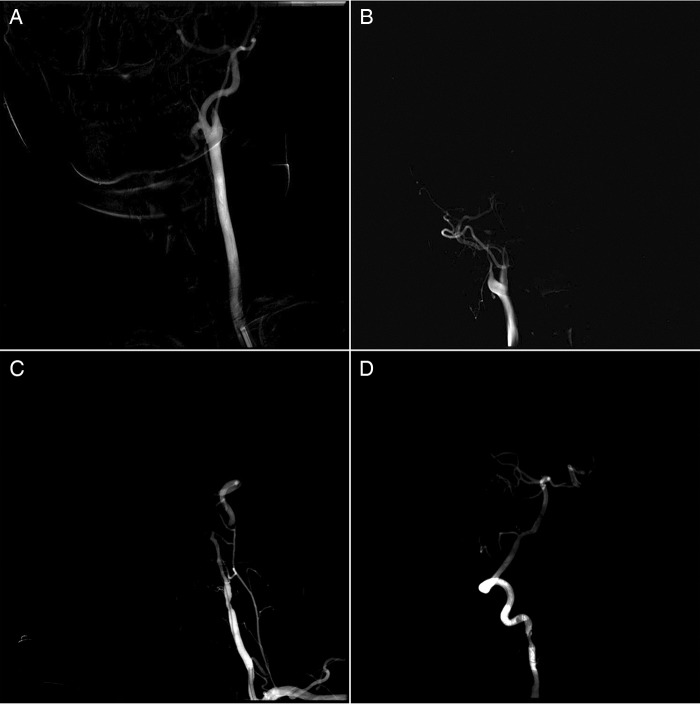
Digital subtracted angiography of four cervicocerebral vessels. (A) Left common carotid artery (CCA), frontal view. Left internal carotid artery (ICA) occluded immediately after CCA bifurcation, with flame-shaped occlusion. (B) Right CCA, lateral view. Flame-shaped occlusion of right ICA. (C) Left vertebral artery (VA), frontal view. Occlusion at C2–C3 level. Intracranial part of VA has partial supply via small anastomosis with muscular branch of the left subclavian artery. (D) Right VA, lateral view. Irregular dissection-like contour of the vessel with stenosis at C2–C3 level. Good collateral flow to the carotid region via posterior communicant artery.
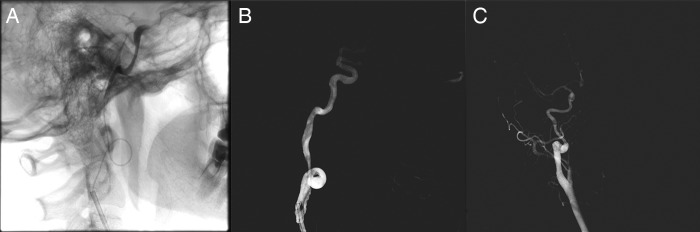
Digital subtracted angiography, stages of right internal carotid artery (ICA) revascularisation. (A) Lateral view: microcatheter passed the occlusion, contrasting the distal part of right ICA. (B) After one pass of stent extraction direct flow appeared, showing irregular dissected vessel wall. (C) After self-expandable nitinol 6×8 × 40 mm, stent implantation lumen of right ICA restored.
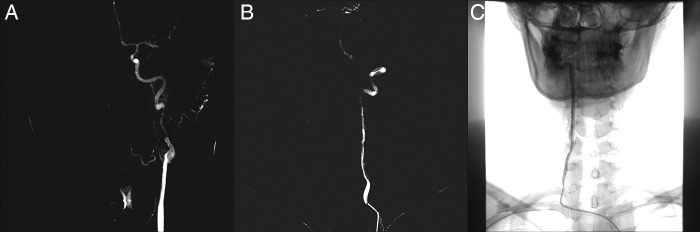
Digital subtracted angiography, 2 weeks after internal carotid artery (ICA) stenting. All frontal view. (A) Small direct flow of previously occluded left ICA appeared. (B) Direct flow of previously occluded left vertebral artery (VA). (C) Stent implantation to right VA at the site of dissection.
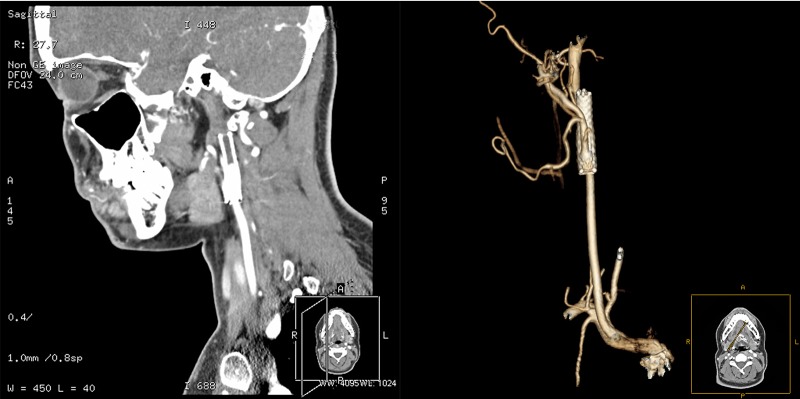
CT angiography at 3-month follow-up. Left: two-dimensional image showing in-stent thrombosis of right internal carotid artery. Right: three-dimensional image showing no flow at the distal end of stent.
References
-
- Larrue V, Berhoune N, Massabuau P, et al. Etiologic investigation of ischemic stroke in young adults. Neurology 2011;76:1983–8 - PubMed
-
- Arnold M, De Marchis GM, Stapf C, et al. Triple and quadruple spontaneous cervical artery dissection: presenting characteristics and long-term outcome. J Neurol Neurosurg Psychiatry 2009;80:171–4 - PubMed
-
- Leys D, Bandu L, Hénon H, et al. Clinical outcome in 287 consecutive young adults (15 to 45 years) with ischemic stroke. Neurology 2002;59:26–33 - PubMed
-
- Newell CP, Seller C, Vizhi M, et al. Case report: spontaneous coronary artery dissection during elective caessarian section under spinal anaesthesia. Anaesthesia 2011;66:615–19 - PubMed
Publication types
MeSH terms
Substances
LinkOut - more resources
Full Text Sources
Other Literature Sources
Miscellaneous