


The color of health: skin color, ethnoracial classification, and discrimination in the health of Latin Americans
- PMID: 24957692
- PMCID: PMC4117723
- DOI: 10.1016/j.socscimed.2014.05.054
The color of health: skin color, ethnoracial classification, and discrimination in the health of Latin Americans
Abstract
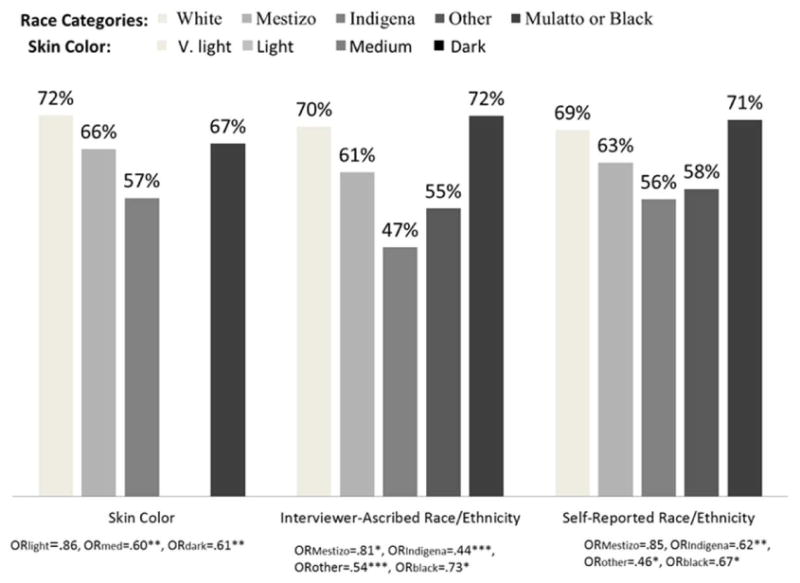
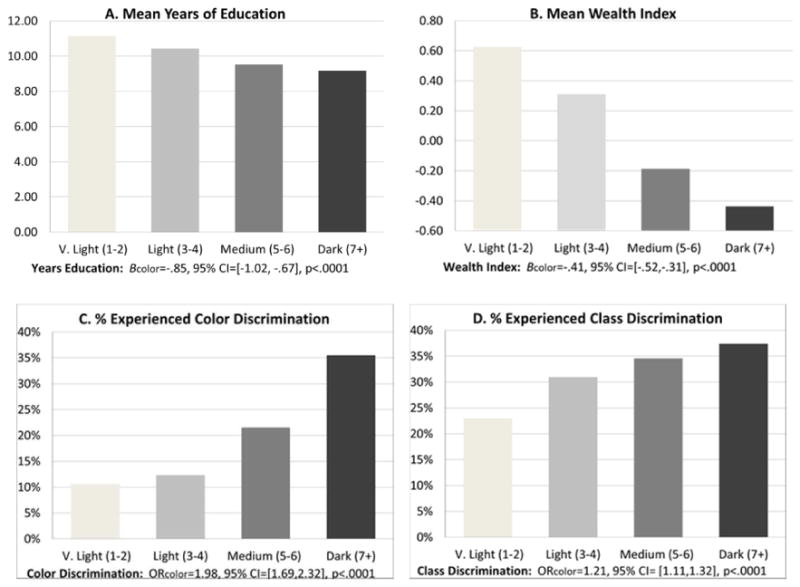
Latin America is one of the most ethnoracially heterogeneous regions of the world. Despite this, health disparities research in Latin America tends to focus on gender, class and regional health differences while downplaying ethnoracial differences. Few scholars have conducted studies of ethnoracial identification and health disparities in Latin America. Research that examines multiple measures of ethnoracial identification is rarer still. Official data on race/ethnicity in Latin America are based on self-identification which can differ from interviewer-ascribed or phenotypic classification based on skin color. We use data from Brazil, Colombia, Mexico, and Peru to examine associations of interviewer-ascribed skin color, interviewer-ascribed race/ethnicity, and self-reported race/ethnicity with self-rated health among Latin American adults (ages 18-65). We also examine associations of observer-ascribed skin color with three additional correlates of health - skin color discrimination, class discrimination, and socio-economic status. We find a significant gradient in self-rated health by skin color. Those with darker skin colors report poorer health. Darker skin color influences self-rated health primarily by increasing exposure to class discrimination and low socio-economic status.
Keywords: Discrimination; Latin America; Latino; Race/ethnicity; Self-rated health; Skin color; Socio-economic status (SES).
Copyright © 2014 Elsevier Ltd. All rights reserved.
Figures
Comment in
-
Skin color, interviewer-ascribed ethnoracial classification, racial/ethnic self-identification & discrimination: commentary on Perreira and Telles (2014).Soc Sci Med. 2014 Sep;116:251-2. doi: 10.1016/j.socscimed.2014.07.013. Epub 2014 Jul 6. Soc Sci Med. 2014. PMID: 25017580 No abstract available.
References
-
- Abdulrahim S, James AA, Yamout R, Baker W. Discrimination and psychological distress: Does Whiteness matter for Arab Americans? Social Science and Medicine. 2012;75:2116–2123. - PubMed
-
- Almeida-Filho N, Lessa I, Magalhães, Araùjo JM, Aquino E, James SA, Kawachi I. Social inequality and depressive disorders in Bahia, Brazil: Interactions of gender, ethnicity, and social class. Social Science and Medicine. 2004;59:1339–1353. - PubMed
-
- Angosto FL, Kradolfer S. Everlasting Countdowns: Race, Ethnicity and National Censuses in Latin American States. Newcastle upon Tyne (UK): Cambridge Scholars Publishing; 2012.
-
- Bastos JL, Peres MA, Peres KG, Dumith SC, Gigante DP. Socioeconomic differences between self- and interviewer classification of color/race. Rev Saúde Pública. 2008;42(2):1–10. - PubMed
Publication types
MeSH terms
Grants and funding
LinkOut - more resources
Full Text Sources
Other Literature Sources
Medical
