. 2012 Nov 28;2(4):1060-89.
doi: 10.3390/metabo2041060.

Glycomics approaches for the bioassay and structural analysis of heparin/heparan sulphates

Affiliations

Glycomics approaches for the bioassay and structural analysis of heparin/heparan sulphates

Tania M Puvirajesinghe et al. Metabolites. .

Abstract

The glycosaminoglycan heparan sulphate (HS) has a heterogeneous structure; evidence shows that specific structures may be responsible for specific functions in biological processes such as blood coagulation and regulation of growth factor signalling. This review summarises the different experimental tools and methods developed to provide more rapid methods for studying the structure and functions of HS. Rapid and sensitive methods for the facile purification of HS, from tissue and cell sources are reviewed. Data sets for the structural analysis are often complex and include multiple sample sets, therefore different software and tools have been developed for the analysis of different HS data sets. These can be readily applied to chromatographic data sets for the simplification of data (e.g., charge separation using strong anion exchange chromatography and from size separation using gel filtration techniques. Finally, following the sequencing of the human genome, research has rapidly advanced with the introduction of high throughput technologies to carry out simultaneous analyses of many samples. Microarrays to study macromolecular interactions (including glycan arrays) have paved the way for bioassay technologies which utilize cell arrays to study the effects of multiple macromolecules on cells. Glycan bioassay technologies are described in which immobilisation techniques for saccharides are exploited to develop a platform to probe cell responses such as signalling pathway activation. This review aims at reviewing available techniques and tools for the purification, analysis and bioassay of HS saccharides in biological systems using "glycomics" approaches.


Figures
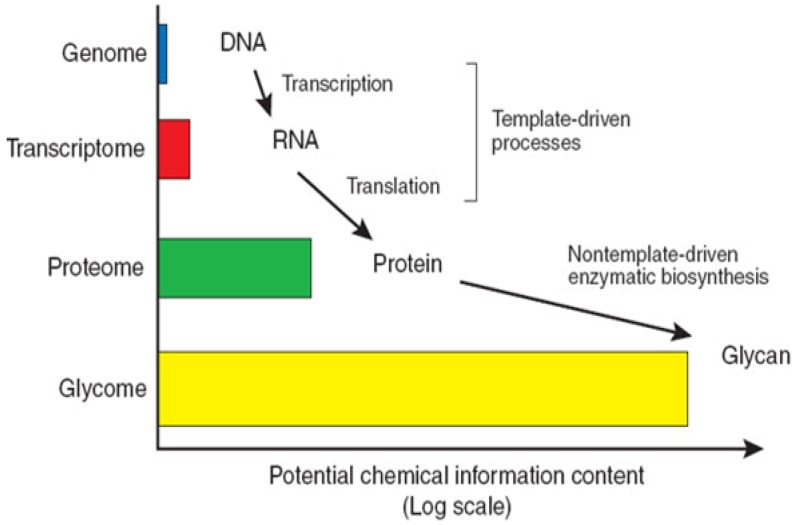
Figure 1
Figure 1
The complexity of the glycome. The glycome is defined as the complete set of glycan structures expressed at a particular time and spatial position in specific cells, tissues or organisms. Therefore the complexity of structures and the potential chemical information of the glycome far exceed that of the genome and proteome. Figure taken from [1].
Figure 2
Figure 2
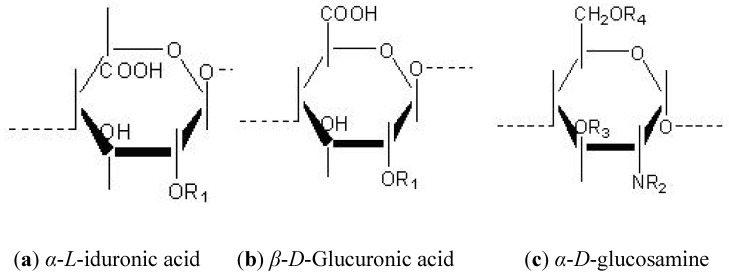
Individual monosaccharide units of heparan sulphate. The repeating dissacharide unit is composed of either α-L-iduronic acid (a) or glucuronic acid (GlcA) (b) and a N-acetylglucosamine residue (GlcNAc) (c). Various biosynthetic modifications can occur on the R positions of the monosaccharide units, involving functional groups, H- hydroxyl, COCH3- acetyl groups and SO3−sulphate groups. R1=H or SO3−, R2 =H2COCH3 or SO3−, R3= H or SO3−, R4= H or SO3−.
Figure 3
Figure 3
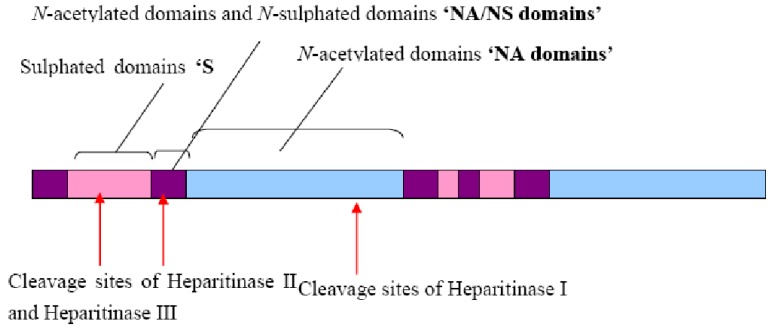
Diagram representing different domains present in HS chains. Sulphated domains (S-domains) contain N-sulphated disaccharides with IdoA-2-O- sulphate as a major uronate component. N-acetylated (NA) domains are non-sulphated and have acetylated regions. In contrast, N-acetylated and N-sulphated (NA/NS) domains contain alternating N-acetylated and N-sulphated units. The cleavage sites for commonly used heparitinase digestion enzymes are shown [11].

References

    1. Turnbull J.E., Field R.A. Emerging glycomics technologies. Nat. Chem. Biol. 2007;3:74–77. doi: 10.1038/nchembio0207-74. - DOI - PubMed
    1. Wang D. Carbohydrate microarrays. Proteomics. 2003;3:2167–2175. doi: 10.1002/pmic.200300601. - DOI - PubMed
    1. Bourin M.C., Lindahl U. Glycosaminoglycans and the regulation of blood coagulation. Biochem.J. 1993;289:313–330. - PMC - PubMed
    1. van Horssen J., Wesseling P., van den Heuvel L.P., de Waal R.M., Verbeek M.M. Heparan sulphate proteoglycans in alzheimer's disease and amyloid-related disorders. Lancet Neurol. 2003;2:482–492. doi: 10.1016/S1474-4422(03)00484-8. - DOI - PubMed
    1. Whitelock J.M., Iozzo R.V. Heparan sulfate: A complex polymer charged with biological activity. Chem. Rev. 2005;105:2745–2764. doi: 10.1021/cr010213m. - DOI - PubMed

LinkOut - more resources