. 2014 Sep;58(9):5269-79.
doi: 10.1128/AAC.03389-14. Epub 2014 Jun 23.

Synergy of streptogramin antibiotics occurs independently of their effects on translation

Affiliations

Synergy of streptogramin antibiotics occurs independently of their effects on translation

Jonas Noeske et al. Antimicrob Agents Chemother. 2014 Sep.

Abstract

Streptogramin antibiotics are divided into types A and B, which in combination can act synergistically. We compared the molecular interactions of the streptogramin combinations Synercid (type A, dalfopristin; type B, quinupristin) and NXL 103 (type A, flopristin; type B, linopristin) with the Escherichia coli 70S ribosome by X-ray crystallography. We further analyzed the activity of the streptogramin components individually and in combination. The streptogramin A and B components in Synercid and NXL 103 exhibit synergistic antimicrobial activity against certain pathogenic bacteria. However, in transcription-coupled translation assays, only combinations that include dalfopristin, the streptogramin A component of Synercid, show synergy. Notably, the diethylaminoethylsulfonyl group in dalfopristin reduces its activity but is the basis for synergy in transcription-coupled translation assays before its rapid hydrolysis from the depsipeptide core. Replacement of the diethylaminoethylsulfonyl group in dalfopristin by a nonhydrolyzable group may therefore be beneficial for synergy. The absence of general streptogramin synergy in transcription-coupled translation assays suggests that the synergistic antimicrobial activity of streptogramins can occur independently of the effects of streptogramin on translation.


Figures

FIG 1
FIG 1
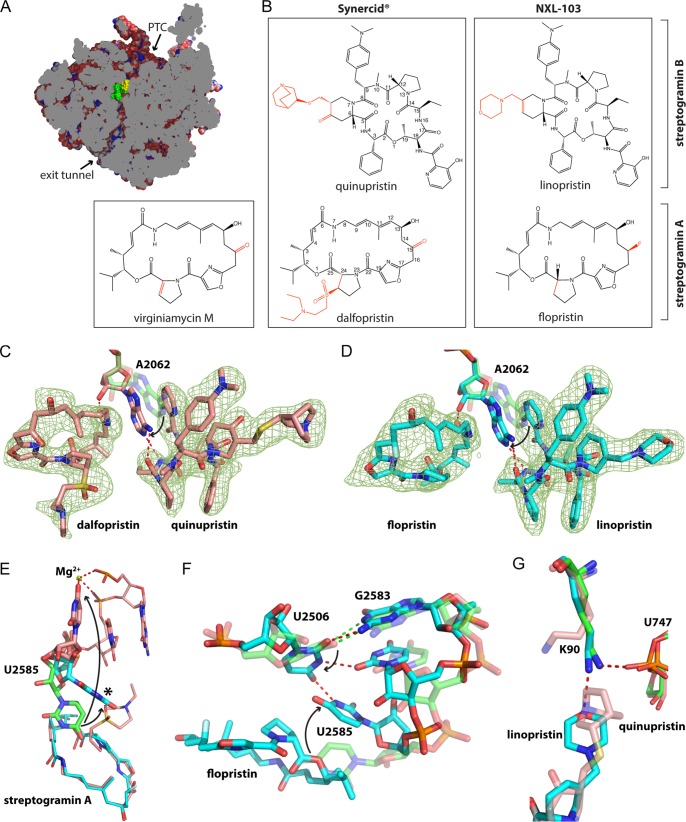
Structures of streptogramins bound to the E. coli 70S ribosome. (A) Cross-section through the bacterial 50S subunit with the peptidyl transferase center (PTC) and the exit tunnel labeled. Streptogramin A (yellow) and streptogramin B (green) are shown. (B) Chemical structure of streptogramin antibiotics, with differences indicated in red. (C and D) Unbiased Fobs − Fcalc difference density shown as mesh with chemical structure of Synercid and NXL 103, respectively. Residue A2062 in the vacant 70S ribosome is shown in transparent green. (E) U2585 assumes different positions in the vacant 70S ribosome (green) and the 70S ribosome in complex with either NXL 103 (cyan) or Synercid (salmon) and is shown by thick bonds. Adjacent nucleotides, the flopristin, and the dalfopristin component are shown by thin bonds. The asterisk indicates the position of U2585 when bound to either dalfopristin under hydrolytic conditions or NXL 103. (F) Conformational changes between the vacant ribosome (green) and the NXL 103 bound ribosome (cyan) are shown. Identical changes are observed in the structure of dalfopristin under hydrolyzing conditions. (G) Interaction of linopristin (cyan) and quinupristin (salmon) with K90 of ribosomal protein L22. (C to G) Hydrogen bonds are indicated by red dashed lines. Hydrogen bonds in the vacant ribosome in panel F are shown by green dashed lines. Arrows indicate conformational changes of rRNA nucleotides upon binding of the different streptogramin compounds.
FIG 2
FIG 2
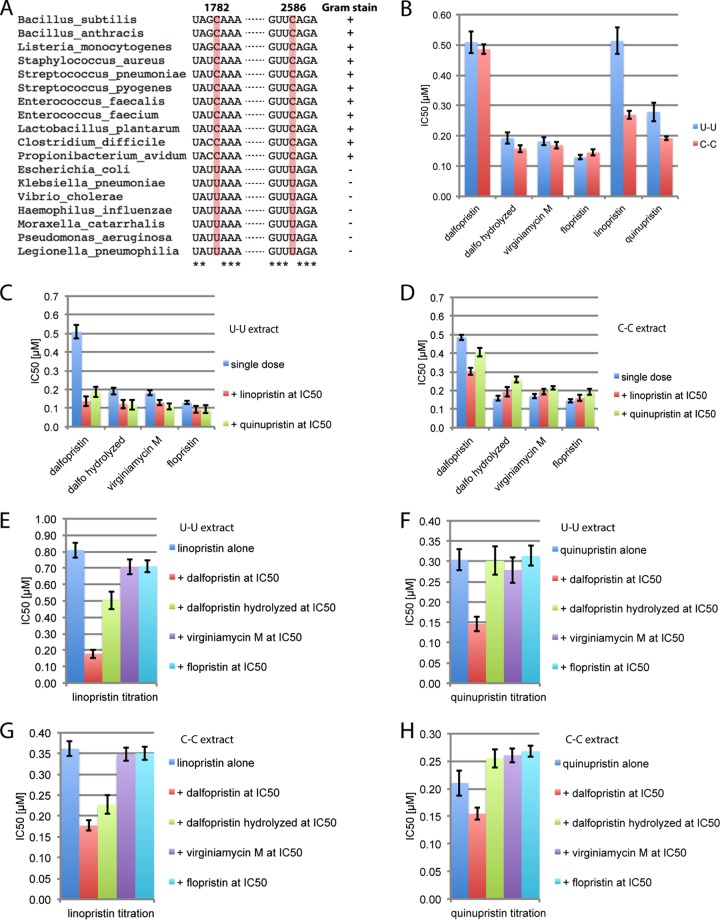
Activities of different streptogramin combinations for wild-type and mutant 70S ribosomes. (A) Sequence alignment of 23S rRNA from various Gram-positive and Gram-negative pathogens. Nucleotides 1782 and 2586 (shaded in red) form a base pair (see Fig. S5 and S6 in the supplemental material). Nucleotides that are conserved in all shown pathogens are indicated by an asterisk. (B to H) IC50 values in μM for different streptogramin antibiotics determined in transcription-coupled translation assays from E. coli bearing either its intrinsic U-U base pair (B, C, E, and F) at position 1782 to 2586 or a C-C base pair (B, D, G, and H). (C and D) Comparison of IC50 values of streptogramin A components in transcription-coupled translation assays either alone or in the presence of streptogramin B at its IC50. (E to H) Comparison of IC50 values of streptogramin B components in transcription-coupled translation assays either alone or in the presence of various streptogramin A components at their IC50 value. The standard deviation of the IC50 values, measured in triplicate, is indicated by the error bars. Dalfo, dalfopristin.

References

    1. Centers for Disease Control and Prevention. 2013. Antibiotic resistance threats in the United States. Threat report 2013. Centers for Disease Control and Prevention, Atlanta, GA: http://www.cdc.gov/drugresistance/threat-report-2013/
    1. Donadio S, Maffioli S, Monciardini P, Sosio M, Jabes D. 2010. Antibiotic discovery in the twenty-first century: current trends and future perspectives. J. Antibiot. (Tokyo) 63:423–430. 10.1038/ja.2010.62 - DOI - PubMed
    1. Wilson DN. 2014. Ribosome-targeting antibiotics and mechanisms of bacterial resistance. Nat. Rev. Microbiol. 12:35–48. 10.1038/nrmicro3155 - DOI - PubMed
    1. Yates JD, Schaible PJ. 1962. Virginiamycin as an antibiotic for poultry feeds. Nature 194:183–184. 10.1038/194183b0 - DOI - PubMed
    1. Pfizer. 2013. Synercid I.V. (quinupristin and dalfopristin for injection), Pfizer Inc., New York, NY: http://labeling.pfizer.com/ShowLabeling.aspx?id=712

Publication types

MeSH terms