


A genome-wide association study identifies a functional ERAP2 haplotype associated with birdshot chorioretinopathy
- PMID: 24957906
- PMCID: PMC4204766
- DOI: 10.1093/hmg/ddu307
A genome-wide association study identifies a functional ERAP2 haplotype associated with birdshot chorioretinopathy
Abstract
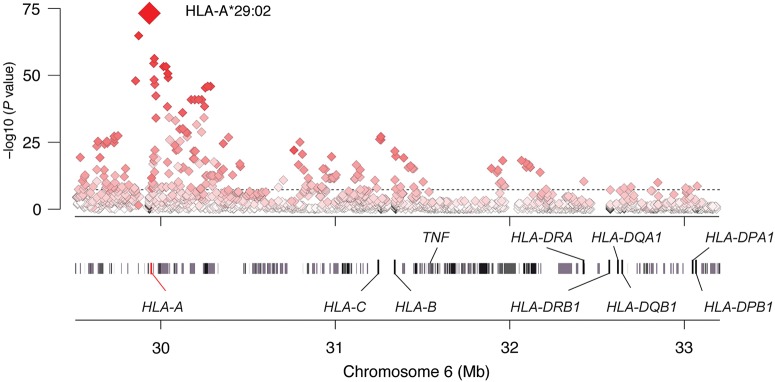
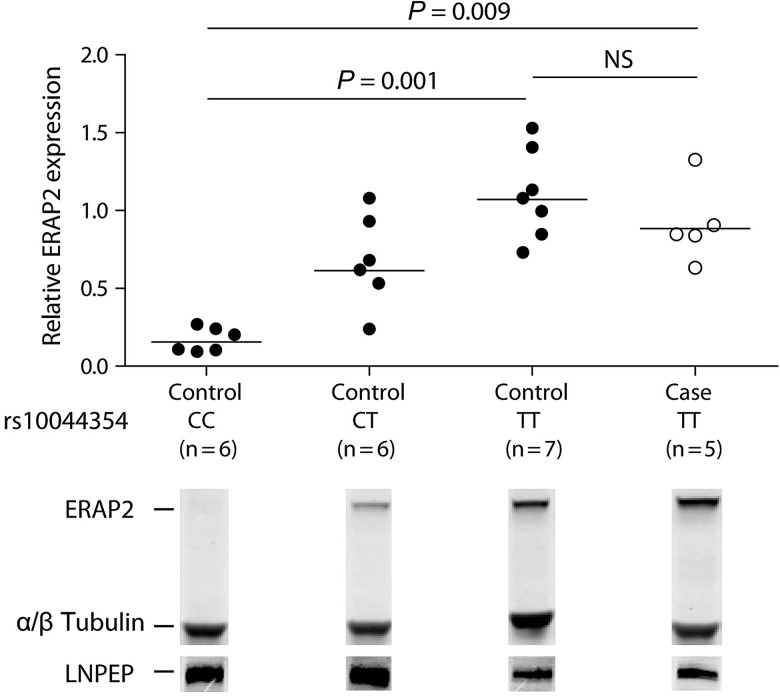
Birdshot chorioretinopathy (BSCR) is a rare form of autoimmune uveitis that can lead to severe visual impairment. Intriguingly, >95% of cases carry the HLA-A29 allele, which defines the strongest documented HLA association for a human disease. We have conducted a genome-wide association study in 96 Dutch and 27 Spanish cases, and 398 unrelated Dutch and 380 Spanish controls. Fine-mapping the primary MHC association through high-resolution imputation at classical HLA loci, identified HLA-A*29:02 as the principal MHC association (odds ratio (OR) = 157.5, 95% CI 91.6-272.6, P = 6.6 × 10(-74)). We also identified two novel susceptibility loci at 5q15 near ERAP2 (rs7705093; OR = 2.3, 95% CI 1.7-3.1, for the T allele, P = 8.6 × 10(-8)) and at 14q32.31 in the TECPR2 gene (rs150571175; OR = 6.1, 95% CI 3.2-11.7, for the A allele, P = 3.2 × 10(-8)). The association near ERAP2 was confirmed in an independent British case-control samples (combined meta-analysis P = 1.7 × 10(-9)). Functional analyses revealed that the risk allele of the polymorphism near ERAP2 is strongly associated with high mRNA and protein expression of ERAP2 in B cells. This study further defined an extremely strong MHC risk component in BSCR, and detected evidence for a novel disease mechanism that affects peptide processing in the endoplasmic reticulum.
© The Author 2014. Published by Oxford University Press. All rights reserved. For Permissions, please email: journals.permissions@oup.com.
Figures
References
-
- Nussenblatt R.B., Mittal K.K., Ryan S., Green W.R., Maumenee A.E. Birdshot retinochoroidopathy associated with HLA-A29 antigen and immune responsiveness to retinal S-antigen. Am. J. Ophthalmol. 1982;94:147–158. - PubMed
-
- Priem H.A., Kijlstra A., Noens L., Baarsma G.S., De Laey J.J., Oosterhuis J.A. HLA typing in birdshot chorioretinopathy. Am. J. Ophthalmol. 1988;105:182–185. - PubMed
-
- Shah K.H., Levinson R.D., Yu F., Goldhardt R., Gordon L.K., Gonzales C.R., Heckenlively J.R., Kappel P.J., Holland G.N. Birdshot chorioretinopathy. Surv. Ophthalmol. 2005;50:519–541. - PubMed
-
- Levinson R.D., Gonzales C.R. Birdshot retinochoroidopathy: immunopathogenesis, evaluation, and treatment. Ophthalmol. Clin. North Am. 2002;15:343–350. - PubMed
Publication types
MeSH terms
Substances
Grants and funding
LinkOut - more resources
Full Text Sources
Other Literature Sources
Research Materials
