


Relationship between weight of rescuer and quality of chest compression during cardiopulmonary resuscitation
- PMID: 24957919
- PMCID: PMC4079182
- DOI: 10.1186/1880-6805-33-16
Relationship between weight of rescuer and quality of chest compression during cardiopulmonary resuscitation
Abstract
Background: According to the guidelines for cardiopulmonary resuscitation (CPR), the rotation time for chest compression should be about 2 min. The quality of chest compressions is related to the physical fitness of the rescuer, but this was not considered when determining rotation time. The present study aimed to clarify associations between body weight and the quality of chest compression and physical fatigue during CPR performed by 18 registered nurses (10 male and 8 female) assigned to light and heavy groups according to the average weight for each sex in Japan.
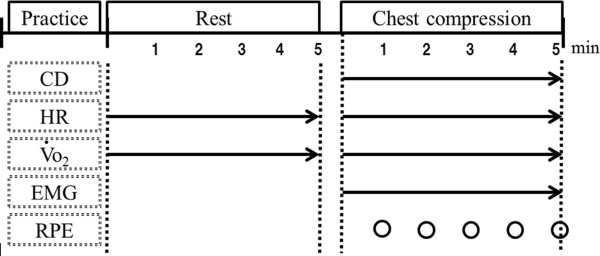
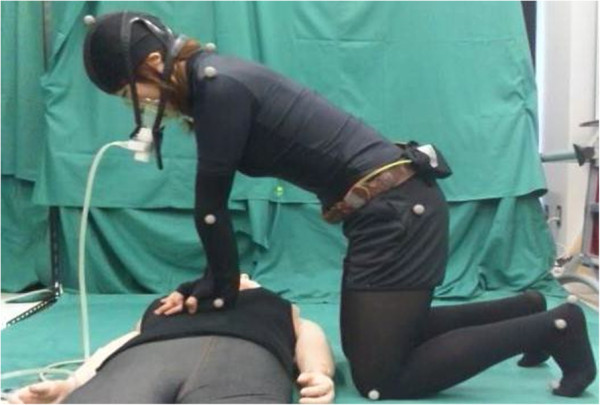
Methods: Five-minute chest compressions were then performed on a manikin that was placed on the floor. Measurement parameters were compression depth, heart rate, oxygen uptake, integrated electromyography signals, and rating of perceived exertion. Compression depth was evaluated according to the ratio (%) of adequate compressions (at least 5 cm deep).
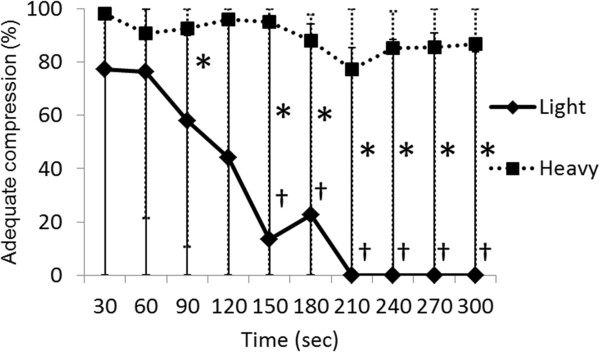
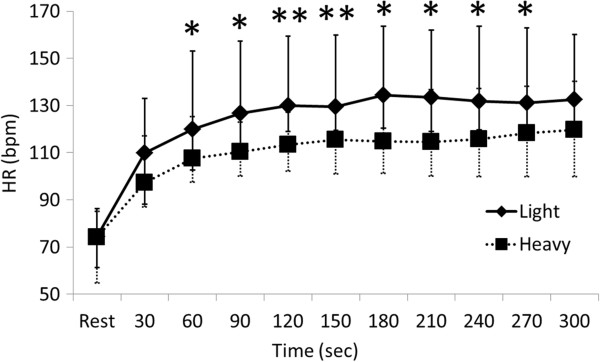
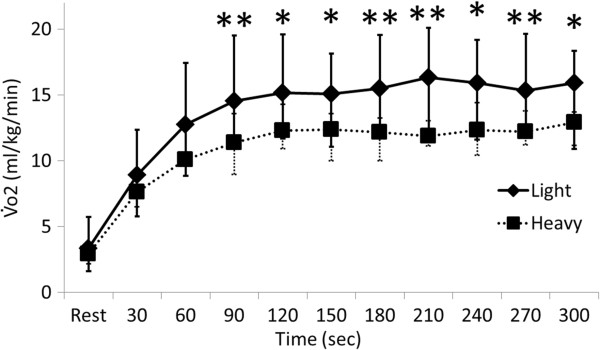
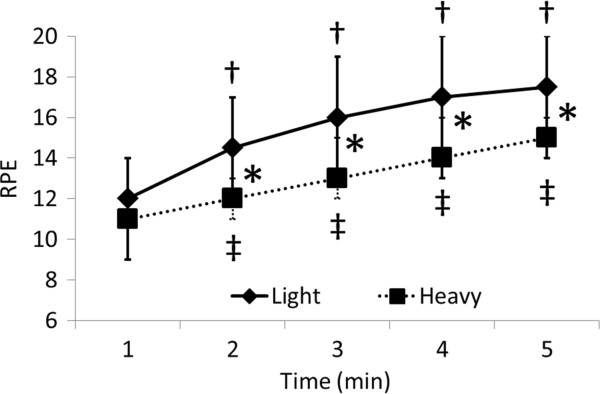
Results: The ratio of adequate compressions decreased significantly over time in the light group. Values for heart rate, oxygen uptake, muscle activity defined as integrated electromyography signals, and rating of perceived exertion were significantly higher for the light group than for the heavy group.
Conclusion: Chest compression caused increased fatigue among the light group, which consequently resulted in a gradual fall in the quality of chest compression. These results suggested that individuals with a lower body weight should rotate at 1-min intervals to maintain high quality CPR and thus improve the survival rates and neurological outcomes of victims of cardiac arrest.
Figures
References
-
- Berg RA, Hemphill R, Abella BS, Aufderheide TP, Cave DM, Hazinski MF, Lerner EB, Rea TD, Sayre MR, Swor RA. Part 5: adult basic life support: 2010 American heart association guidelines for cardiopulmonary resuscitation and emergency cardiovascular care. Circulation. 2010;122:S685S705. - PubMed
-
- Koster RW, Baubin MA, Bossaert LL, Caballero A, Cassan P, Castrén M, Granja C, Handley AJ, Monsieurs KG, Perkins GD, Raffay V, Sandroni C. European resuscitation council guidelines for resuscitation 2010 section 2. Adult basic life support and use of automated external defibrillators. Resuscitation. 2010;81:12771292. - PMC - PubMed
-
- Heidenreich JW, Bonner A, Sanders AB. Rescuer fatigue in the elderly: standard vs. hands-only CPR. J Emerg Med. 2012;42:8889. - PubMed
-
- Holmberg M, Holmberg S, Herlitz J. Effect of bystander cardiopulmonary resuscitation in out-of- hospital cardiac arrest patients in Sweden. Resuscitation. 2000;47:5970. - PubMed
-
- SOS-KANTO study group. Cardiopulmonary resuscitation by bystanders with chest compression only (SOS-KANTO): an observational study. Lancet. 2007;369:920926. - PubMed
Publication types
MeSH terms
LinkOut - more resources
Full Text Sources
Other Literature Sources
Medical
