CALGB 150905 (Alliance): rituximab broadens the antilymphoma response by activating unlicensed NK cells
- PMID: 24958280
- PMCID: PMC4264658
- DOI: 10.1158/2326-6066.CIR-13-0158
CALGB 150905 (Alliance): rituximab broadens the antilymphoma response by activating unlicensed NK cells
Abstract
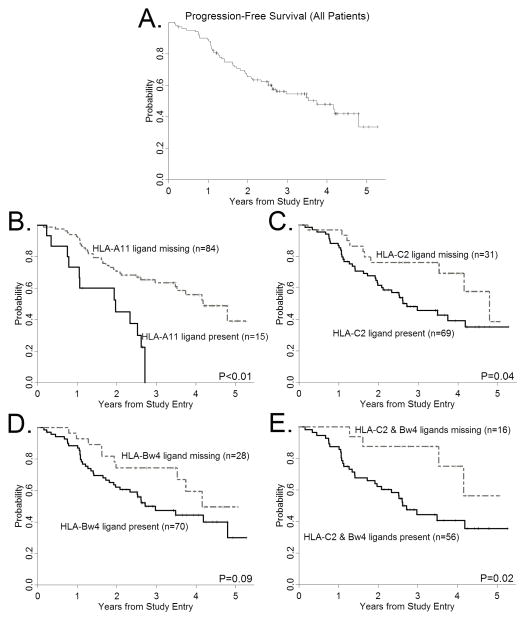
Natural killer (NK) cells contribute to clinical responses in patients treated with rituximab, but the rules determining NK-cell responsiveness to mAb therapies are poorly defined. A deeper understanding of the mechanisms responsible for antibody-dependent cellular cytotoxicity (ADCC) could yield useful biomarkers for predicting clinical responses in patients. Unlicensed NK cells, defined as NK cells lacking expression of an inhibitory KIR for self-HLA class I ligands, are hyporesponsive in steady state, but are potent effectors in inflammatory conditions. We hypothesized that antitumor antibodies such as rituximab can overcome NK-cell dependence on licensing, making unlicensed NK cells important for clinical responses. Here, we examined the influences of variations in KIR and HLA class I alleles on in vitro responses to rituximab. We tested the clinical significance in a cohort of patients with follicular lymphoma treated with rituximab-containing mAb combinations, and show that rituximab triggers responses from all NK-cell populations regardless of licensing. Neither IL2 nor accessory cells are required for activating unlicensed NK cells, but both can augment rituximab-mediated ADCC. Moreover, in 101 patients with follicular lymphoma treated with rituximab-containing mAb combinations, a "missing ligand" genotype (predictive of unlicensed NK cells) is associated with a higher rate of progression-free survival. Our data suggest that the clinical efficacy of rituximab may be driven, in part, by its ability to broaden the NK-cell repertoire to include previously hyporesponsive, unlicensed NK cells. A "missing ligand" KIR and HLA class I genotype may be predictive of this benefit and useful for personalizing treatment decisions in lymphomas and other tumors.
©2014 American Association for Cancer Research.
Conflict of interest statement
Figures
References
-
- Grillo-López AJ. Monoclonal antibody therapy for B-cell lymphoma. Int J Hematol. 2002;76:385–93. - PubMed
-
- Cartron G, Dacheux L, Salles G, Solal-Celigny P, Bardos P, Colombat P, et al. Therapeutic activity of humanized anti-CD20 monoclonal antibody and polymorphism in IgG Fc receptor Fcgamma RIIIa gene. Blood. 2002;99:754–8. - PubMed
-
- McLaughlin P, Grillo-Lopez A, Link B, Levy R, Czuczman M, Williams M, et al. Rituximab chimeric anti-CD20 monoclonal antibody therapy for relapsed indolent lymphoma: half of patients respond to a four-dose treatment program. J Clin Oncol. 1998;16:2825–33. - PubMed
-
- Clynes RA, Towers TL, Presta LG, Ravetch JV. Inhibitory Fc receptors modulate in vivo cytoxicity against tumor targets. Nat Med. 2000;6:443–6. - PubMed
Publication types
MeSH terms
Substances
Grants and funding
- U10 CA032291/CA/NCI NIH HHS/United States
- U10 CA077658/CA/NCI NIH HHS/United States
- CA77406/CA/NCI NIH HHS/United States
- AI068129/AI/NIAID NIH HHS/United States
- U10 CA114558/CA/NCI NIH HHS/United States
- CA77440/CA/NCI NIH HHS/United States
- U10 CA041287/CA/NCI NIH HHS/United States
- CA45564/CA/NCI NIH HHS/United States
- CA04326/CA/NCI NIH HHS/United States
- U10 CA180867/CA/NCI NIH HHS/United States
- U10 CA047642/CA/NCI NIH HHS/United States
- CA07968/CA/NCI NIH HHS/United States
- CA33601/CA/NCI NIH HHS/United States
- CA77597/CA/NCI NIH HHS/United States
- CA32291/CA/NCI NIH HHS/United States
- CA29165/CA/NCI NIH HHS/United States
- U10 CA045564/CA/NCI NIH HHS/United States
- CA41287/CA/NCI NIH HHS/United States
- U10 CA045808/CA/NCI NIH HHS/United States
- U10 CA007968/CA/NCI NIH HHS/United States
- CA03927/CA/NCI NIH HHS/United States
- U10 CA031946/CA/NCI NIH HHS/United States
- CA77651/CA/NCI NIH HHS/United States
- NIH AI068129/AI/NIAID NIH HHS/United States
- U10 CA033601/CA/NCI NIH HHS/United States
- U10 CA045389/CA/NCI NIH HHS/United States
- CA59518/CA/NCI NIH HHS/United States
- CA60138/CA/NCI NIH HHS/United States
- CA45389/CA/NCI NIH HHS/United States
- U10 CA077597/CA/NCI NIH HHS/United States
- U10 CA180821/CA/NCI NIH HHS/United States
- CA26806/CA/NCI NIH HHS/United States
- CA45808/CA/NCI NIH HHS/United States
- U10 CA059518/CA/NCI NIH HHS/United States
- U10 CA077440/CA/NCI NIH HHS/United States
- CA16450/CA/NCI NIH HHS/United States
- U10 CA047559/CA/NCI NIH HHS/United States
- U10 CA077651/CA/NCI NIH HHS/United States
- UG1 CA233180/CA/NCI NIH HHS/United States
- CA74811/CA/NCI NIH HHS/United States
- R01 AI068129/AI/NIAID NIH HHS/United States
- CA47559/CA/NCI NIH HHS/United States
- CA114558-02/CA/NCI NIH HHS/United States
- CA47642/CA/NCI NIH HHS/United States
- U10 CA074811/CA/NCI NIH HHS/United States
- CA77658/CA/NCI NIH HHS/United States
- CA31946/CA/NCI NIH HHS/United States
- U10 CA003927/CA/NCI NIH HHS/United States
LinkOut - more resources
Full Text Sources
Other Literature Sources
Medical
Molecular Biology Databases
Research Materials