


Predictors of poor outcomes after transcatheter aortic valve replacement: results from the PARTNER (Placement of Aortic Transcatheter Valve) trial
- PMID: 24958751
- PMCID: PMC4198056
- DOI: 10.1161/CIRCULATIONAHA.113.007477
Predictors of poor outcomes after transcatheter aortic valve replacement: results from the PARTNER (Placement of Aortic Transcatheter Valve) trial
Abstract
Background: Transcatheter aortic valve replacement (TAVR) is a less invasive option for treatment of high-risk patients with severe aortic stenosis. We sought to identify patients at high risk for poor outcome after TAVR using a novel definition of outcome that integrates quality of life with mortality.
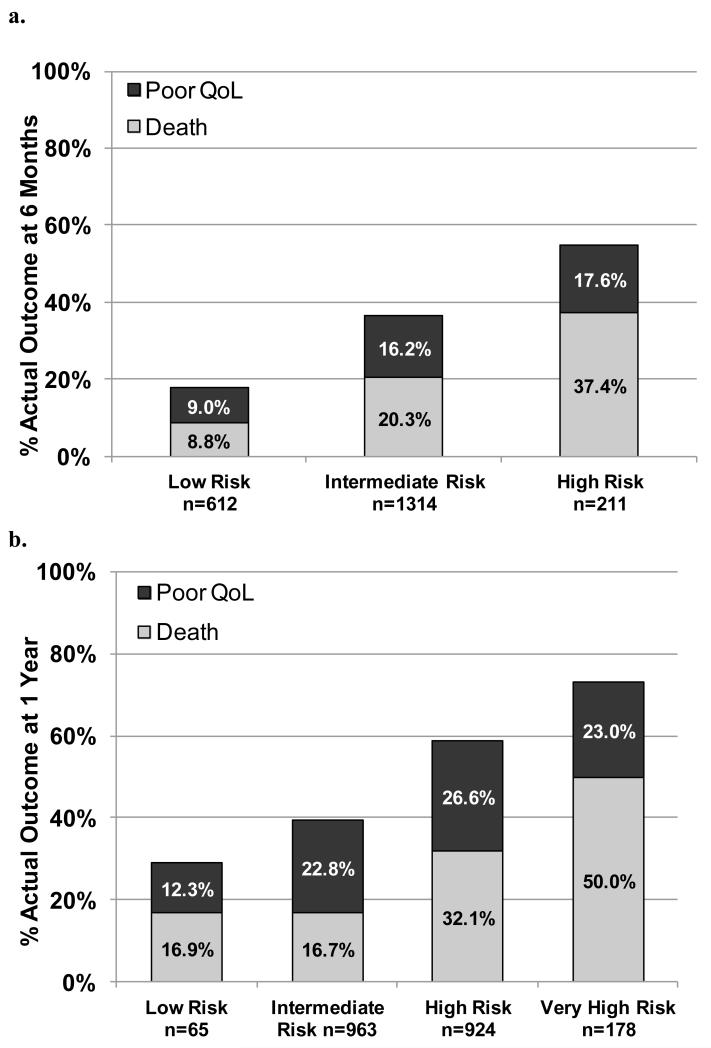
Methods and results: Among 2137 patients who underwent TAVR in the PARTNER (Placement of Aortic Transcatheter Valve) trial or its associated continued access registry, quality of life was assessed with the Kansas City Cardiomyopathy Questionnaire-Overall Summary Scale (KCCQ-OS; range 0-100, where a higher score equates to a better quality of life) at baseline and at 1, 6, and 12 months after TAVR. A poor 6-month outcome (defined as death, KCCQ-OS score <45, or ≥10-point decrease in KCCQ-OS score compared with baseline) occurred in 704 patients (33%). Using a split-sample design, we developed a multivariable model to identify a parsimonious set of covariates to identify patients at high risk for poor outcome. The model demonstrated moderate discrimination (c-index=0.66) and good calibration with the observed data, performed similarly in the separate validation cohort (c-index=0.64), and identified 211 patients (10% of the population) with a ≥50% likelihood of a poor outcome after TAVR. A second model that explored predictors of poor outcome at 1 year identified 1102 patients (52%) with ≥50% likelihood and 178 (8%) with ≥70% likelihood of a poor 1-year outcome after TAVR.
Conclusions: Using a large, multicenter cohort, we have developed and validated predictive models that can identify patients at high risk for a poor outcome after TAVR. Although model discrimination was moderate, these models may help guide treatment choices and offer patients realistic expectations of outcomes based on their presenting characteristics.
Clinical trial registration url: http://www.clinicaltrials.gov. Unique identifier: NCT00530894.
Keywords: aortic valve stenosis; heart valves; outcomes assessment; quality of life.
© 2014 American Heart Association, Inc.
Figures


Comment in
-
Can we predict who will be alive and well after transcatheter aortic valve replacement? Is that useful to individual patients?Circulation. 2014 Jun 24;129(25):2636-7. doi: 10.1161/CIRCULATIONAHA.114.010516. Epub 2014 May 23. Circulation. 2014. PMID: 24958750 Free PMC article. No abstract available.
References
-
- Leon MB, Smith CR, Mack M, Miller DC, Moses JW, Svensson LG, Tuzcu EM, Webb JG, Fontana GP, Makkar RR, Brown DL, Block PC, Guyton RA, Pichard AD, Bavaria JE, Herrmann HC, Douglas PS, Petersen JL, Akin JJ, Anderson WN, Wang D, Pocock S. Transcatheter aortic-valve implantation for aortic stenosis in patients who cannot undergo surgery. N Engl J Med. 2010;363:1597–1607. - PubMed
-
- Reynolds MR, Magnuson EA, Lei Y, Leon MB, Smith CR, Svensson LG, Webb JG, Babaliaros VC, Bowers BS, Fearon WF, Herrmann HC, Kapadia S, Kodali SK, Makkar RR, Pichard AD, Cohen DJ. Health-related quality of life after transcatheter aortic valve replacement in inoperable patients with severe aortic stenosis. Circulation. 2011;124:1964–1972. - PubMed
-
- Smith CR, Leon MB, Mack MJ, Miller DC, Moses JW, Svensson LG, Tuzcu EM, Webb JG, Fontana GP, Makkar RR, Williams M, Dewey T, Kapadia S, Babaliaros V, Thourani VH, Corso P, Pichard AD, Bavaria JE, Herrmann HC, Akin JJ, Anderson WN, Wang D, Pocock SJ. Transcatheter versus surgical aortic-valve replacement in high-risk patients. N Engl J Med. 2011;364:2187–2198. - PubMed
-
- Reynolds MR, Magnuson EA, Wang K, Thourani VH, Williams M, Zajarias A, Rihal CS, Brown DL, Smith CR, Leon MB, Cohen DJ. Health-related quality of life after transcatheter or surgical aortic valve replacement in high-risk patients with severe aortic stenosis: Results from the partner (placement of aortic transcatheter valve) trial (cohort a) J Am Coll Cardiol. 2012;60:548–558. - PubMed
-
- Vahanian A, Alfieri O, Al-Attar N, Antunes M, Bax J, Cormier B, Cribier A, De Jaegere P, Fournial G, Kappetein AP, Kovac J, Ludgate S, Maisano F, Moat N, Mohr F, Nataf P, Pierard L, Pomar JL, Schofer J, Tornos P, Tuzcu M, van Hout B, Von Segesser LK, Walther T. Transcatheter valve implantation for patients with aortic stenosis: A position statement from the european association of cardio-thoracic surgery (eacts) and the european society of cardiology (esc), in collaboration with the european association of percutaneous cardiovascular interventions (eapci) Eur Heart J. 2008;29:1463–1470. - PubMed
Publication types
MeSH terms
Associated data
Grants and funding
LinkOut - more resources
Full Text Sources
Other Literature Sources
Medical
