Review
. 2014 Aug 5;369(1648):20130344.
doi: 10.1098/rstb.2013.0344.

The demography and population genomics of evolutionary transitions to self-fertilization in plants

Affiliations
Review

The demography and population genomics of evolutionary transitions to self-fertilization in plants

Spencer C H Barrett et al. Philos Trans R Soc Lond B Biol Sci. .

Abstract

The evolution of self-fertilization from outcrossing has occurred on numerous occasions in flowering plants. This shift in mating system profoundly influences the morphology, ecology, genetics and evolution of selfing lineages. As a result, there has been sustained interest in understanding the mechanisms driving the evolution of selfing and its environmental context. Recently, patterns of molecular variation have been used to make inferences about the selective mechanisms associated with mating system transitions. However, these inferences can be complicated by the action of linked selection following the transition. Here, using multilocus simulations and comparative molecular data from related selfers and outcrossers, we demonstrate that there is little evidence for strong bottlenecks associated with initial transitions to selfing, and our simulation results cast doubt on whether it is possible to infer the role of bottlenecks associated with reproductive assurance in the evolution of selfing. They indicate that the effects of background selection on the loss of diversity and efficacy of selection occur rapidly following the shift to high selfing. Future comparative studies that integrate explicit ecological and genomic details are necessary for quantifying the independent and joint effects of selection and demography on transitions to selfing and the loss of genetic diversity.

Keywords: background selection; demography; genetic bottlenecks; plant mating; reproductive assurance; self-fertilization.


Figures

Figure 1.
Figure 1.
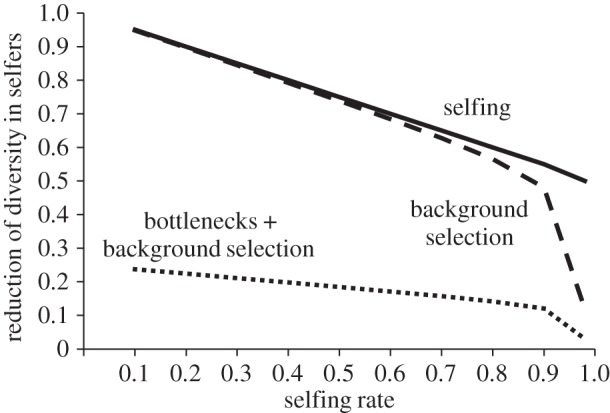
Expected reduction in genetic diversity in selfing compared to outcrossing populations with selfing (solid line), selfing and background selection (long dashed line) and with selfing, background selection and population bottlenecks (short dashed line). The expected reduction in diversity due to selfing alone was 1/(1 + F), where F is the inbreeding coefficient. The expected reduction in diversity due to background selection was modelled after Glémin & Ronfort [41], with selection and mutation parameters taken from estimates in the Brassicaceae, as described in the electronic supplementary material. The effect of a bottleneck was assumed to be a reduction in diversity to 25% of the original value, regardless of selfing rate.
Figure 2.
Figure 2.
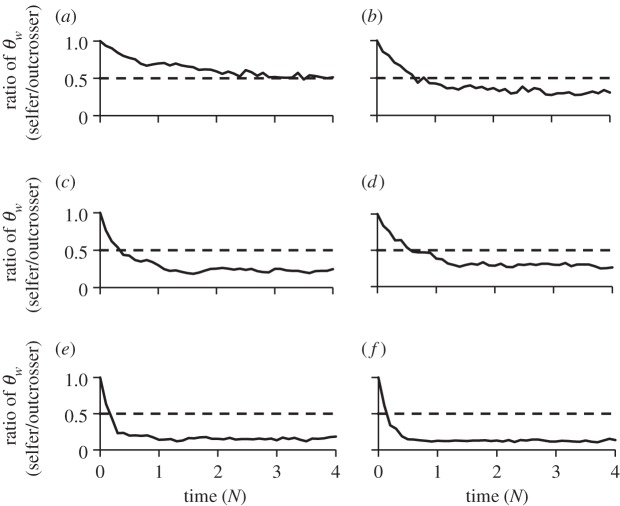
The reduction in synonymous diversity (θw) as a function of time since the transition to selfing, in units of N generations, where N is the effective population size of the ancestral outcrossing populations. We performed forward population genetic simulations using 300 individuals with 100 Mb genomes comprising alternating non-coding (NC) and coding (C) regions of various sizes. All NC sites were neutral, whereas for C sites 25% were neutral and 75% were deleterious under variable selection pressures as measured by s, the mean selection coefficient acting on deleterious mutations. Details of simulations are in the electronic supplementary material. Shown are plots for: (a) s = 0, C = 200 bp, NC = 800 bp; (b) s = −0.1, C = 200 bp, NC = 800 bp; (c) s = −0.05, C = 200 bp, NC = 800 bp; (d) s = −0.005, C = 200 bp, NC = 800 bp; (e) s = −0.05, C = 350 bp, NC = 650 bp; and (f) s = −0.05, C = 500 bp, NC = 500 bp. The ratio of the means across five runs for each interval (solid line) and the expected twofold reduction due to selfing alone (dashed line) are plotted. The plots are ordered by parameters that led to increasingly stronger background selection. Without background selection, the loss of diversity occurred within approximately 2N (a). As s was decreased, the loss of diversity occurred within 1 – 2N generations (bd). Reduction in the size of NC, even under moderate s, led to the strongest effect of background selection where the loss of diversity occurred within 0.5N (e,f).
Figure 3.
Figure 3.
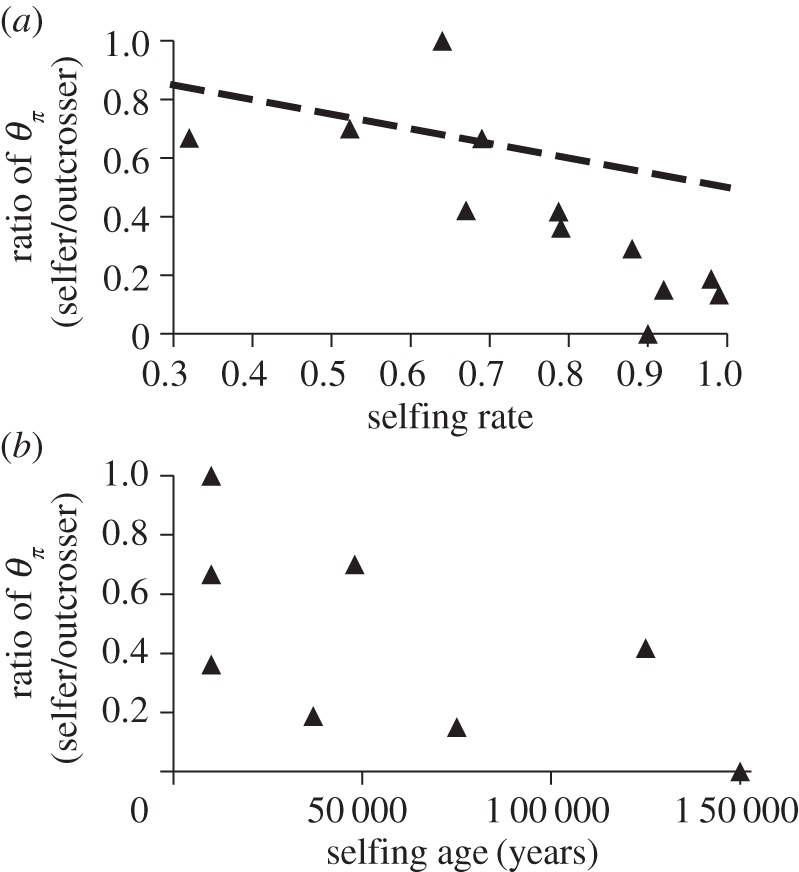
Ratio of synonymous diversity (θπ) for related selfing and outcrossing populations and species in relation to: (a) the rate of selfing in populations with the higher degree of self-fertilization and (b) the estimated age (in years) of the transition to higher rates of selfing. In (a), the expected reduction in diversity due to selfing alone was 1/(1 + F), where F is the inbreeding coefficient (dashed line).
Figure 4.
Figure 4.
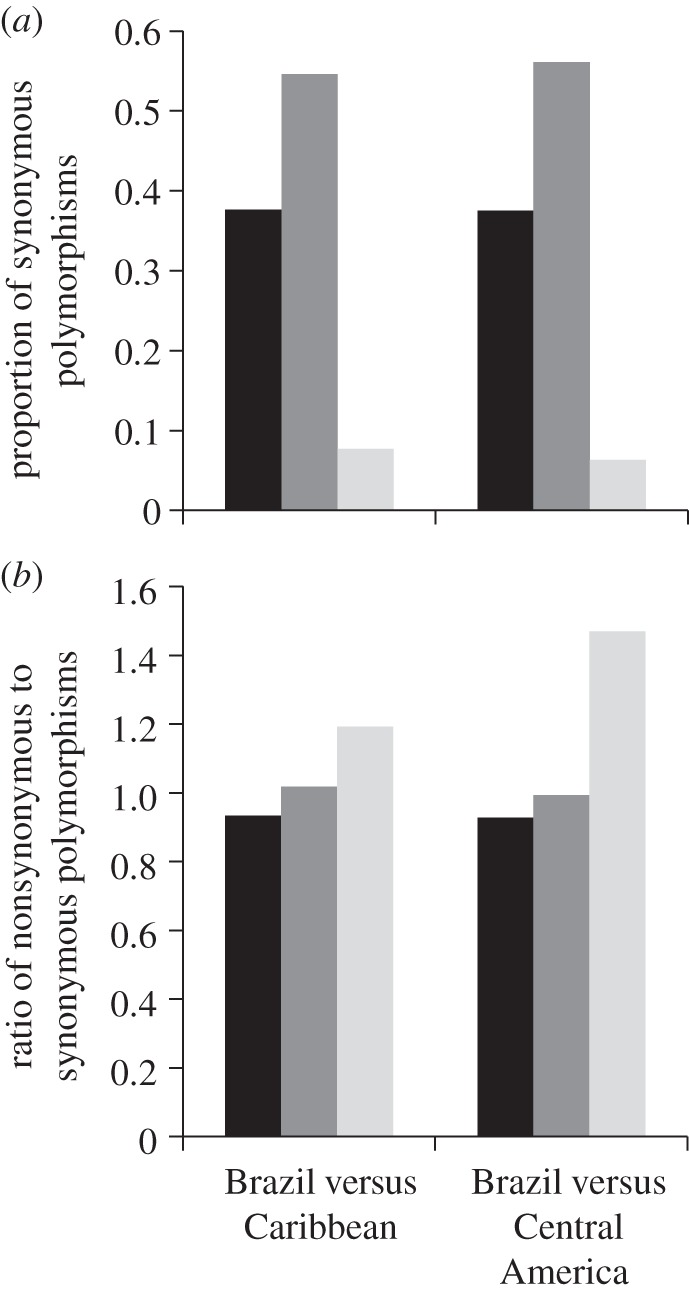
Shared (black) and unique sequence polymorphisms between outcrossing (dark grey) and selfing (light grey) populations of E. paniculata sampled from different parts of the geographical range: (a) proportion of synonymous polymorphisms and (b) ratio of nonsynonymous relative to synonymous polymorphisms. Shown are pairwise comparisons between a single diploid chromosome from an outcrossing individual and haploid chromosomes from two selfing individuals. Two selfers were used as the high homozygosity of selfing genomes reduces the effective number of chromosomes sampled from selfing individuals to approximately half of that of outcrossing individuals. Details of sampling and methods to estimate the proportion of polymorphisms are provided in the electronic supplementary material.

References

    1. Barrett SCH, Harder LD, Worley AC. 1996. Comparative biology of pollination and mating. Phil. Trans. R. Soc. Lond. B 351, 1271–1280. ( 10.1098/rstb.1996.0110) - DOI
    1. Stebbins GL. 1974. Flowering plants: evolution above the species level. Cambridge, MA: Harvard University Press.
    1. Jain SK. 1976. The evolution of inbreeding in plants. Annu. Rev. Ecol. Syst. 7, 469–495. ( 10.1146/annurev.es.07.110176.002345) - DOI
    1. Lloyd DG. 1980. Demographic factors and mating patterns in angiosperms. In Demography and evolution in plant populations (ed. Solbrig OT.), pp. 67–88. Oxford, UK: Blackwell.
    1. Igic B, Busch JW. 2013. Is self-fertilization an evolutionary dead end? New Phytol. 198, 386–397. ( 10.1111/nph.12182) - DOI - PubMed

Publication types