


Associations of NINJ2 sequence variants with incident ischemic stroke in the Cohorts for Heart and Aging in Genomic Epidemiology (CHARGE) consortium
- PMID: 24959832
- PMCID: PMC4069013
- DOI: 10.1371/journal.pone.0099798
Associations of NINJ2 sequence variants with incident ischemic stroke in the Cohorts for Heart and Aging in Genomic Epidemiology (CHARGE) consortium
Abstract
Background: Stroke, the leading neurologic cause of death and disability, has a substantial genetic component. We previously conducted a genome-wide association study (GWAS) in four prospective studies from the Cohorts for Heart and Aging Research in Genomic Epidemiology (CHARGE) consortium and demonstrated that sequence variants near the NINJ2 gene are associated with incident ischemic stroke. Here, we sought to fine-map functional variants in the region and evaluate the contribution of rare variants to ischemic stroke risk.
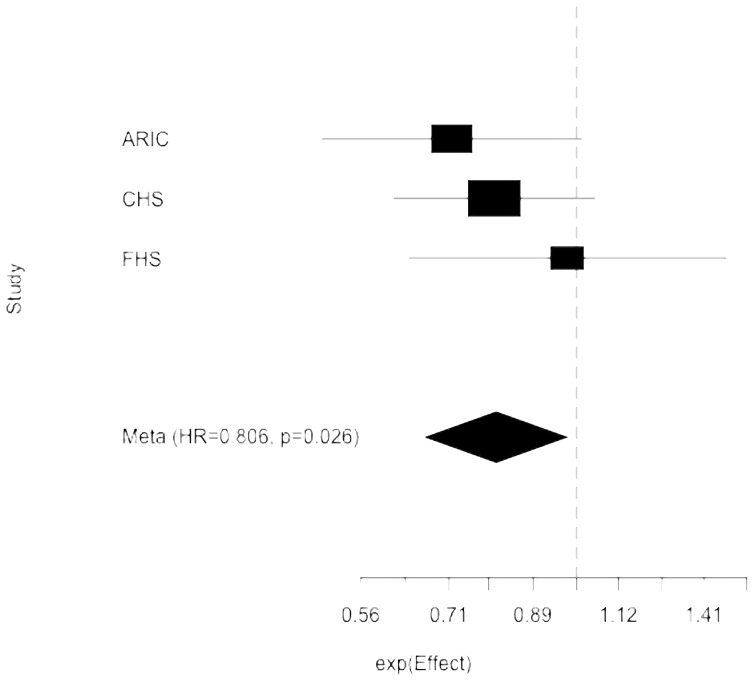
Methods and results: We sequenced 196 kb around NINJ2 on chromosome 12p13 among 3,986 European ancestry participants, including 475 ischemic stroke cases, from the Atherosclerosis Risk in Communities Study, Cardiovascular Health Study, and Framingham Heart Study. Meta-analyses of single-variant tests for 425 common variants (minor allele frequency [MAF] ≥ 1%) confirmed the original GWAS results and identified an independent intronic variant, rs34166160 (MAF = 0.012), most significantly associated with incident ischemic stroke (HR = 1.80, p = 0.0003). Aggregating 278 putatively-functional variants with MAF≤ 1% using count statistics, we observed a nominally statistically significant association, with the burden of rare NINJ2 variants contributing to decreased ischemic stroke incidence (HR = 0.81; p = 0.026).
Conclusion: Common and rare variants in the NINJ2 region were nominally associated with incident ischemic stroke among a subset of CHARGE participants. Allelic heterogeneity at this locus, caused by multiple rare, low frequency, and common variants with disparate effects on risk, may explain the difficulties in replicating the original GWAS results. Additional studies that take into account the complex allelic architecture at this locus are needed to confirm these findings.
Conflict of interest statement
Figures

References
-
- Bak S, Gaist D, Sindrup SH, Skytthe A, Christensen K (2002) Genetic liability in stroke: a long-term follow-up study of Danish twins. Stroke 33: 769–774. - PubMed
-
- Jousilahti P, Rastenyte D, Tuomilehto J, Sarti C, Vartiainen E (1997) Parental history of cardiovascular disease and risk of stroke. A prospective follow-up of 14371 middle-aged men and women in Finland. Stroke 28: 1361–1366. - PubMed
-
- Liao D, Myers R, Hunt S, Shahar E, Paton C, et al. (1997) Familial history of stroke and stroke risk. The Family Heart Study. Stroke 28: 1908–1912. - PubMed
Publication types
MeSH terms
Substances
Grants and funding
- HHSN268201100010C/HL/NHLBI NIH HHS/United States
- HHSN268201100011C/HL/NHLBI NIH HHS/United States
- R01 HL087652/HL/NHLBI NIH HHS/United States
- HL120393/HL/NHLBI NIH HHS/United States
- R01 HL105756/HL/NHLBI NIH HHS/United States
- HHSN268201100006C/HL/NHLBI NIH HHS/United States
- N01 HC085079/HL/NHLBI NIH HHS/United States
- R01 HL080295/HL/NHLBI NIH HHS/United States
- R01 AG020098/AG/NIA NIH HHS/United States
- HL080295/HL/NHLBI NIH HHS/United States
- N01 HC085081/HL/NHLBI NIH HHS/United States
- HHSN268201100012C/HL/NHLBI NIH HHS/United States
- N02-HL-6-4278/HL/NHLBI NIH HHS/United States
- N01-HC-25195/HC/NHLBI NIH HHS/United States
- RC2 HL102419/HL/NHLBI NIH HHS/United States
- R01 HL103612/HL/NHLBI NIH HHS/United States
- HHSN268201100009I/HL/NHLBI NIH HHS/United States
- N01 HC085080/HL/NHLBI NIH HHS/United States
- AG027058/AG/NIA NIH HHS/United States
- R01 NS017950/NS/NINDS NIH HHS/United States
- AG15928/AG/NIA NIH HHS/United States
- 5RC2HL102419/HL/NHLBI NIH HHS/United States
- R01 HL120393/HL/NHLBI NIH HHS/United States
- R01 AG015928/AG/NIA NIH HHS/United States
- HHSN268201100008C/HL/NHLBI NIH HHS/United States
- U01 HL080295/HL/NHLBI NIH HHS/United States
- HHSN268201100008I/HL/NHLBI NIH HHS/United States
- HHSN268201100005G/HL/NHLBI NIH HHS/United States
- N01 HC085082/HL/NHLBI NIH HHS/United States
- HHSN268201100007C/HL/NHLBI NIH HHS/United States
- HL105756/HL/NHLBI NIH HHS/United States
- HHSN268200800007C/HL/NHLBI NIH HHS/United States
- N01 HC085086/HL/NHLBI NIH HHS/United States
- N01 HC085083/HL/NHLBI NIH HHS/United States
- U01 HL120393/HL/NHLBI NIH HHS/United States
- R56 AG020098/AG/NIA NIH HHS/United States
- HHSN268201100011I/HL/NHLBI NIH HHS/United States
- HL087652/HL/NHLBI NIH HHS/United States
- U54 HG003273/HG/NHGRI NIH HHS/United States
- HHSN268201200036C/HL/NHLBI NIH HHS/United States
- N01 HC025195/HL/NHLBI NIH HHS/United States
- N01 HC055222/HL/NHLBI NIH HHS/United States
- HHSN268201100005I/HL/NHLBI NIH HHS/United States
- HHSN268201100009C/HL/NHLBI NIH HHS/United States
- HHSN268201100005C/HL/NHLBI NIH HHS/United States
- HHSN268201100007I/HL/NHLBI NIH HHS/United States
- P30 AG010129/AG/NIA NIH HHS/United States
- AG20098/AG/NIA NIH HHS/United States
- R01 AG023629/AG/NIA NIH HHS/United States
- HL103612/HL/NHLBI NIH HHS/United States
- R01 AG027058/AG/NIA NIH HHS/United States
- AG023629/AG/NIA NIH HHS/United States
- R56 AG023629/AG/NIA NIH HHS/United States
LinkOut - more resources
Full Text Sources
Other Literature Sources
Medical
