


Factors associated with short-term changes in HIV viral load and CD4(+) cell count in antiretroviral-naive individuals
- PMID: 24959963
- PMCID: PMC4032217
- DOI: 10.1097/QAD.0000000000000224
Factors associated with short-term changes in HIV viral load and CD4(+) cell count in antiretroviral-naive individuals
Abstract
Objectives: Among antiretroviral therapy (ART)-naive individuals, viral load levels tend to increase and CD4(+) cell counts decline over time. We sought to explore the rate of change and influence of other factors associated with these markers of HIV progression.
Design: An observational cohort collaboration study.
Methods: A total of 158 385 pairs of consecutive viral load and CD4(+) cell count simultaneously measured from 34 384 ART-naive individuals in the COHERE database were analysed. Annual changes and factors associated with these changes were estimated using generalized estimating equations.
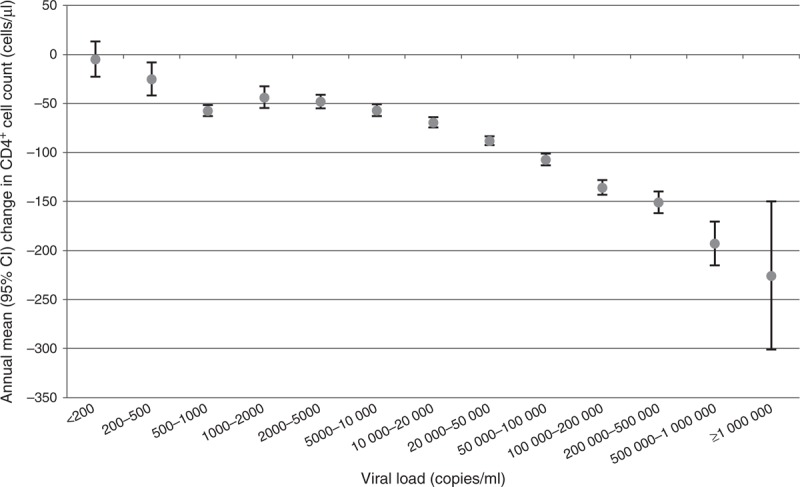
Results: Viral load continued to rise at a mean [95% confidence interval (CI)] rate of 0.091 (0.086-0.096) log10 copies/ml per year. A faster rise in viral load was significantly associated with older age, such that for every 10 years older, it was a mean 0.022 log10 copies/ml per year greater. The mean (95% CI) CD4(+) cell count change was -78.0 (-80.1 to -76.0) cell/μl per year and it was strongly associated with a higher current viral load: for every 1 log10 copies/ml higher, CD4(+) cell count declined by an additional 37.6 cells/μl per year (P < 0.001). Current viral load was a stronger predictor of CD4(+) cell count depletion than baseline viral load. Neither sex, race nor transmission by injecting drug use was associated with change in either the viral load or CD4(+) cell count.
Discussion: We found that in ART-naive individuals, viral load continues to increase over time and more sharply in those who are older. Our results also suggest that higher current viral load is strongly associated with ongoing rate of CD4(+) cell count depletion.
Figures
References
-
- Sabin CA, Devereux H, Phillips AN, Hill A, Janossy G, Lee CA, et al. Course of viral load throughout HIV-1 infection. J Acquir Immune Defic Syndr 2000; 23:172–177 - PubMed
-
- Mellors JW, Munoz A, Giorgi JV, Margolick JB, Tassoni CJ, Gupta P, et al. Plasma viral load and CD4+ lymphocytes as prognostic markers of HIV-1 infection. Ann Intern Med 1997; 126:946–954 - PubMed
-
- Lyles RH, Munoz A, Yamashita TE, Bazmi H, Detels R, Rinaldo CR, et al. Natural history of human immunodeficiency virus type 1 viremia after seroconversion and proximal to AIDS in a large cohort of homosexual men. J Infect Dis 2000; 181:872–880 - PubMed
-
- Phillips AN, Lee CA, Elford J, Janossy G, Timms A, Bofill M, et al. Serial lymphocyte CD4 counts and development of AIDS. Lancet 1991; 337:389–392 - PubMed
-
- CASCADE Collaboration Short-term risk of AIDS according to current CD4 cell count and viral load in antiretroviral drug-naive individuals and those treated in the monotherapy era. AIDS 2004; 18:51–58 - PubMed
Publication types
MeSH terms
Grants and funding
LinkOut - more resources
Full Text Sources
Other Literature Sources
Medical
Research Materials
