


Prevalence and virologic consequences of transmitted HIV-1 drug resistance in Uganda
- PMID: 24960249
- PMCID: PMC4151058
- DOI: 10.1089/AID.2014.0043
Prevalence and virologic consequences of transmitted HIV-1 drug resistance in Uganda
Abstract
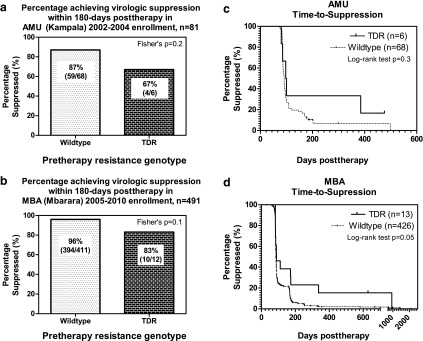
Few reports have examined the impact of HIV-1 transmitted drug resistance (TDR) in resource-limited settings where there are fewer regimen choices and limited pretherapy/posttherapy resistance testing. In this study, we examined TDR prevalence in Kampala and Mbarara, Uganda and assessed its virologic consequences after antiretroviral therapy initiation. We sequenced the HIV-1 protease/reverse transcriptase from n=81 and n=491 treatment-naive participants of the Uganda AIDS Rural Treatment Outcomes (UARTO) pilot study in Kampala (AMU 2002-2004) and main cohort in Mbarara (MBA 2005-2010). TDR-associated mutations were defined by the WHO 2009 surveillance mutation list. Posttreatment viral load data were available for both populations. Overall TDR prevalence was 7% (Kampala) and 3% (Mbarara) with no significant time trend. There was a slight but statistically nonsignificant trend indicating that the presence of TDR was associated with a worse treatment outcome. Virologic suppression (≤400 copies/ml within 6 months posttherapy initiation) was achieved in 87% and 96% of participants with wildtype viruses versus 67% and 83% of participants with TDR (AMU, MBA p=0.2 and 0.1); time to suppression (log-rank p=0.3 and p=0.05). Overall, 85% and 96% of study participants achieved suppression regardless of TDR status. Surprisingly, among the TDR cases, approximately half still achieved suppression; the presence of pretherapy K103N while on nevirapine and fewer active drugs in the first regimen were most often observed with failures. The majority of patients benefited from the local HIV care system even without resistance monitoring. Overall, TDR prevalence was relatively low and its presence did not always imply treatment failure.
Figures
References
-
- Kuritzkes DR, Lalama CM, Ribaudo HJ, Marcial M, Meyer W, Shikuma C, et al. : Preexisting resistance to nonnucleoside reverse-transcriptase inhibitors predicts virologic failure of an efavirenz-based regimen in treatment-naive HIV-1-infected subjects. J Infect Dis 2008;197:867–870 - PubMed
-
- Wittkop L, Günthard HF, de Wolf F, Dunn D, Cozzi-Lepri A, de Luca A, et al. : Effect of transmitted drug resistance on virological and immunological response to initial combination antiretroviral therapy for HIV (EuroCoord-CHAIN joint project): A European multicohort study. Lancet Infect Dis 2011;11:363–371 - PubMed
-
- Little SJ, Holte S, Routy J-P, Daar ES, Markowitz M, Collier AC, et al. : Antiretroviral-drug resistance among patients recently infected with HIV. N Engl J Med 2002;347:385–394 - PubMed
-
- Grant RM, Hecht FM, Warmerdam M, Liu L, Liegler T, Petropoulos CJ, et al. : Time trends in primary HIV-1 drug resistance among recently infected persons. JAMA 2002;288:181–188 - PubMed
-
- Asboe D, Aitken C, Boffito M, Booth C, Cane P, Fakoya A, et al. : British HIV Association guidelines for the routine investigation and monitoring of adult HIV-1-infected individuals 2011. HIV Med 2012;13:1–44 - PubMed
Publication types
MeSH terms
Grants and funding
LinkOut - more resources
Full Text Sources
Other Literature Sources
Medical
Molecular Biology Databases
