. 2012 Dec 14;2(4):745-68.
doi: 10.3390/brainsci2040745.

Wnt Signaling in Neurogenesis during Aging and Physical Activity

Affiliations

Wnt Signaling in Neurogenesis during Aging and Physical Activity

Michael Chen et al. Brain Sci. .

Abstract

Over the past decade, much progress has been made regarding our understanding of neurogenesis in both young and old animals and where it occurs throughout the lifespan, although the growth of new neurons declines with increasing age. In addition, physical activity can reverse this age-dependent decline in neurogenesis. Highly correlated with this decline is the degree of inter and intracellular Wnt signaling, the molecular mechanisms of which have only recently started to be elucidated. So far, most of what we know about intracellular signaling during/following exercise centers around the CREB/CRE initiated transcriptional events. Relatively little is known, however, about how aging and physical activity affect the Wnt signaling pathway. Herein, we briefly review the salient features of neurogenesis in young and then in old adult animals. Then, we discuss Wnt signaling and review the very few in vitro and in vivo studies that have examined the Wnt signaling pathways in aging and physical activity.


Figures
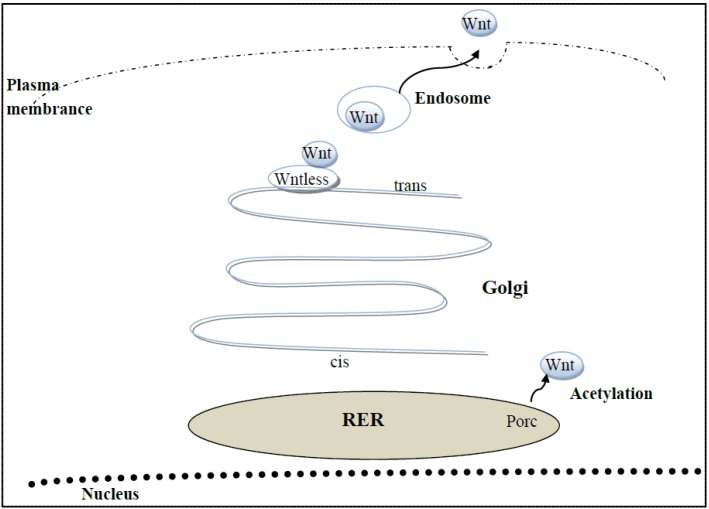
Figure 1
Figure 1
Wnts are secreted by astrocytes, neural stem cells or neural progenitor cells. Wnts are transcribed and translated and then acetylated by the acetyltransferase, Porcupine (Porc), in the endoplasmic reticulum. On the trans face of the Golgi, is a multimeric protein, called wntless, which aids in the transfer of Wnts to endosomes. Upon fusion of the two membranes, Wnt is secreted to the exterior of the cell.
Figure 2
Figure 2
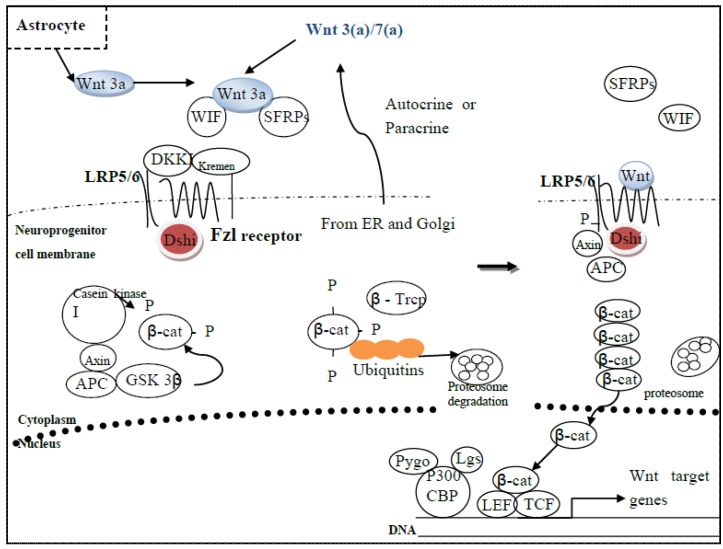
(Left) Wnt signaling is turned off when the ligand, although secreted by nearby astrocytes or neuroprogenitor cells, is bound by various Wnt inhibitors, such as Wnt inhibitory factor (WIF) and secreted fzl-related proteins (SFRPs). The fzl receptor remains bound by disheveled (dsh1) and LRP5/6 is bound by Dickopf (DKK1)-kremen complex, which helps anchor the complex into the membrane. With adenomatous polyposis (APC) and axin bound to casein kinase 1 and GSK-3β, these two kinases can now phosphorylate β-catenin, which is then sequestered by ubiquitins with the help of β-Trcp. β-Catenin is then degraded in the proteosome. (Right) Wnt signaling is turned on when Wnt binds fzl and the LRP5/6 co-receptor, promoting axin to dissociate from APC and dsh1 to phosphorylate LRP5/6. Meanwhile, casein kinase 1 phosphorylates GSK-3β, thereby inactivating it. β-Catenin then accumulates in the cytoplasm, enters the nucleus, where it binds to TCF/LEF and co-activators, such as pygopus (Pygo), legless (lgs), and P300/CBP, leading to the transcription of Wnt target genes.
Figure 3
Figure 3
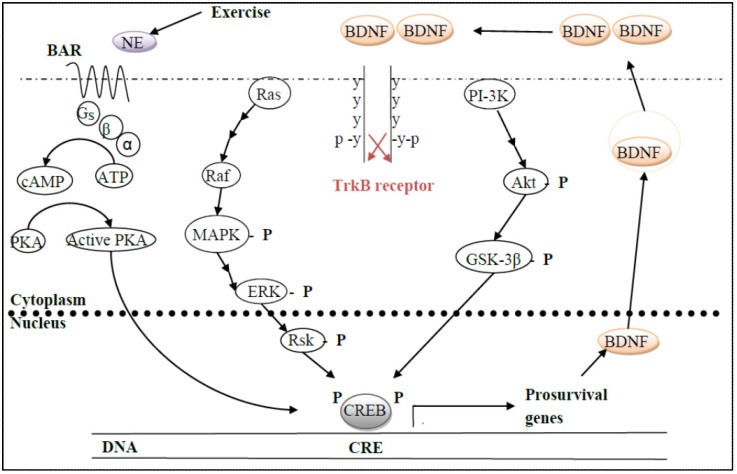
Exercise releases norepinephrine (NE), which binds its GPCR, β-adrenergic receptor (βAR), and then activates cAMP-dependent protein kinase A (PKA), which is only one of many kinases capable of phosphorylating the transcription factor, cAMP-response element binding protein (CREB). Activated CREB is then able to transcribe a wide array of pro-survival genes, one of which is BDNF. The neurotrophin is then packaged into vesicles and released to the extracellular space, where it dimerizes before binding to its receptor, TrkB, which also dimerizes upon ligand binding. TrkB dimerization results in the receptor cross-phosphorylating on opposite tyrosine residues, which then activates many different downstream intracellular signaling pro-survival pathways, only two of which are illustrated here: the phosphatidylinositol 3′-kinase (PI-3K) and mitogen-activated protein kinase (MAPK), ultimately also phosphorylating CREB for continued transcription of BDNF. Any of these pathways can be slowed down or inactivated by the action of phosphatases.
Figure 4
Figure 4
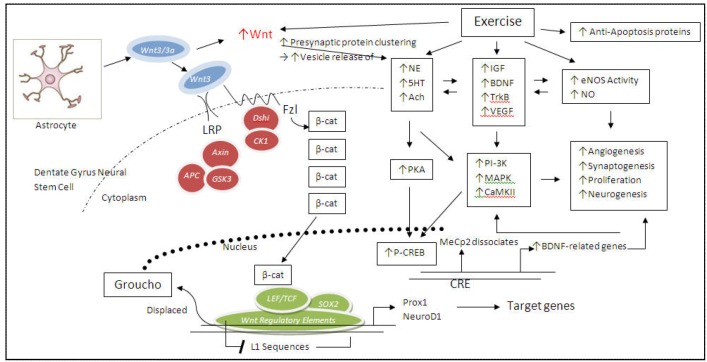
Exercise activates a wide variety of intracellular signal transduction pathways to promote neurogenesis of granule cells from neuroprogenitors in the dentate gyrus. Specifically applicable to neurogenesis, Wnt is released from neighboring astrocytes in a paracrine fashion, whereupon exercise increases Wnt signaling. Wnt binds its fzl receptor, complexed with LRP, and leading to the activation of Dshi, which, in turn, inactivates GSK3. The resulting accumulation of β-catenin (β-cat) in the cytoplasm and nucleus then binds to, and displaces, the gene regulatory proteins, LEF/TCF and Sox2 and the co-repressor, Groucho. β-Catenin then acts as a co-activator, and with transcription factors Prox1 and NeuroD1, stimulates the transcription of Wnt target genes. In addition, exercise also lifts the repressive MeCp2, thereby enhancing transcription. Normally, in the absence of exercise, Wnt3/3a is sent to the noncoding region of the granule cell, where L1 mobile elements are repressed during adult neurogenesis. Because L1 sequences contain the Wnt-regulatory element, the nearby genes can be indirectly up-regulated when the β-catenin/TCF-LEF complex is activated via Wnt signaling. In addition, exercise increases Wnt activity, leading to increased presynaptic protein and vesicle clustering, in turn leading to increased release of various neurotransmitters (norepinephrine, serotonin). Through a dizzying array of receptor and pathway cross-talk, these neurotransmitters, via GPCR signaling, can not only directly activate downstream PKA and subsequent transcription factor, CREB, thereby leading to the transcription of BDNF and related neurotrophic genes, but also activate other trophic factors (IGF-1, VEGF), thereby, in turn, activating a variety in intracellular signaling survival pathways (PI-3K, MAPK, CamKII), while simultaneously inhibiting apoptosis and inducing eNOS. Thus, both the Wnt regulatory element and the cAMP-response element (CRE) may participate (synergistically) to promote synaptogenesis, angiogenesis, proliferation, and neurogenesis.

References

    1. Dishman R.K., Berthoud H.R., Booth F.W., Cotman C.W., Edgerton V.R., Fleshner M.R., Gandevia S.C., Gomez-Pinilla F., Greenwood B.N., Hillman C.H., et al. Neurobiology of exercise. Obesity. 2006;14:345–356. doi: 10.1038/oby.2006.46. - DOI - PubMed
    1. Deslandes A., Moraes H., Ferreira C., Veiga H., Silveira H., Mouta R., Pompeu F.A.M.S., Coutinho E.S.F., Laks J. Exercise and mental health: Many reasons to move. Neuropsychobiology. 2009;59:191–198. doi: 10.1159/000223730. - DOI - PubMed
    1. Stranahan A.M., Zhou Y., Martin B., Maudsley S. Pharmacomimetics of exercise: Novel approaches for hippocampally-targeted neuroprotective agents. Curr. Med. Chem. 2009;35:4668–4685. - PMC - PubMed
    1. Stranahan A.M., Lee K., Becker K.G., Zhang Y., Maudsley S., Martin B., Cutler R.G., Mattson M.P. Hippocampal gene expression patterns underlying the enhancement of memory by running in aged mice. Neurobiol. Aging. 2010;31:1937–1949. doi: 10.1016/j.neurobiolaging.2008.10.016. - DOI - PMC - PubMed
    1. Stroth S., Hille K., Spitzer M., Reinhardt R. Aerobic endurance exercise benefits memory and affect in young adults. Neuropsychol. Rehabil. 2009;19:223–243. doi: 10.1080/09602010802091183. - DOI - PubMed

LinkOut - more resources