


An exome sequencing strategy to diagnose lethal autosomal recessive disorders
- PMID: 24961629
- PMCID: PMC4205099
- DOI: 10.1038/ejhg.2014.120
An exome sequencing strategy to diagnose lethal autosomal recessive disorders
Abstract
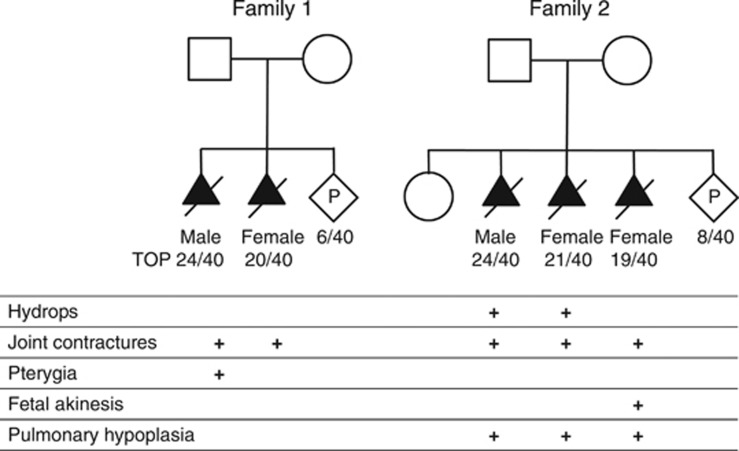
Rare disorders resulting in prenatal or neonatal death are genetically heterogeneous. For some conditions, affected fetuses can be diagnosed by ultrasound scan, but this is not usually possible until mid-gestation. There is often limited fetal DNA available for investigation. We investigated a strategy for diagnosing autosomal recessive lethal disorders in non-consanguineous pedigrees with multiple affected fetuses. Exome sequencing was performed to identify genes where each parent is heterozygous for a rare non-synonymous-coding or splicing variant. Putative pathogenic variants were tested for cosegregation in affected fetuses and unaffected siblings. In eight couples of European ancestry, we found on average 1.75 genes (range 0-4) where both parents were heterozygous for rare potentially deleterious variants. A proof-of-principle study detected heterozygous DYNC2H1 variants in a couple whose five fetuses had short-rib polydactyly. Prospective analysis of two couples with multiple pregnancy terminations for fetal akinesia syndrome was performed and a diagnosis was obtained in both the families. The first couple were each heterozygous for a previously reported GLE1 variant, p.Arg569His or p.Val617Met; both were inherited by their two affected fetuses. The second couple were each heterozygous for a novel RYR1 variant, c.14130-2A>G or p.Ser3074Phe; both were inherited by their three affected fetuses but not by their unaffected child. Biallelic GLE1 and RYR1 disease-causing variants have been described in other cases with fetal akinesia syndrome. We conclude that exome sequencing of parental samples can be an effective tool for diagnosing lethal recessive disorders in outbred couples. This permits early prenatal diagnosis in future pregnancies.
Figures
References
-
- Haack TB, Danhauser K, Haberberger B, et al. Exome sequencing identifies ACAD9 mutations as a cause of complex I deficiency. Nat Genet. 2010;42:1131–1134. - PubMed
MeSH terms
Grants and funding
LinkOut - more resources
Full Text Sources
Other Literature Sources
Medical
