. 2014 Aug 15;289(33):23200-23208.
doi: 10.1074/jbc.M114.587196. Epub 2014 Jun 24.

NADPH oxidase 4 induces cardiac arrhythmic phenotype in zebrafish

Affiliations

NADPH oxidase 4 induces cardiac arrhythmic phenotype in zebrafish

Yixuan Zhang et al. J Biol Chem. .

Abstract

Oxidative stress has been implicated in cardiac arrhythmia, although a causal relationship remains undefined. We have recently demonstrated a marked up-regulation of NADPH oxidase isoform 4 (NOX4) in patients with atrial fibrillation, which is accompanied by overproduction of reactive oxygen species (ROS). In this study, we investigated the impact on the cardiac phenotype of NOX4 overexpression in zebrafish. One-cell stage embryos were injected with NOX4 RNA prior to video recording of a GFP-labeled (myl7:GFP zebrafish line) beating heart in real time at 24-31 h post-fertilization. Intriguingly, NOX4 embryos developed cardiac arrhythmia that is characterized by irregular heartbeats. When quantitatively analyzed by an established LQ-1 program, the NOX4 embryos displayed much more variable beat-to-beat intervals (mean S.D. of beat-to-beat intervals was 0.027 s/beat in control embryos versus 0.038 s/beat in NOX4 embryos). Both the phenotype and the increased ROS in NOX4 embryos were attenuated by NOX4 morpholino co-injection, treatments of the embryos with polyethylene glycol-conjugated superoxide dismutase, or NOX4 inhibitors fulvene-5, 6-dimethylamino-fulvene, and proton sponge blue. Injection of NOX4-P437H mutant RNA had no effect on the cardiac phenotype or ROS production. In addition, phosphorylation of calcium/calmodulin-dependent protein kinase II was increased in NOX4 embryos but diminished by polyethylene glycol-conjugated superoxide dismutase, whereas its inhibitor KN93 or AIP abolished the arrhythmic phenotype. Taken together, our data for the first time uncover a novel pathway that underlies the development of cardiac arrhythmia, namely NOX4 activation, subsequent NOX4-specific NADPH-driven ROS production, and redox-sensitive CaMKII activation. These findings may ultimately lead to novel therapeutics targeting cardiac arrhythmia.

Keywords: Ca2+/Calmodulin-dependent Protein Kinase II (CaMKII); NADPH Oxidase; Oxidative Stress; Reactive Oxygen Species (ROS); Signal Transduction.


Figures

FIGURE 1.
FIGURE 1.
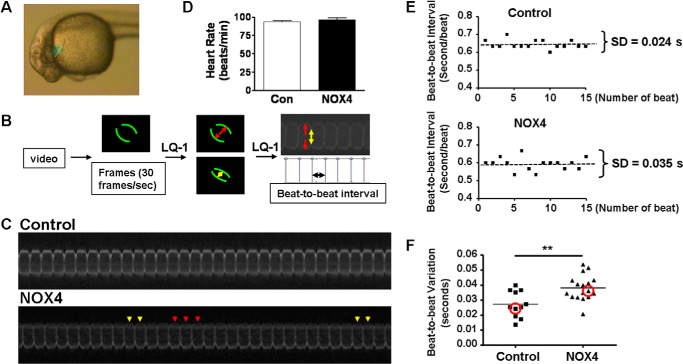
NOX4 overexpression induces cardiac arrhythmia in zebrafish embryos, quantitative analyses. A, representative myl7:GFP zebrafish embryo. The outline of the heart is marked in green. White line indicates scanning line position of the LQ-1 program. B, flow chart demonstrating video analyses and measurements of beat-to-beat intervals. Red and yellow arrows indicate heart relaxation and contraction, respectively. Black arrow indicates a beat-to-beat interval. C, representative LQ-1 plots of beat-to-beat intervals against time to demonstrate beat-to-beat variations. Note the faster beats (yellow arrowheads) and the slower heartbeats (red arrowheads) in NOX4 RNA-injected embryos. D, heart rates in control and NOX4 embryos at 24–30 hpf. n = 11 and 17. E, dotted lines mark average beat-to-beat intervals of representative embryos, and the standard deviations are calculated. F, distributions of beat-to-beat variations of control and NOX4 RNA-injected embryos. One dot represents standard deviation of one embryo. Red circles indicate standard deviations in E. **, p < 0.01 versus control. n = 11 and 17.
FIGURE 2.
FIGURE 2.
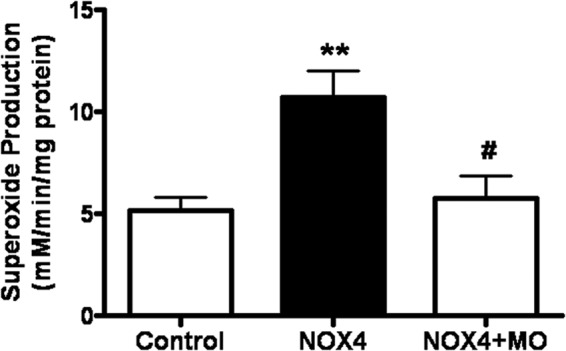
NOX4 overexpression results in increased superoxide in zebrafish embryos that is attenuated by NOX4 morpholino co-injection. Superoxide production from control and NOX4 RNA-injected zebrafish embryos was determined by electron spin resonance. MO, NOX4 morpholino. **, p < 0.01 versus control group; #, p < 0.05 versus NOX4 group. n = 12, 10, and 3, respectively.
FIGURE 3.
FIGURE 3.
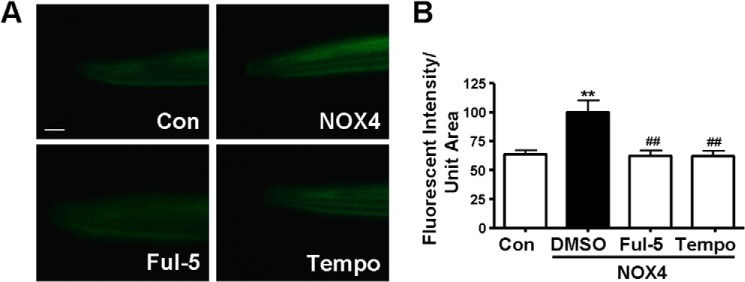
NOX4 overexpression increases superoxide-dependent H2O2 production in zebrafish embryos. A, images of DCFH-DA staining indicating endogenous H2O2 generation in tails of zebrafish embryos. The scale bar indicates 100 μm. B, arbitrary units of mean density of DCFH-DA signals quantified by ImageJ. Ful-5, fulvene-5, 10 μm; Tempo, 10 μm. **, p < 0.01 versus control (Con); ##, p < 0.01 versus NOX4/DMSO group. n = 21, 13, 15, and 20 from three injections.
FIGURE 4.
FIGURE 4.
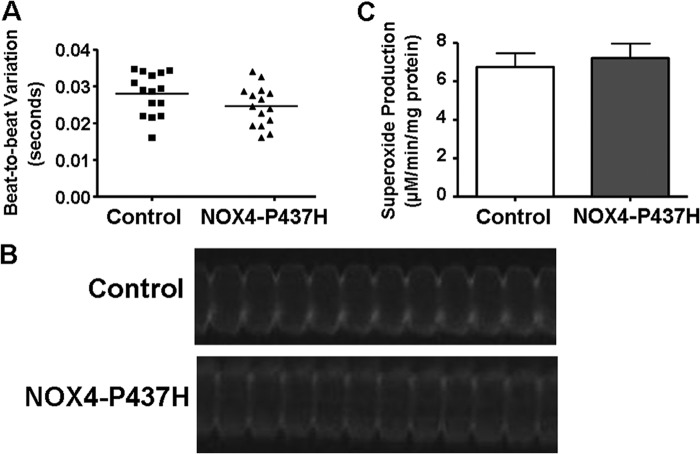
Overexpression of NOX4 mutant deficient in NADPH binding had no effect on cardiac phenotype. A, distributions of beat-to-beat variations of control and NOX4-P437H RNA-injected zebrafish embryos at 24–30 hpf. n = 15. B, representative LQ-1 results and analyses of beat-to-beat intervals in control and NOX4-P437H embryos. C, superoxide production in control and NOX4-P437H embryos. n = 5.
FIGURE 5.
FIGURE 5.
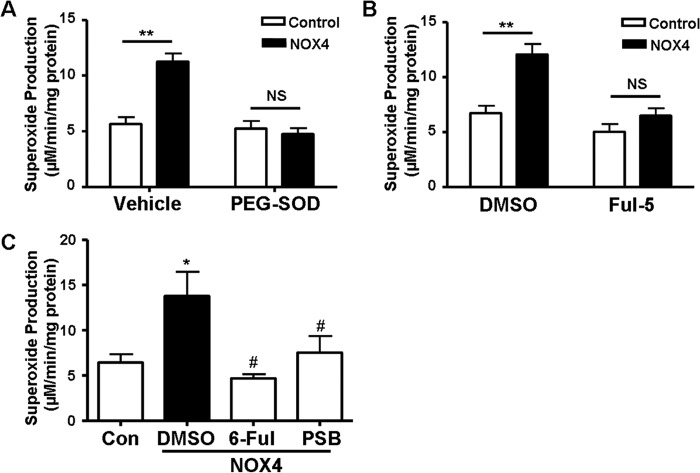
Superoxide dismutase or NOX/NOX4 inhibitors attenuate superoxide production in NOX4-overexpressed zebrafish embryos. Superoxide production in PEG-SOD (25 units/ml) (A), fulvene-5 (Ful-5, 10 μm) (B), 6-dimethylamino-fulvene (6-Ful, 10 μm), or proton sponge blue (PSB, 5 μm) (C)-treated zebrafish embryos started at 22–23 hpf. **, p < 0.01 versus control; NS, not significant versus control. *, p < 0.05 versus control; #, p < 0.05 versus NOX4 group. n = 4 for PEG-SOD, n = 4 for Ful-5, and n = 3 for 6-dimethylamino-fulvene and proton sponge blue treatments, respectively.
FIGURE 6.
FIGURE 6.
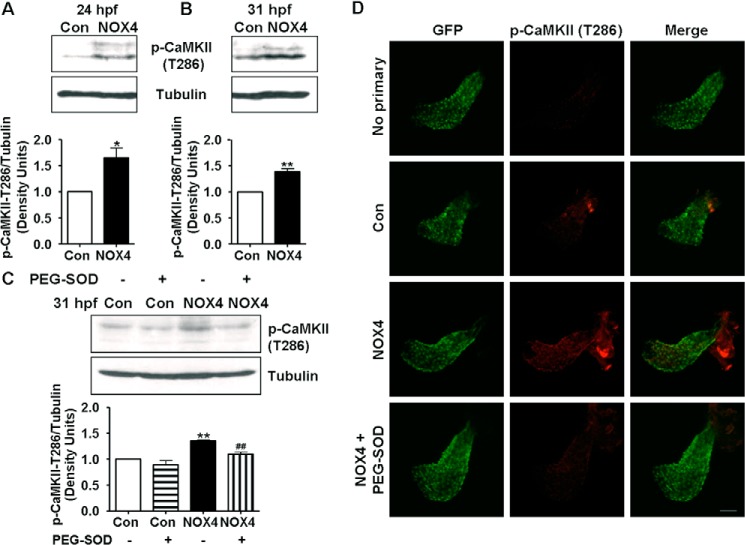
NOX4 overexpression activates CaMKII in a superoxide-dependent fashion in zebrafish embryos. Representative Western blot and quantitative data of CaMKII phosphorylation (Thr-286) at 24 hpf (A) and 31 hpf (B). n = 4. *, p < 0.05; **, p < 0.01 versus control group. C, representative Western blot and quantitative data of CaMKII phosphorylation (Thr-286) in PEG-SOD-treated embryos at 31 hpf. n = 3. **, p < 0.01 versus control; ##, p < 0.01 versus NOX4 group. D, confocal Z-stack images of heart (31–32 hpf) from indicated embryos. The scale bar is set at 50 μm. No primary, no primary antibody incubation as negative control.
FIGURE 7.
FIGURE 7.
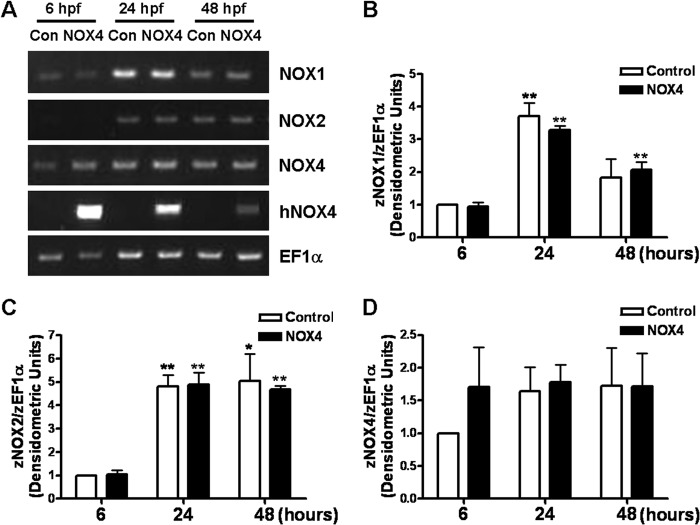
Levels of endogenous zebrafish NOX1, NOX2, and NOX4 isoforms were not affected by injection of human NOX4 RNA. A, representative RT-PCR results of zebrafish NOX1/2/4 and human NOX4 expression through different developmental stages. Same amount of cDNA was used as template in each PCR. B–D, quantitative analyses of zebrafish NOX1/2/4 at indicated times from RT-PCR results. The housekeeping gene ef1α was used as an internal control. Gene expression level was normalized to the control group at 6 hpf. *, p < 0.05; **, p < 0.01 compared with 6 hpf. No difference was found between control and NOX4 groups. n = 3. Note that interestingly, although zebrafish NOX4 was expressed at an earlier stage of the development (6 hpf), the zebrafish NOX1/2 isoforms only became detectable after 24 hpf.

References

    1. Cai H., Li Z., Goette A., Mera F., Honeycutt C., Feterik K., Wilcox J. N., Dudley S. C., Jr., Harrison D. G., Langberg J. J. (2002) Downregulation of endocardial nitric oxide synthase expression and nitric oxide production in atrial fibrillation: potential mechanisms for atrial thrombosis and stroke. Circulation 106, 2854–2858 - PubMed
    1. Kim Y. M., Guzik T. J., Zhang Y. H., Zhang M. H., Kattach H., Ratnatunga C., Pillai R., Channon K. M., Casadei B. (2005) A myocardial Nox2 containing NAD(P)H oxidase contributes to oxidative stress in human atrial fibrillation. Circ. Res. 97, 629–636 - PubMed
    1. Dudley S. C., Jr., Hoch N. E., McCann L. A., Honeycutt C., Diamandopoulos L., Fukai T., Harrison D. G., Dikalov S. I., Langberg J. (2005) Atrial fibrillation increases production of superoxide by the left atrium and left atrial appendage: role of the NADPH and xanthine oxidases. Circulation 112, 1266–1273 - PubMed
    1. Youn J. Y., Zhang J., Zhang Y., Chen H., Liu D., Ping P., Weiss J. N., Cai H. (2013) Oxidative stress in atrial fibrillation: an emerging role of NADPH oxidase. J. Mol. Cell. Cardiol. 62, 72–79 - PMC - PubMed
    1. Zhang J., Youn J. Y., Kim A. Y., Ramirez R. J., Gao L., Ngo D., Chen P., Scovotti J., Mahajan A., Cai H. (2012) NOX4-dependent hydrogen peroxide overproduction in human atrial fibrillation and HL-1 atrial cells: relationship to hypertension. Front Physiol. 3, 140. - PMC - PubMed

Publication types

MeSH terms

Substances