Review
. 2015 Feb;142 Suppl 1(Suppl 1):S16-25.
doi: 10.1017/S0031182014000766. Epub 2014 Jun 25.

The origins of malaria: there are more things in heaven and earth …

Affiliations
Review

The origins of malaria: there are more things in heaven and earth …

P J Keeling et al. Parasitology. 2015 Feb.

Abstract

SUMMARY Malaria remains one of the most significant global public health burdens, with nearly half of the world's population at risk of infection. Malaria is not however a monolithic disease - it can be caused by multiple different parasite species of the Plasmodium genus, each of which can induce different symptoms and pathology, and which pose quite different challenges for control. Furthermore, malaria is in no way restricted to humans. There are Plasmodium species that have adapted to infect most warm-blooded vertebrate species, and the genus as a whole is both highly successful and highly diverse. How, where and when human malaria parasites originated from within this diversity has long been a subject of fascination and sometimes also controversy. The past decade has seen the publication of a number of important discoveries about malaria parasite origins, all based on the application of molecular diagnostic tools to new sources of samples. This review summarizes some of those recent discoveries and discusses their implication for our current understanding of the origin and evolution of the Plasmodium genus. The nature of these discoveries and the manner in which they are made are then used to lay out a series of opportunities and challenges for the next wave of parasite hunters.

Keywords: phylogeny.


Figures
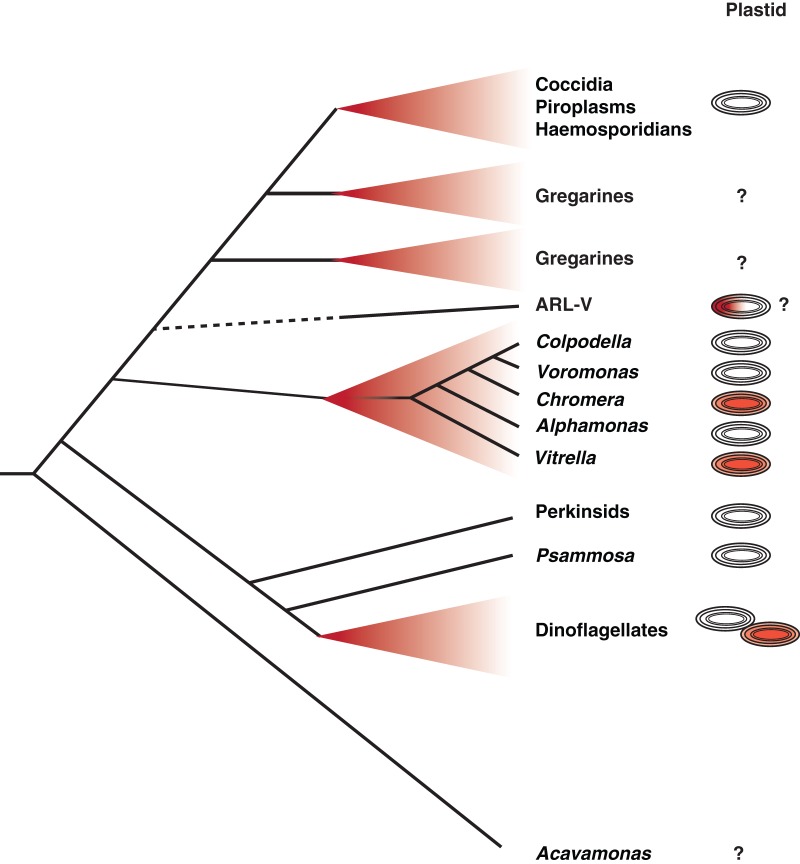
Fig. 1.
Fig. 1.
Schematic representation of relationships between apicomplexan parasites and their closest relatives and the evolution of their plastids. The closest known branch to the ‘true’ apicomplexans (at top, including Coccidia, Piroplasms, Haemosporidians and the paraphyletic Gregarines) is a biologically undescribed lineage known only from plastid environmental surveys, the so-called ARL-V lineage. The nearest relatives that have been biologically characterized include a diverse array of predatory flagellates (Colpodella, Voromonas and Alphamonas), photosynthetic coral symbionts (Chromera and Vitrella) and a large number of unknown environmental lineages (many from coral, but also many from other environments). These are all in turn related to a large group including dinoflagellates and their closest relatives, the Perkinsids and Psammosa, both of which possess structures homologous to the apical complex, and the enigmatic predator Acavamons. The column to the right summarizes what we know about plastids in each lineage: red plastids indicate photosynthesis, colourless plastids indicates plastids that are known but non-photosynthetic. ARL-V is hypothesized to be photosynthetic but this has not been tested, and dinoflagellates contain about 50% photosynthetic and non-photosynthetic species. Lineages for which no plastid has been detected are indicated by a question mark.
Fig. 2.
Fig. 2.
Schematic representation of the major radiations amongst Plasmodium species. Since becoming parasites of vertebrates, the genus Plasmodium has expanded to infect a wide variety of hosts. Only a handful of these species, those referred to specifically in the text as well as some other major groupings, are represented here. The precise relationships between the species are not always known, so branch positioning is indicative rather than definitive – more detailed analyses are available elsewhere (Martinsen and Perkins, 2013). Human parasites originate from Plasmodium clades that have expanded in related groups of hosts, including the Laverania radiation in African apes, which includes the most deadly form of human malaria, P. falciparum, and an expansion of P. vivax-related parasites in African apes and Southeast Asian monkeys. The other two major human malaria parasites, P. ovale and P. malariae, also have relatives in African apes, but the full diversity and relationship between these species is not currently known. Recent works indicates that rodent and bat Plasmodium parasites are closely related, with possible host switching occurring on more than one occasion (Schaer et al. 2013).

References

    1. Beadell J. S., Covas R., Gebhard C., Ishtiaq F., Melo M., Schmidt B. K., Perkins S. L., Graves G. R. and Fleischer R. C. (2009). Host associations and evolutionary relationships of avian blood parasites from West Africa. International Journal for Parasitology 39, 257–266. doi: 10.1016/j.ijpara.2008.06.005. - DOI - PMC - PubMed
    1. Coatney R., Collins W. E., Warren M. and Contacos P. G. (1971). The Primate Malarias. National Institutes of Health, Bethesda, MD, USA.
    1. Collins W. E., Skinner J. C., Pappaioanou M., Broderson J. R. and Mehaffey P. (1986). The sporogonic cycle of Plasmodium reichenowi. Journal of Parasitology 72, 292–298. - PubMed
    1. Craig A. G., Grau G. E., Janse C., Kazura J. W., Milner D., Barnwell J. W., Turner G. and Langhorne J. (2012). The role of animal models for research on severe malaria. PLOS Pathogens 8, . doi: 10.1371/journal.ppat.1002401. - DOI - PMC - PubMed
    1. Duval L., Nerrienet E., Rousset D., Sadeuh Mba S. A., Houze S., Fourment M., Le Bras J., Robert V. and Ariey F. (2009). Chimpanzee malaria parasites related to Plasmodium ovale in Africa. PLOS ONE 4, . doi: 10.1371/journal.pone.0005520. - DOI - PMC - PubMed

Publication types