doi: 10.3201/eid2007.140190.
New viruses in idiopathic human diarrhea cases, the Netherlands
- PMID: 24964003
- PMCID: PMC4073879
- DOI: 10.3201/eid2007.140190
Item in Clipboard
New viruses in idiopathic human diarrhea cases, the Netherlands
Emerg Infect Dis.
2014 Jul.
Abstract
Emerging viral infections can be identified by using a viral metagenomics approach for clinical human material. Diarrhea samples of patients with unexplained gastroenteritis from the Netherlands were analyzed by using viral metagenomics. Novel circular DNA viruses, bufaviruses, and genogroup III picobirnaviruses were identified. These data expand our knowledge of the human virome.
Keywords: bufavirus; circovirus; circular DNA virus; diarrhea; enteric infections; idiopathic human diarrhea cases; next-generation sequencing; picobirnavirus; random amplification; the Netherlands; viruses.
Figures
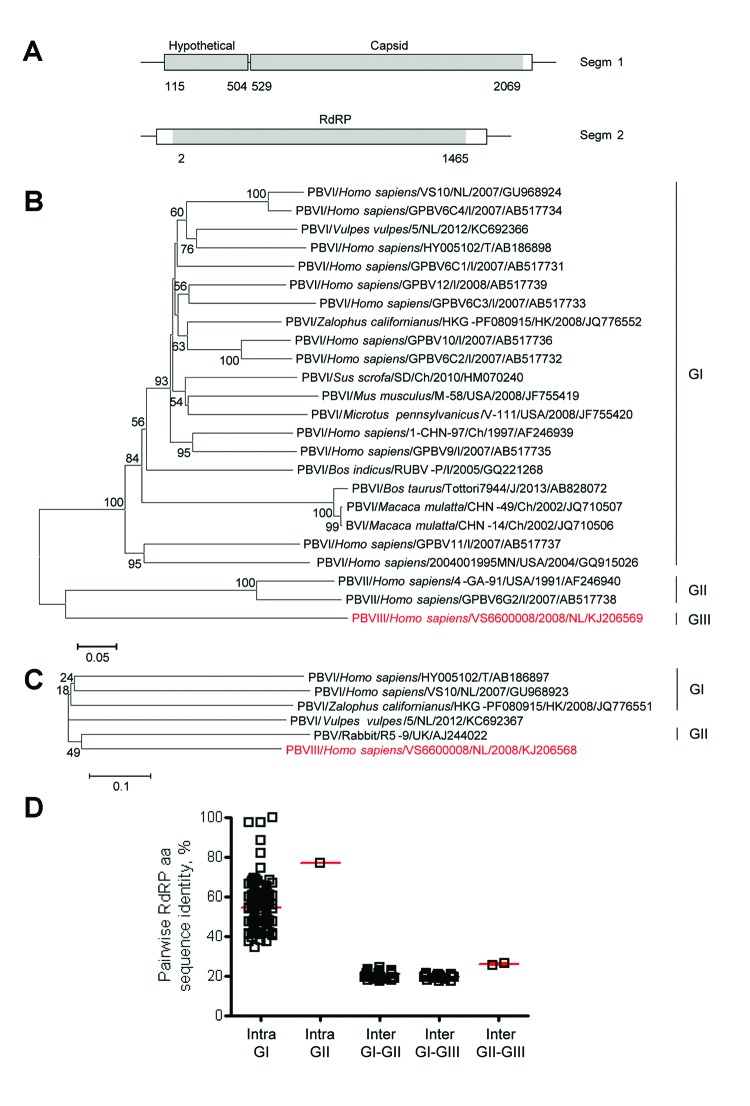
Genome organization and phylogenetic analysis of human picobirnavirus (PBV) VS6600008 isolated in the Netherlands, 2005–2009. A) Putative schematic genome organization of human PBV VS6600008. Locations of major open reading frames are indicated in white and sequences obtained by next-generation sequencing are indicated in gray. Segm, segment; RdRP, RNA-dependent RNA polymerase. B) Phylogenetic neighbor-joining tree with p-distances and 1,000 bootstrap replicates of amino acid sequences of partial RdRP genes corresponding to aa 80–377 of reference PBV strain HY005102; AB186898, PBV VS6600008, and representative PBVs. Alignments were created by using ClustalX 2.0 (http://www.clustal.org/ ). Viruses are shown as virus/host species/strain/country/year/GenBank accession no. (if available). Virus isolated in this study is indicated in red. Genogroups are indicated on the right. Scale bar indicates amino acid substitutions per site. NL, the Netherlands; I, India; T, Thailand; Ch, China; USA, United States; UK, United Kingdom; J, Japan; HK, Hong Kong. C) Phylogenetic neighbor-joining tree with p-distances and 1,000 bootstrap replicates of the amino acid sequences of the partial capsid genes corresponding to aa 1–220 of reference PBV strain HY005102; AB186897, PBV VS6600008, and representative PBVs. Alignments were created by using ClustalX 2.0. Virus isolated in this study is indicated in red. Genogroups are indicated on the right. Scale bar indicates amino acid substitutions per site. D) Pairwise intragenogroup (Intra) and intergenogroup (Inter) amino acid sequence identities determined by using Bioedit 7.0.9.0 (http://www.mbio.ncsu.edu/bioedit/bioedit.html ) between the partial RdRP sequences (corresponding to amino acids 80–377 of reference PBV strain HY005102; AB186898). Each square represents pairwise RdRP amino acid sequence identity between viruses in panel B. Red bars indicate mean and SEM.
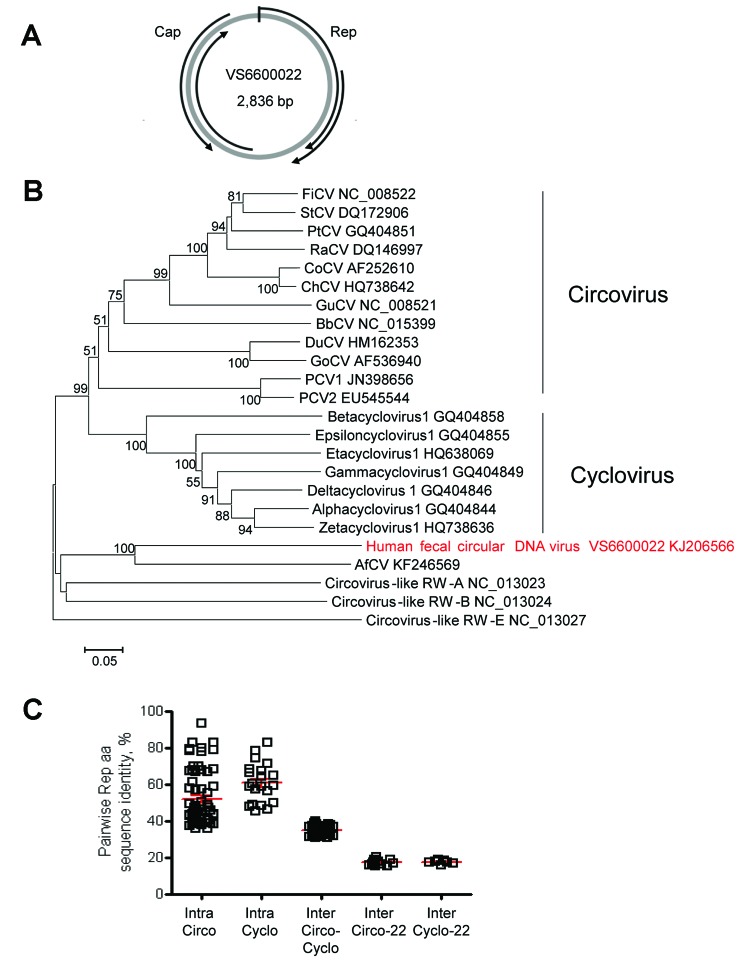
Genome organization and phylogenetic analysis of human fecal circular DNA virus VS6600022, the Netherlands, 2005–2009. A) Putative schematic genome organization. Arrows indicate major open reading frames. Cap, capsid; Rep, rolling circle replication initiator protein. B) Phylogenetic neighbor-joining tree with p-distances and 1,000 bootstrap replicates created with MEGA5 of amino acid sequences of the Rep genes of human fecal circular DNA virus VS6600022 and representative circoviruses that were aligned by using ClustalX2.0 (http://www.clustal.org/ ). Virus isolated in this study is indicated in red. Scale bar indicates amino acid substitutions per site. FiCV, finch circovirus; StCV, starling circovirus; PtCV, Pan troglodytes circovirus; RaCV, raven circovirus; CoCV, columbid circovirus; ChCV, chicken circovirus; GuCV, gull circovirus; PCV, porcine circovirus; BbCV; Barbus barbus circovirus; DuCV, duck circovirus; GoCV, goose circovirus; AfCV, Arctocephalus forsteri circovirus. C) Pairwise intraspecies (Intra) and interspecies (Inter) amino acid sequence identities determined by using Bioedit 7.0.9.0 (http://www.mbio.ncsu.edu/bioedit/bioedit.html ) between the Rep protein sequences of VS6600022 and representative species in the genera Circovirus (Circo) and Cyclovirus (Cyclo). Each square represents the pairwise RdRP amino acid sequence identity between the viruses in panel B. Red bars indicate mean and SEM.
References
Publication types
MeSH terms
LinkOut - more resources
Full Text Sources
Other Literature Sources
Medical