


Common attentional constraints in visual foraging
- PMID: 24964082
- PMCID: PMC4071029
- DOI: 10.1371/journal.pone.0100752
Common attentional constraints in visual foraging
Abstract
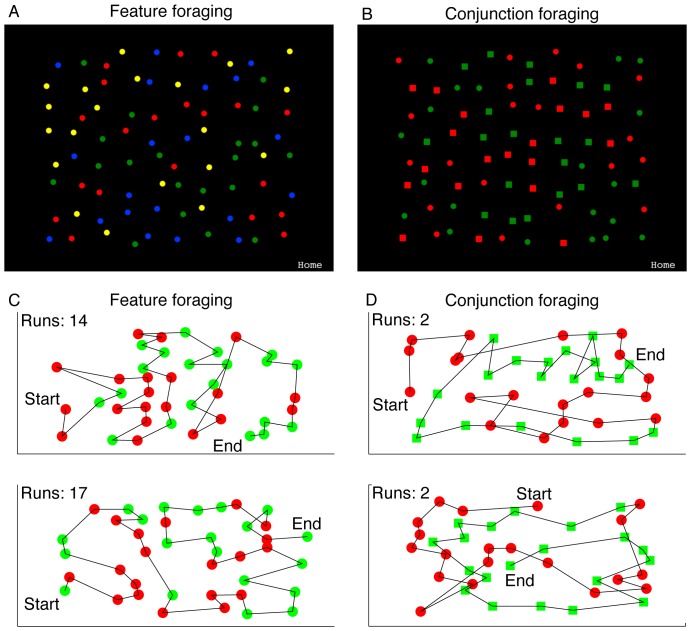
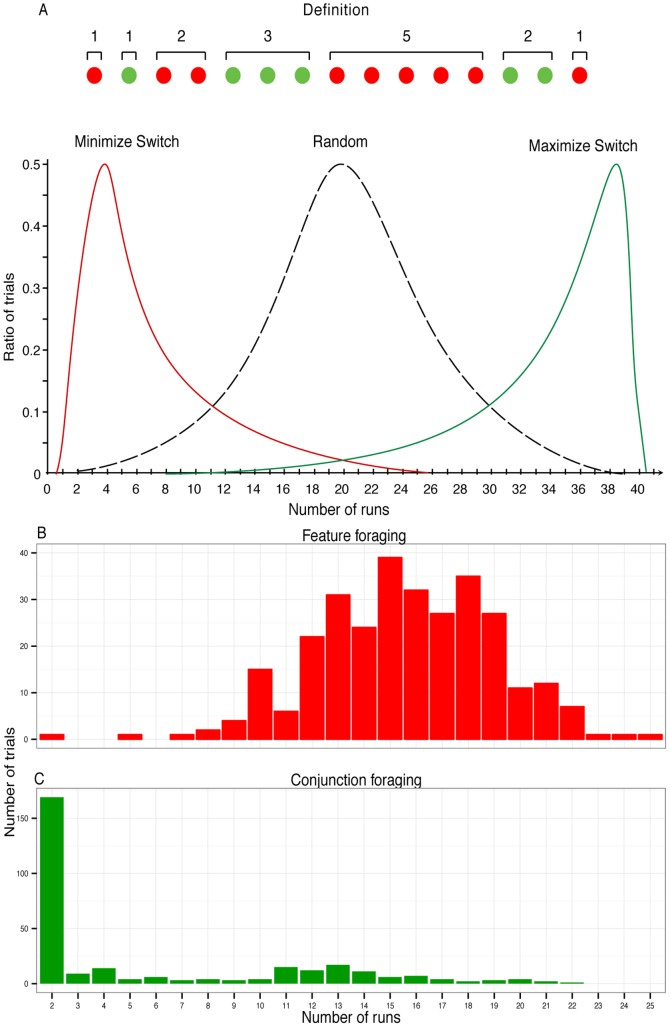
Predators are known to select food of the same type in non-random sequences or "runs" that are longer than would be expected by chance. If prey are conspicuous, predators will switch between available sources, interleaving runs of different prey types. However, when prey are cryptic, predators tend to focus on one food type at a time, effectively ignoring equally available sources. This latter finding is regarded as a key indicator that animal foraging is strongly constrained by attention. It is unknown whether human foraging is equally constrained. Here, using a novel iPad task, we demonstrate for the first time that it is. Participants were required to locate and touch 40 targets from 2 different categories embedded within a dense field of distractors. When individual target items "popped-out" search was organized into multiple runs, with frequent switching between target categories. In contrast, as soon as focused attention was required to identify individual targets, participants typically exhausted one entire category before beginning to search for the other. This commonality in animal and human foraging is compelling given the additional cognitive tools available to humans, and suggests that attention constrains search behavior in a similar way across a broad range of species.
Conflict of interest statement
Figures
References
-
- Tinbergen L (1960) The natural control of insects in pinewoods I. Factors influencing the intensity of predation by songbirds. Arch Neerl Zool 13: 265–343.
-
- Dawkins M (1971) Shifts of ‘attention’ in chicks during feeding. Anim Behav 19: 575–582.
-
- Bond AB (1983) Visual search and selection of natural stimuli in the pigeon: the attention threshold hypothesis. J Exp Psychol Anim Behav 9: 292–306. - PubMed
-
- Punzalan D, Rodd FH, Hughes KA (2005) Perceptual processes and the maintenance of polymorphism through frequency-dependent predation. Evol Ecol 19: 303–320.
-
- Bond AB (2007) The evolution of color polymorphism: Crypticity, searching images, and apostatic selection. Annu Rev Ecol Evol S 38: 489–514.
MeSH terms
LinkOut - more resources
Full Text Sources
Other Literature Sources
