. 2014 Sep;21(9):1215-23.
doi: 10.1128/CVI.00205-14. Epub 2014 Jun 25.

Immunogenicity of a synthetic vaccine based on Plasmodium vivax Duffy binding protein region II

Affiliations

Immunogenicity of a synthetic vaccine based on Plasmodium vivax Duffy binding protein region II

Francis B Ntumngia et al. Clin Vaccine Immunol. 2014 Sep.

Abstract

Molecules that play a role in Plasmodium merozoite invasion of host red blood cells represent attractive targets for blood-stage vaccine development against malaria. In Plasmodium vivax, merozoite invasion of reticulocytes is mediated by the Duffy binding protein (DBP), which interacts with its cognate receptor, the Duffy antigen receptor for chemokines, on the surface of reticulocytes. The DBP ligand domain, known as region II (DBPII), contains the critical residues for receptor recognition, making it a prime target for vaccine development against blood-stage vivax malaria. In natural infections, DBP is weakly immunogenic and DBPII allelic variation is associated with strain-specific immunity, which may compromise vaccine efficacy. In a previous study, a synthetic vaccine termed DEKnull that lacked an immunodominant variant epitope in DBPII induced functional antibodies to shared neutralizing epitopes on the native Sal1 allele. Anti-DEKnull antibody titers were lower than anti-Sal1 titers but produced more consistent, strain-transcending anti-DBPII inhibitory responses. In this study, we further characterized the immunogenicity of DEKnull, finding that immunization with recombinant DEKnull produced an immune response comparable to that obtained with native recombinant DBP alleles. Further investigation of DEKnull is necessary to enhance its immunogenicity and broaden its specificity.


Figures

FIG 1
FIG 1
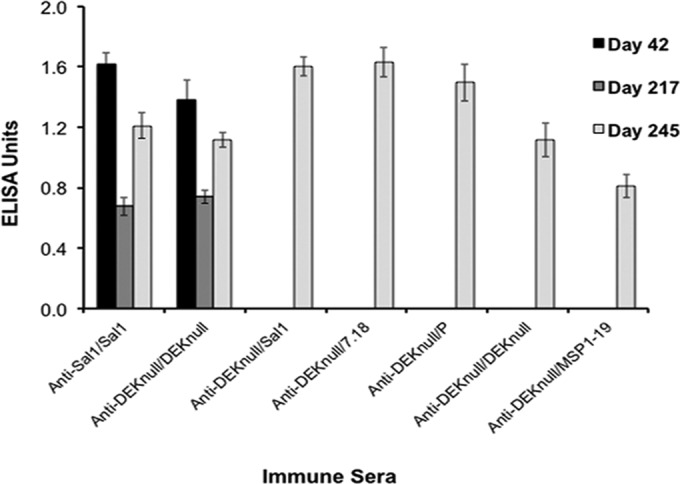
Anamnestic response to rDEKnull. Mice were primed twice 3 weeks apart with either rDEKnull or rSal1 (control), and their serum anti-DEKnull IgG titers were determined (day 42). Antibody titers were allowed to decline by ∼50% (day 217). Mice from each group were boosted on day 224 with a naturally occurring rDBPII allele (Sal1, 7.18, or P), rDEKnull, or rMSP1-19, and their serum anti-DBPII IgG titers were again determined on day 245 (final blood collection). Bars represent the mean antibody titers (EU) for reactivity of immune sera from each group at a 1 × 10⁵ dilution against the boosting antigen for that group. Error bars represent standard errors.
FIG 2
FIG 2
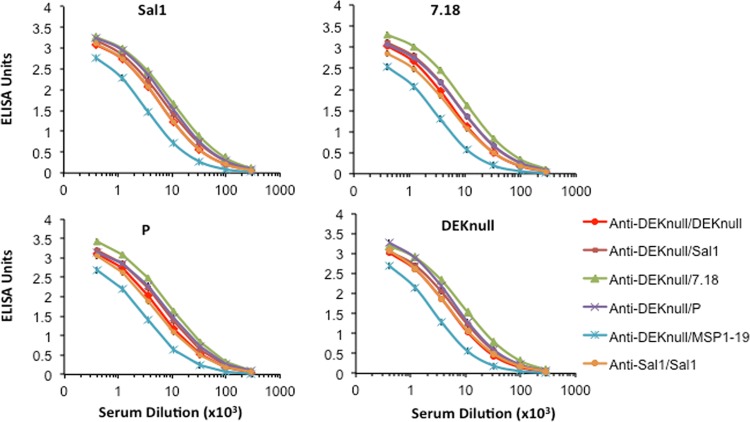
Anti-DBPII reactivity profiles. Antisera from the different immunization groups were evaluated in an ELISA by endpoint dilution for cross-reactivity with variant recombinant DBPII alleles. Antigen preparations (2 μg/ml) were allowed to adsorb to the wells of microtiter plates and then allowed to react with different dilutions of antiserum from individual mice. Each curve is a four-parameter logistic regression curve for antisera from each group (n = 14) against the different alleles, and error bars represent standard deviations.
FIG 3
FIG 3
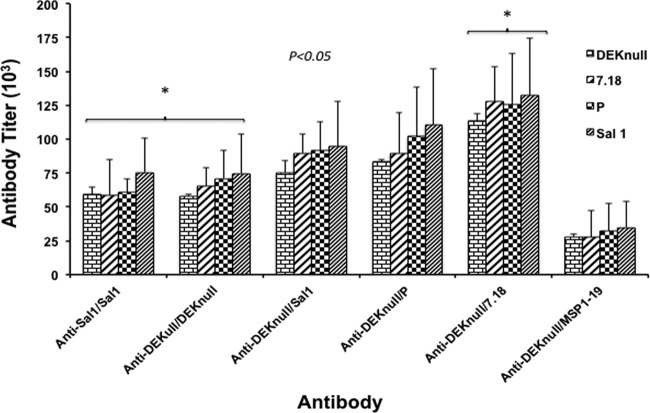
Quantitative analysis of anti-DBPII antiserum binding specificity. The binding specificity of antiserum from each immunization group was compared against that of recombinant Sal1, 7.18, P, and DEKnull by ELISA. Antibody titers were calculated as the serum dilution required to achieve 1.5 EU. Each bar represents the titer for each antiserum against a specific recombinant DBPII allele, and error bars indicate standard deviations. Asterisks indicate significant differences in antibody titers between the two groups.
FIG 4
FIG 4
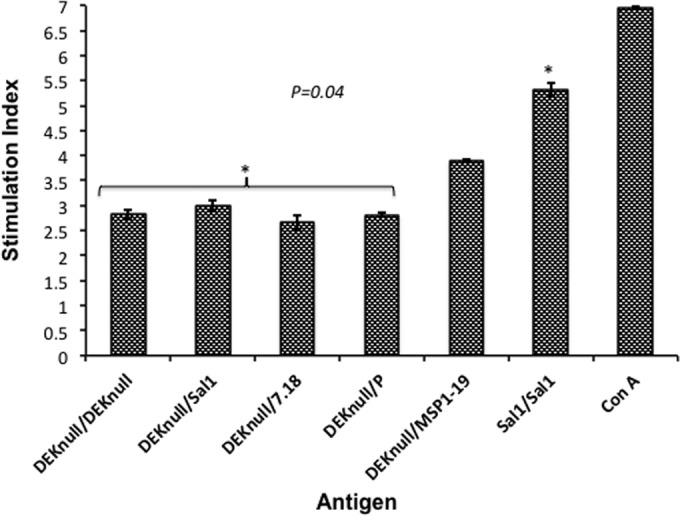
Lymphocyte proliferation. Groups of BALB/c mice were primed with rDEKnull and boosted with recombinant DEKnull, Sal1, 7.18, P, or MSP1-19. An rSal1 prime-boost group served as a control. Cultured splenocytes harvested 3 weeks after boosting were stimulated with the booster antigen. The T-cell proliferative response was quantified by an MTS assay, and the SI was determined as the ratio of the absorbance at 490 nm of stimulated cells to that of unstimulated cells. Bars represent mean SI values ± standard deviations of triplicate wells. The asterisks indicate significant SI differences between the control group (Sal1-Sal1 prime-boost) and the DEKnull prime–heterologous-boost groups.
FIG 5
FIG 5
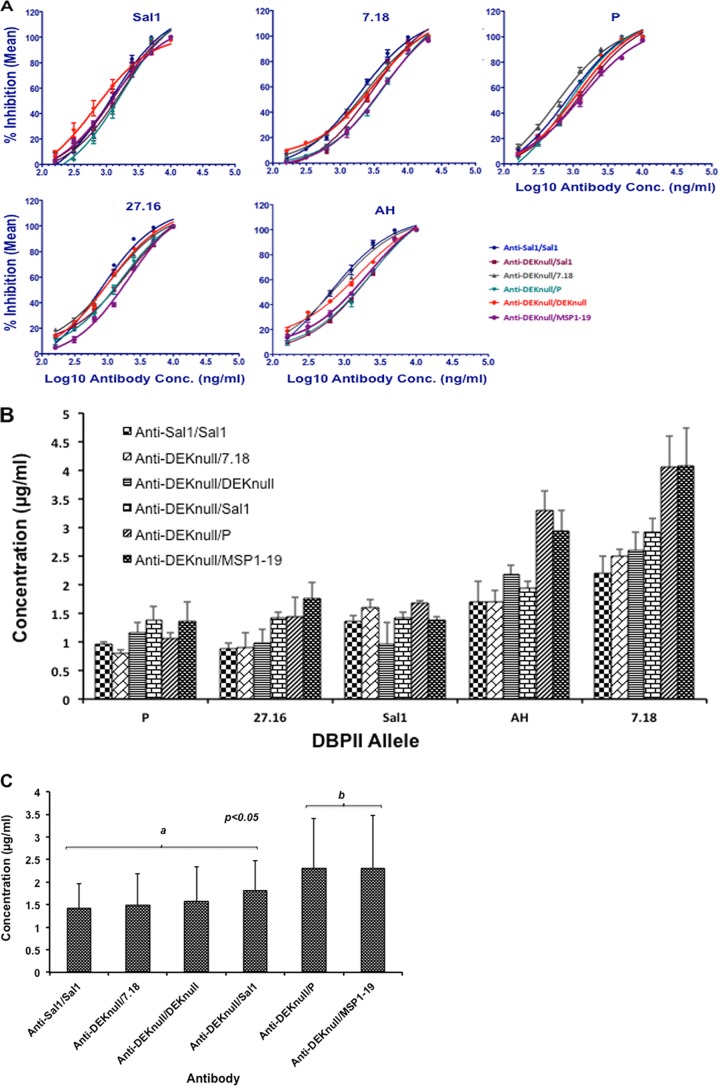
Inhibition of erythrocyte binding to rDBPII expressed on COS-7 cells. Purified total serum IgG from the different prime-boost groups was tested for inhibition of DBPII-erythrocyte binding against a panel of COS-7 cell-expressed DBPII alleles by endpoint dilution. A monolayer of transfected COS-7 cells expressing rDBPII from five different alleles was incubated with the purified serum IgG at different concentrations prior to the addition of human erythrocytes. Binding was scored by counting rosettes in 30 microscopic fields at a magnification of ×200. Percent binding inhibition was determined relative to that of the purified IgG from preimmune sera used as a control. (A) Charts show nonlinear regression curves for the inhibitory activities of the different antibodies against each DBPII allele. Each antibody concentration was tested in triplicate for two independent experiments. (B) Quantitative analysis of anti-DBPII binding inhibition. Bars represent the IC50s of each antibody against individual alleles. (C) Multiple comparisons of anti-DBPII binding-inhibitory responses. The overall inhibitory responses of serum anti-DBPII IgG from each group against all five COS-7-expressed alleles were compared by Bonferroni multiple-comparison adjustment. Bars represent the mean IC50s of each antibody against all the natural alleles. Antibodies were classified into two inhibitory groups (a and b), with a statistically significant difference in inhibitory responses between the groups. Error bars represent standard deviations.

References

    1. Branch OH, Udhayakumar V, Hightower AW, Oloo AJ, Hawley WA, Nahlen BL, Bloland PB, Kaslow DC, Lal AA. 1998. A longitudinal investigation of IgG and IgM antibody responses to the merozoite surface protein-1 19-kiloDalton domain of Plasmodium falciparum in pregnant women and infants: associations with febrile illness, parasitemia, and anemia. Am. J. Trop. Med. Hyg. 58:211–219 - PubMed
    1. King CL, Michon P, Shakri AR, Marcotty A, Stanisic D, Zimmerman PA, Cole-Tobian JL, Mueller I, Chitnis CE. 2008. Naturally acquired Duffy-binding protein-specific binding inhibitory antibodies confer protection from blood-stage Plasmodium vivax infection. Proc. Natl. Acad. Sci. U. S. A. 105:8363–8368. 10.1073/pnas.0800371105 - DOI - PMC - PubMed
    1. Cohen S, McGregor IA, Carrington S. 1961. Gamma-globulin and acquired immunity to human malaria. Nature 192:733–737. 10.1038/192733a0 - DOI - PubMed
    1. Clyde DF, Most H, McCarthy VC, Vanderberg JP. 1973. Immunization of man against sporozoite-induced falciparum malaria. Am. J. Med. Sci. 266:169–177. 10.1097/00000441-197309000-00002 - DOI - PubMed
    1. Grimberg BT, Udomsangpetch R, Xainli J, McHenry A, Panichakul T, Sattabongkot J, Cui L, Bockarie M, Chitnis C, Adams J, Zimmerman PA, King CL. 2007. Plasmodium vivax invasion of human erythrocytes inhibited by antibodies directed against the Duffy binding protein. PLoS Med. 4(12):e337. 10.1371/journal.pmed.0040337 - DOI - PMC - PubMed

Publication types

MeSH terms