


Television viewing, computer use, time driving and all-cause mortality: the SUN cohort
- PMID: 24965030
- PMCID: PMC4309083
- DOI: 10.1161/JAHA.114.000864
Television viewing, computer use, time driving and all-cause mortality: the SUN cohort
Abstract
Background: Sedentary behaviors have been directly associated with all-cause mortality. However, little is known about different types of sedentary behaviors in relation to overall mortality. Our objective was to assess the association between different sedentary behaviors and all-cause mortality.
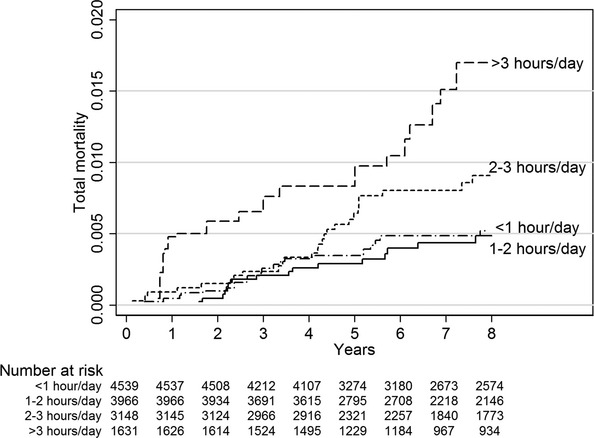
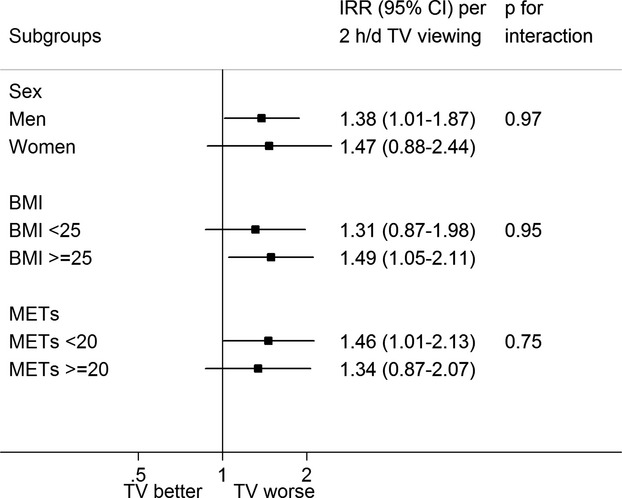
Methods and results: In this prospective, dynamic cohort study (the SUN Project) 13 284 Spanish university graduates with a mean age of 37 years were followed-up for a median of 8.2 years. Television, computer, and driving time were assessed at baseline. Poisson regression models were fitted to examine the association between each sedentary behavior and total mortality. All-cause mortality incidence rate ratios (IRRs) per 2 hours per day were 1.40 (95% confidence interval (CI): 1.06 to 1.84) for television viewing, 0.96 (95% CI: 0.79 to 1.18) for computer use, and 1.14 (95% CI: 0.90 to 1.44) for driving, after adjustment for age, sex, smoking status, total energy intake, Mediterranean diet adherence, body mass index, and physical activity. The risk of mortality was twofold higher for participants reporting ≥ 3 h/day of television viewing than for those reporting <1 h/d (IRR: 2.04 [95% CI 1.16 to 3.57]).
Conclusions: Television viewing was directly associated with all-cause mortality. However, computer use and time spent driving were not significantly associated with higher mortality. Further cohort studies and trials designed to assess whether reductions in television viewing are able to reduce mortality are warranted. The lack of association between computer use or time spent driving and mortality needs further confirmation.
Keywords: death; prospective cohort study; sedentary behavior; sedentary time; sitting time.
© 2014 The Authors. Published on behalf of the American Heart Association, Inc., by Wiley Blackwell.
Figures
References
-
- World Health Organization. Global Health Risks: Mortality and Burden of Disease Attributable to Selected Major Risks. Geneva, Switzerland: Who Press; 2009.
-
- Physical Activity Guidelines Advisory Committee. Physical Activity Guidelines Advisory Committee Report 2008. Washington, DC: US Dept of Health and Human Services; 2008. - PubMed
-
- Dietz WH. The role of lifestyle in health: the epidemiology and consequences of inactivity. Proc Nutr Soc. 1996; 55:829-840. - PubMed
Publication types
MeSH terms
LinkOut - more resources
Full Text Sources
Other Literature Sources
