


Effects of homocysteine lowering with B vitamins on cognitive aging: meta-analysis of 11 trials with cognitive data on 22,000 individuals
- PMID: 24965307
- PMCID: PMC4095663
- DOI: 10.3945/ajcn.113.076349
Effects of homocysteine lowering with B vitamins on cognitive aging: meta-analysis of 11 trials with cognitive data on 22,000 individuals
Abstract
Background: Elevated plasma homocysteine is a risk factor for Alzheimer disease, but the relevance of homocysteine lowering to slow the rate of cognitive aging is uncertain.
Objective: The aim was to assess the effects of treatment with B vitamins compared with placebo, when administered for several years, on composite domains of cognitive function, global cognitive function, and cognitive aging.
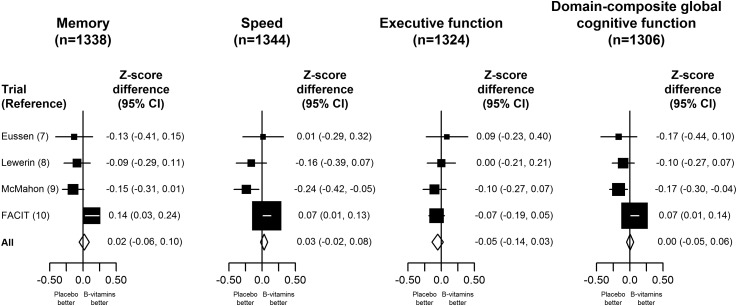
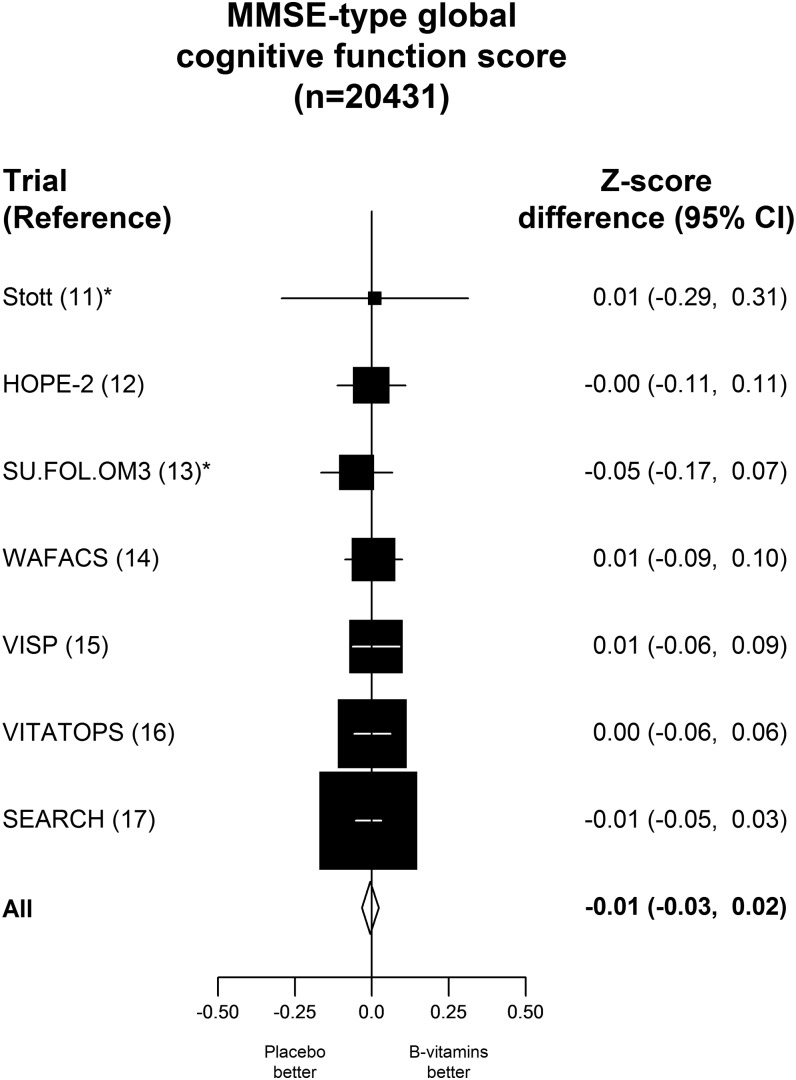
Design: A meta-analysis was conducted by using data combined from 11 large trials in 22,000 participants. Domain-based z scores (for memory, speed, and executive function and a domain-composite score for global cognitive function) were available before and after treatment (mean duration: 2.3 y) in the 4 cognitive-domain trials (1340 individuals); Mini-Mental State Examination (MMSE)-type tests were available at the end of treatment (mean duration: 5 y) in the 7 global cognition trials (20,431 individuals).
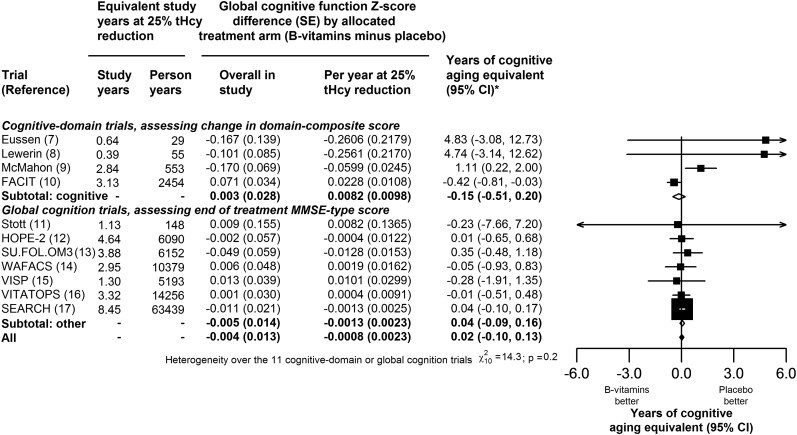
Results: The domain-composite and MMSE-type global cognitive function z scores both decreased with age (mean ± SE: -0.054 ± 0.004 and -0.036 ± 0.001/y, respectively). Allocation to B vitamins lowered homocysteine concentrations by 28% in the cognitive-domain trials but had no significant effects on the z score differences from baseline for individual domains or for global cognitive function (z score difference: 0.00; 95% CI: -0.05, 0.06). Likewise, allocation to B vitamins lowered homocysteine by 26% in the global cognition trials but also had no significant effect on end-treatment MMSE-type global cognitive function (z score difference: -0.01; 95% CI: -0.03, 0.02). Overall, the effect of a 25% reduction in homocysteine equated to 0.02 y (95% CI: -0.10, 0.13 y) of cognitive aging per year and excluded reductions of >1 mo per year of treatment.
Conclusion: Homocysteine lowering by using B vitamins had no significant effect on individual cognitive domains or global cognitive function or on cognitive aging.
Figures
Comment in
-
B-vitamin trials meta-analysis: less than meets the eye.Am J Clin Nutr. 2015 Feb;101(2):414-5. doi: 10.3945/ajcn.114.097808. Am J Clin Nutr. 2015. PMID: 25646342 No abstract available.
-
Homocysteine lowering, B vitamins, and cognitive aging.Am J Clin Nutr. 2015 Feb;101(2):415-6. doi: 10.3945/ajcn.114.098467. Am J Clin Nutr. 2015. PMID: 25646343 No abstract available.
-
Reply to Garrard and Jacoby and Smith et al.Am J Clin Nutr. 2015 Feb;101(2):416-7. doi: 10.3945/ajcn.114.100941. Am J Clin Nutr. 2015. PMID: 25646344 No abstract available.
References
-
- Mayeux R. Early Alzehimer's disease. N Engl J Med 2010;362:2194–201. - PubMed
-
- Clarke R, Smith AD, Jobst K, Sutton L, Refsum H, Ueland PM. Plasma homocysteine, folate and vitamin B-12 as risk factors for confirmed Alzheimer's disease. Arch Neurol 1998;55:1449–55. - PubMed
-
- Clarke R. B-vitamins and prevention of dementia. Proc Nutr Soc 2008;67:75–81. - PubMed
-
- Clarke R, Birks J, Nexo E, Ueland PM, Schneede PM, Scott J, Molloy A, Frost C, Evans JM. Low vitamin B12 status and risk of cognitive decline in older people. Am J Clin Nutr 2007;86:1384–91. - PubMed
-
- Seshadri S, Beiser A, Selhub J, Jacques P, D'Agostino RB, Wilson PW, Wolf PA. Plasma homocysteine as a risk factor for dementia and Alzheimer's disease. N Engl J Med 2002;346:476–83. - PubMed
Publication types
MeSH terms
Substances
Grants and funding
LinkOut - more resources
Full Text Sources
Other Literature Sources
Medical
