


Structural rearrangements of a polyketide synthase module during its catalytic cycle
- PMID: 24965656
- PMCID: PMC4074775
- DOI: 10.1038/nature13409
Structural rearrangements of a polyketide synthase module during its catalytic cycle
Abstract
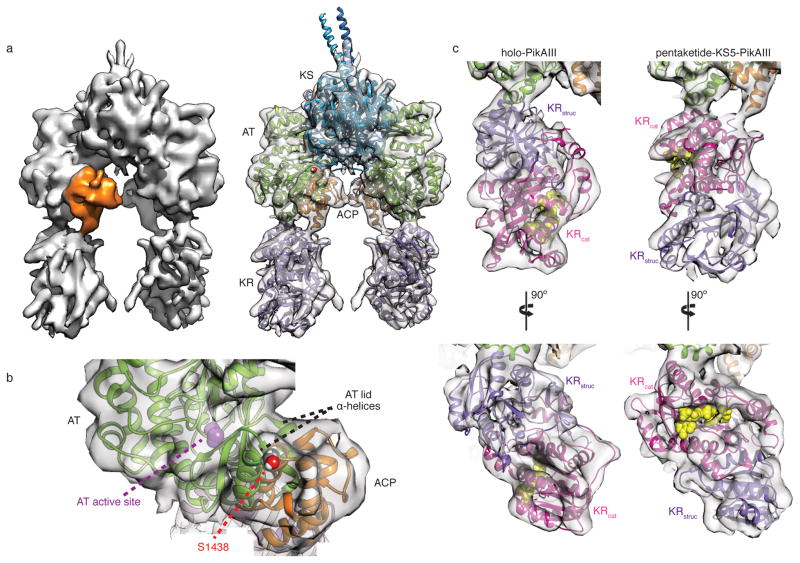
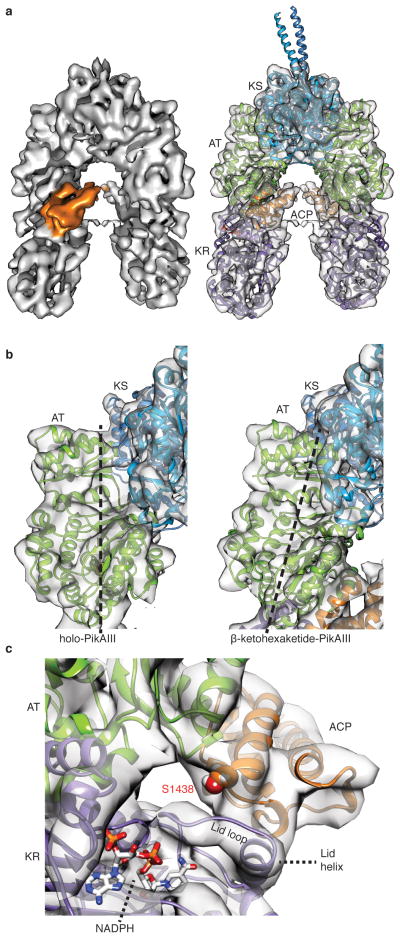
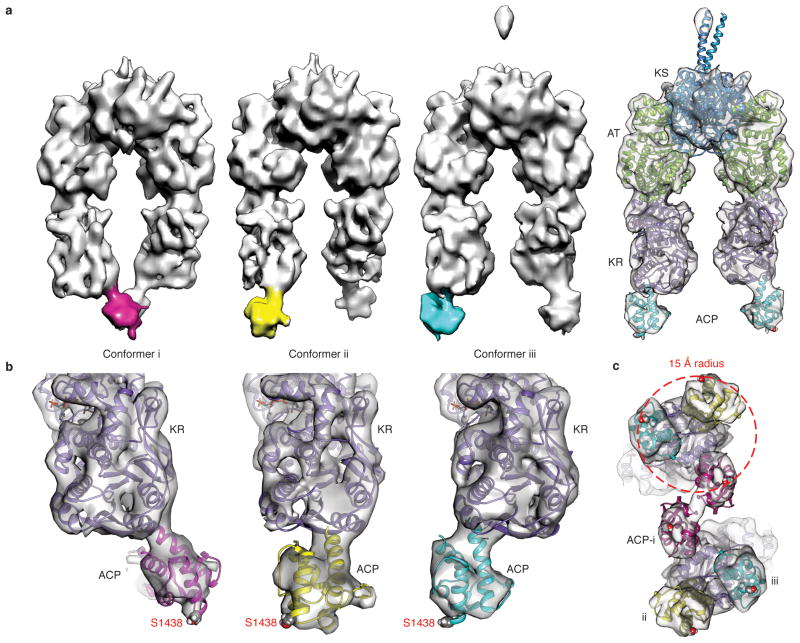
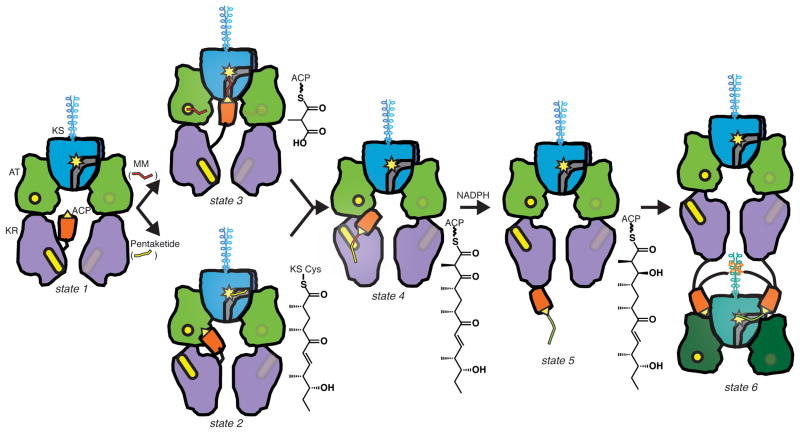
The polyketide synthase (PKS) mega-enzyme assembly line uses a modular architecture to synthesize diverse and bioactive natural products that often constitute the core structures or complete chemical entities for many clinically approved therapeutic agents. The architecture of a full-length PKS module from the pikromycin pathway of Streptomyces venezuelae creates a reaction chamber for the intramodule acyl carrier protein (ACP) domain that carries building blocks and intermediates between acyltransferase, ketosynthase and ketoreductase active sites (see accompanying paper). Here we determine electron cryo-microscopy structures of a full-length pikromycin PKS module in three key biochemical states of its catalytic cycle. Each biochemical state was confirmed by bottom-up liquid chromatography/Fourier transform ion cyclotron resonance mass spectrometry. The ACP domain is differentially and precisely positioned after polyketide chain substrate loading on the active site of the ketosynthase, after extension to the β-keto intermediate, and after β-hydroxy product generation. The structures reveal the ACP dynamics for sequential interactions with catalytic domains within the reaction chamber, and for transferring the elongated and processed polyketide substrate to the next module in the PKS pathway. During the enzymatic cycle the ketoreductase domain undergoes dramatic conformational rearrangements that enable optimal positioning for reductive processing of the ACP-bound polyketide chain elongation intermediate. These findings have crucial implications for the design of functional PKS modules, and for the engineering of pathways to generate pharmacologically relevant molecules.
Figures
Comment in
-
Structural biology: enzyme assembly line pictured.Nature. 2014 Jun 26;510(7506):482-3. doi: 10.1038/nature13505. Epub 2014 Jun 18. Nature. 2014. PMID: 24965648 No abstract available.
References
-
- Kittendorf JD, Sherman DH. Developing tools for engineering hybrid polyketide synthetic pathways. Curr Opin Biotechnol. 2006;17:597–605. - PubMed
-
- Walsh CT. Combinatorial biosynthesis of antibiotics: challenges and opportunities. Chembiochem. 2002;3:125–134. - PubMed
-
- Menzella HG, Reeves CD. Combinatorial biosynthesis for drug development. Curr Opin Microbiol. 2007;10:238–245. - PubMed
-
- Menzella HG, Carney JR, Santi DV. Rational design and assembly of synthetic trimodular polyketide synthases. Chem Biol. 2007;14:143–151. - PubMed
Publication types
MeSH terms
Substances
Grants and funding
LinkOut - more resources
Full Text Sources
Other Literature Sources
Molecular Biology Databases
Miscellaneous
