


Use of the cortisol-to-ACTH ratio for diagnosis of primary hypoadrenocorticism in dogs
- PMID: 24966067
- PMCID: PMC4895572
- DOI: 10.1111/jvim.12392
Use of the cortisol-to-ACTH ratio for diagnosis of primary hypoadrenocorticism in dogs
Abstract
Background: The ACTH stimulation test is currently required for definitive diagnosis of hypoadrenocorticism. Increased cost of synthetic ACTH (cosyntropin) has prompted a search for alternative diagnostic methods.
Objective: The purpose of this study was to determine whether a cortisol-to-ACTH ratio (CAR) can be used to differentiate dogs with hypoadrenocorticism from normal dogs and those with nonadrenal illness.
Animals: Eight healthy dogs (H), 19 dogs with nonadrenal illness (NAI), and 15 dogs with hypoadrenocorticism (HAD).
Methods: Dogs in the HAD group were retrospectively identified from PUVTH medical records. The NAI group consisted of hospitalized dogs with clinical signs, clinicopathologic findings, or both, consistent with a diagnosis of hypoadrenocorticism, but in which hypoadrenocorticism was ruled out based on ACTH stimulation test results. Healthy dogs were recruited from hospital staff and students. Endogenous ACTH concentrations and cortisol concentrations before and after ACTH stimulation were measured in all dogs.
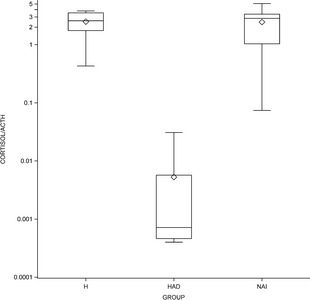
Results: Baseline cortisol concentration was significantly lower, and ACTH concentration was significantly higher, in the HAD group versus the H and NAI group (P < .001). However, there was overlap among groups. Cortisol-to-ACTH ratio was significantly lower in the HAD group versus the H and NAI groups (P < .001), and there was no overlap between the HAD group and the other 2 groups.
Conclusions and clinical importance: CAR can be used for definitive diagnosis of primary hypoadrenocorticism.
Keywords: Addison's; Adrenocorticotropic; Canine; Cosyntropin; Hormone.
Copyright © 2014 by the American College of Veterinary Internal Medicine.
Figures


References
-
- Lathan P, Moore GE, Zambon S, Scott‐Moncrieff JC. Use of a low‐dose ACTH stimulation test for diagnosis of hypoadrenocorticism in dogs. J Vet Intern Med 2008;22:1070–1073. - PubMed
-
- Lennon EM, Boyle TE, Hutchins G, et al. Use of basal serum or plasma cortisol concentrations to rule out a diagnosis of hypoadrenocorticism in dogs: 123 cases (2000–2005). J Am Vet Med Assoc 2007;231:413–416. - PubMed
-
- Javadi S, Galac S, Boer P, et al. Aldosterone‐to‐renin and cortisol‐to‐adrenocorticotropic hormone ratios in healthy dogs and dogs with primary hypoadrenocorticism. J Vet Intern Med 2006;20:556–561. - PubMed
-
- Burkitt JM, Haskins SC, Newlson RW, Kass PH. Relative adrenal insufficiency in dogs with sepsis. J Vet Intern Med 2007;21:226–231. - PubMed
-
- Singh AK, Jiang Y, Jiang Y, et al. Validation of nonradioactive chemiluminescent immunoassaymethods for the analysis of thyroxine and cortisol in blood samples obtained from dogs, cats, and horses. J Vet Diag Invest 1997;9:261–268. - PubMed
Publication types
MeSH terms
Substances
LinkOut - more resources
Full Text Sources
Other Literature Sources