Effect of incorporation of silane in the bonding agent on the repair potential of machinable esthetic blocks
- PMID: 24966745
- PMCID: PMC4054031
- DOI: 10.4103/1305-7456.126240
Effect of incorporation of silane in the bonding agent on the repair potential of machinable esthetic blocks
Abstract
Objective: To investigate the repair potential of CAD/CAM (computer-aided design/computer-aided manufacturing) ceramic and composite blocks using a silane-containing bonding agent with different repair protocols.
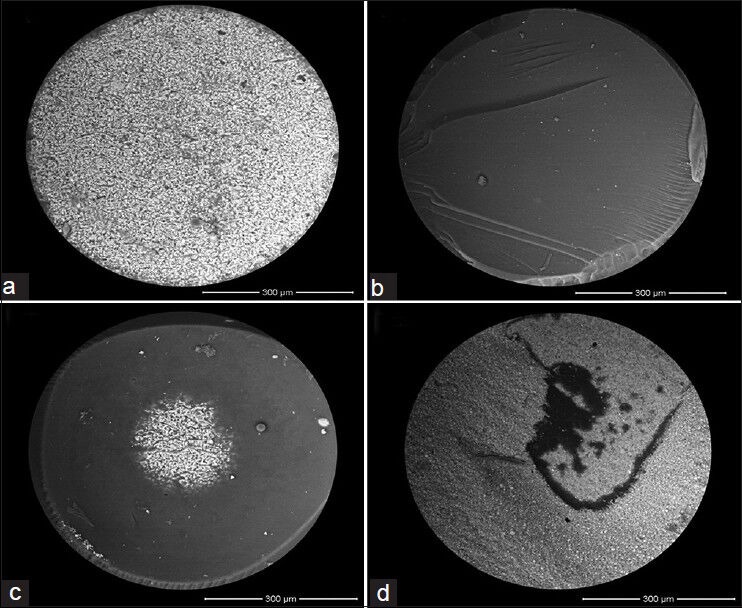
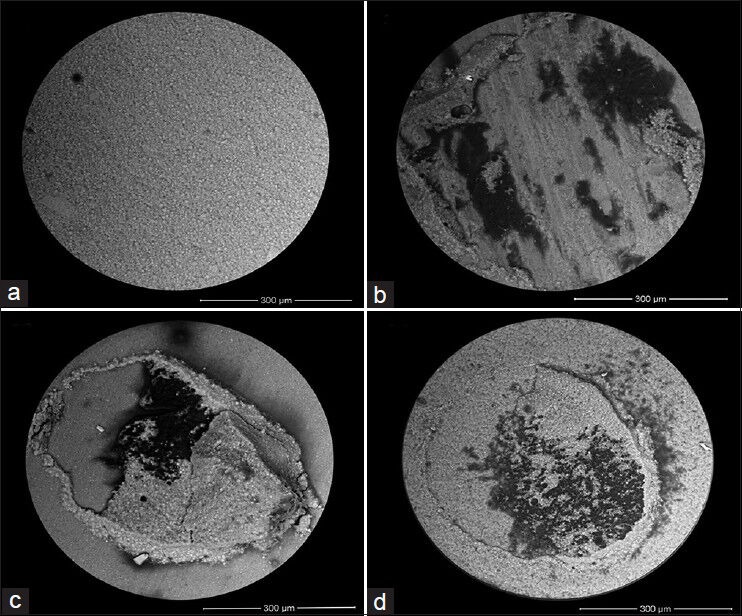
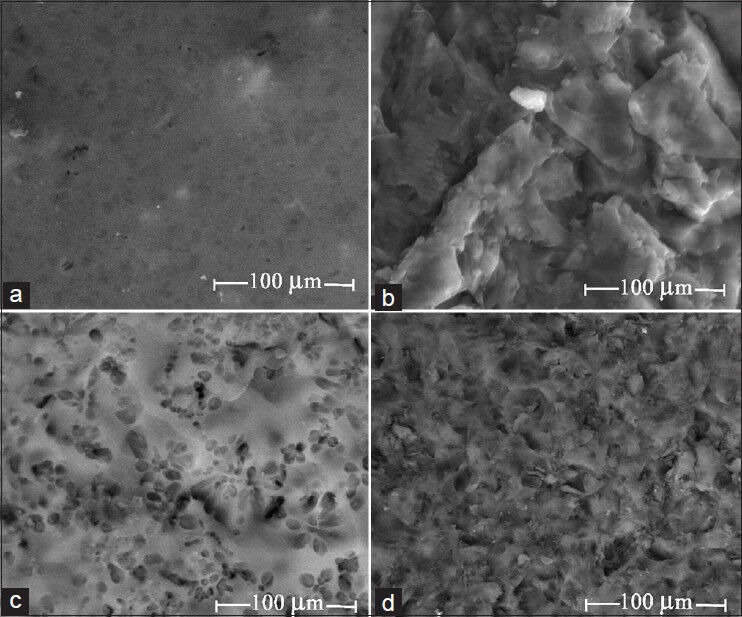
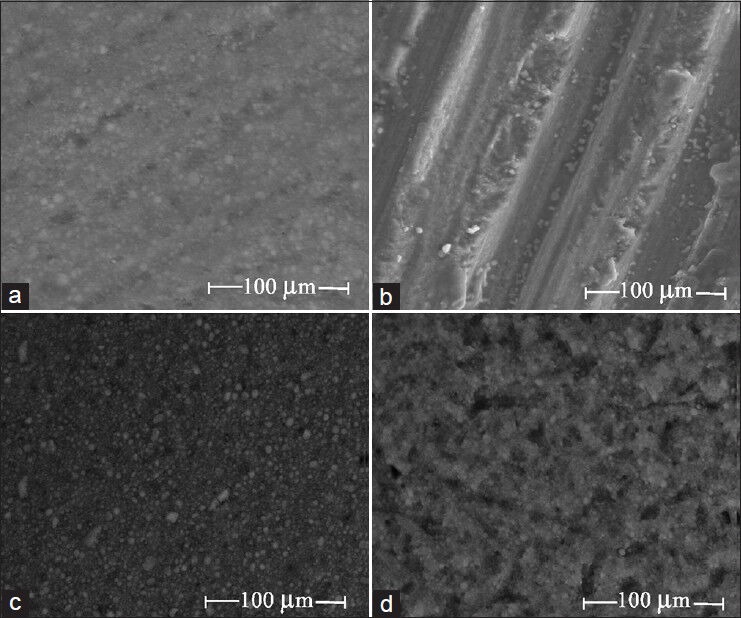
Materials and methods: Twenty-four discs were constructed from CAD/CAM ceramic and composite blocks. The discs were divided into six groups according to surface pre-treatment employed; GI: Diamond stone roughening (SR), GII: SR+ silanization (SR+S), GIII: Hydrofluoric acid etching (HF), GIV: HF+ silanization (HF+S), GV: Silica coating (SC), GVI: SC+ silanization (SC+S). Silane-containing bonding agent (Single Bond Universal adhesive, 3M ESPE) was applied to the pre-treated discs. Prior to light curing, irises were cut from tygon tubes (internal diameter = 0.8 mm and height = 0.5 mm) and mounted on each treated surface. Nanofilled resin composite (Filtek Z350(XT), 3M ESPE) was packed into the cylinder lumen and light-cured (n = 10). The specimens were subjected to microshear bond strength testing (μ-SBS) using universal testing machine. Failure modes of the fractured specimens were analyzed using field emission scanning electron microscope (FESEM). Eight representative discs were prepared to analyze the effect of surface treatments on surface topography using FESEM. μ-SBS results were analyzed using ANOVA and Tukeys post-hoc test.
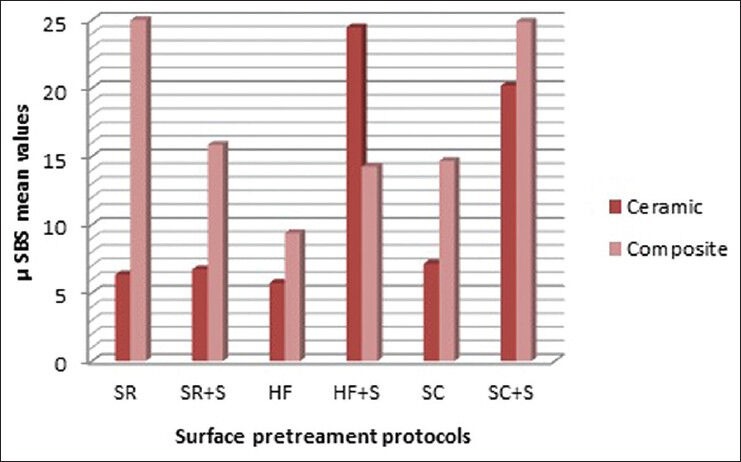
Results: Three-way ANOVA results showed that the materials, surface pre-treatment protocols, and silanization step had a statistically significant effect on the mean μ-SBS values at P ≤ 0.001. For ceramic discs, the groups were ranked; GIV (24.45 ± 7.35)> GVI ((20.18 ± 2.84)> GV (7.14 ± 14)= GII (6.72 ± 1.91)=GI (6.34 ± 2.21)=GIII (5.72 ± 2.18). For composite discs, groups were ranked; GI (24.98 ± 7.69)=GVI (24.84 ± 7.00) >GII (15.85 ± 5.29) =GV (14.65 ± 4.5)= GIV (14.24 ± 2.95)≥ GIII ((9.37 ± 2.78).
Conclusion: The additional silanization step cannot be omitted if the repair protocol comprises of either hydrofluoric acid etching or silica coating for both CAD/CAM esthetic restorative materials. However, this step can be suppressed by using silane-containing adhesive with diamond stone roughened repair protocol.
Keywords: Computer-aided design/computer-aided manufacturing esthetic blocks; microshear bond strength; repair; scanning electron microscopy; silane.
Conflict of interest statement
Figures
References
-
- Mörmann WH, Brandestini M, Lutz F. The Cerec system: Computer-assisted preparation of direct ceramic inlays in 1 setting. Quintessenz. 1987;38:457–70. - PubMed
-
- Akbar JH, Petrie CS, Walker MP, Williams K, Eick JD. Marginal adaptation of Cerec 3 CAD/CAM composite crowns using two different finish line preparation designs. J Prosthodont. 2006;15:155–63. - PubMed
-
- Reiss B. Occlusal surface design with Cerec 3D. Int J Comput Dent. 2003;6:333–42. - PubMed
-
- Sato K, Matsumura H, Atsuta M. Relation between cavity design and marginal adaptation in a machine-milled ceramic restorative system. J Oral Rehabil. 2002;29:24–7. - PubMed
-
- Peumans M, Hikita K, De Munck J, Van Landuyt K, Poitevin A, Lambrechts P, et al. Effects of ceramic surface treatments on the bond strength of an adhesive luting agent to CAD-CAM ceramic. J Dent. 2007;35:282–8. - PubMed
LinkOut - more resources
Full Text Sources
Other Literature Sources
Research Materials
Miscellaneous