Review
. 2014 Apr 15;7(5):2624-35.
eCollection 2014.

A case of recurrent autoimmune hemolytic anemia during remission associated with acute pure red cell aplasia and hemophagocytic syndrome due to human parvovirus B19 infection successfully treated by steroid pulse therapy with a review of the literature

Affiliations
Review

A case of recurrent autoimmune hemolytic anemia during remission associated with acute pure red cell aplasia and hemophagocytic syndrome due to human parvovirus B19 infection successfully treated by steroid pulse therapy with a review of the literature

Yasunobu Sekiguchi et al. Int J Clin Exp Pathol. .

Abstract

The patient was a 47-year-old man diagnosed as having autoimmune hemolytic anemia (AIHA) in April 2011. He also had a congenital chromosomal abnormality, a balanced translocation. Treatment with prednisolone (PSL) 60 mg/day resulted in resolution of the AIHA, and the treatment was completed in November 2011. While the patient no longer had anemia, the direct and indirect Coombs tests remained positive. In May 2013, he developed recurrent AIHA associated with acute pure red cell aplasia (PRCA) and hemophagocytic syndrome (HPS) caused by human parvovirus B19 (HPV B19) infection. Tests for anti-erythropoietin and anti-erythropoietin receptor antibodies were positive. Steroid pulse therapy resulted in resolution of the AIHA, PRCA, as well as HPS. The serum test for anti-erythropoietin antibodies also became negative after the treatment. However, although the serum was positive for anti-HPV B19 IgG antibodies, the patient continued to have a low CD4 lymphocyte count (CD4, <300/μL) and persistent HPV B19 infection (HPV B19 DNA remained positive), suggesting the risk of recurrence and bone marrow failure.

Keywords: Autoimmune hemolytic anemia; CD4 lymphocyte count; hemophagocytic syndrome; human parvovirus B19; pure red cell aplasia.


Figures
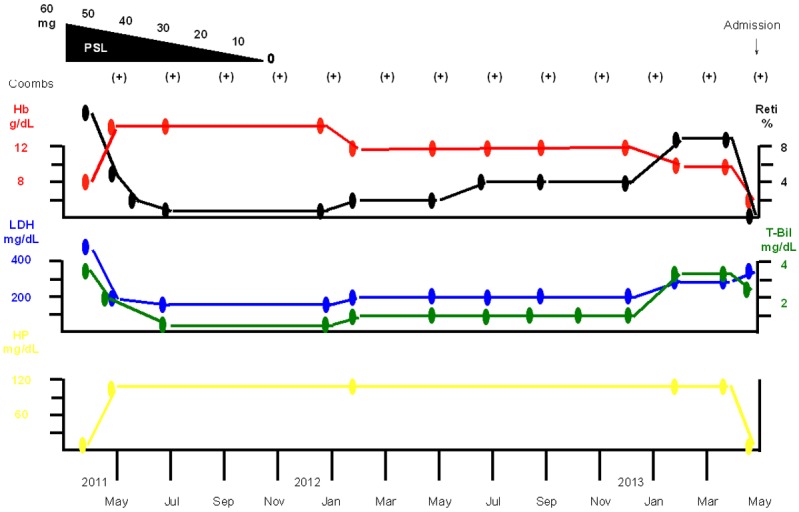
Figure 1
Figure 1
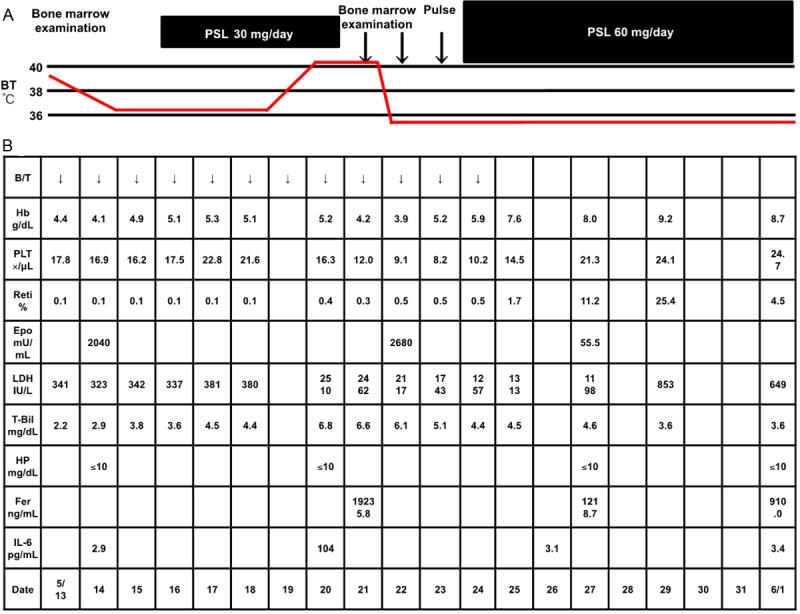
Clinical course from the first examination to admission. The patient was diagnosed as having AIHA in April 2011. Treatment with PSL 60 mg/day was started and the AIHA improved. The dose was gradually tapered and the PSL treatment was completed in November 2011. He no longer had anemia, although the direct and indirect Coombs tests remained positive. He developed marked anemia, with a Hb level of 4.4 g/dL, in early May 2013, and was admitted to our department in mid-May.
Figure 2
Figure 2
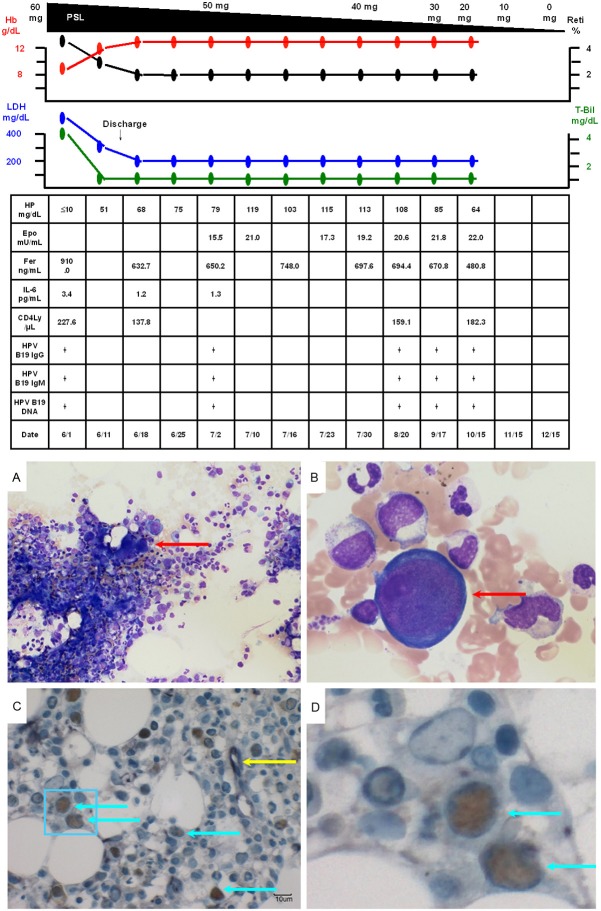
A, B. The patient was diagnosed as having recurrent AIHA associated with PRCA caused by HPV B19 infection. The recurrent AIHA was treated with PSL 30 mg/day, however, the Hb level did not improve, remaining at 4 to 6 g/dL. The reticulocyte count increased to 0.4%, suggesting a tendency towards improvement of the PRCA. One week after admission, the patient again developed fever (body temperature 41 degrees Celsius). Bone marrow examination was performed again, which led to the diagnosis of HPS. Methylprednisolone pulse therapy resulted in resolution of the HPS, as well as of the AIHA and PRCA. Subsequently, the patient was treated with PSL at the dose of 60 mg/day. The PSL treatment was completed in January 2014. The patient has had no recurrence of AIHA, PRCA or HPS, and his clinical course has been uneventful.
Figure 3
Figure 3
A. Bone marrow examination (smear; ×40) revealed normal cellularity and a marked decrease in the density of erythroblasts, with an M/E ratio of 117.25. B. Bone marrow examination (smear; ×600) also showed giant proerythroblasts (red arrow), suggesting that the patient also had PRCA. C. Double-immunostaining (enzyme-labeled antibody method; ×400) of bone marrow biopsy specimens showed positivity of the erythroblasts for anti-HPV B19 antibodies (brown staining of nuclei) and anti-erythropoietin receptor antibodies (purple staining of the cytoplasm) (light blue arrows). Some erythroblasts showed positivity for only anti-erythropoietin receptor antibodies (yellow arrow). D. An enlarged image of the area in the light blue frame in C.
Figure 4
Figure 4
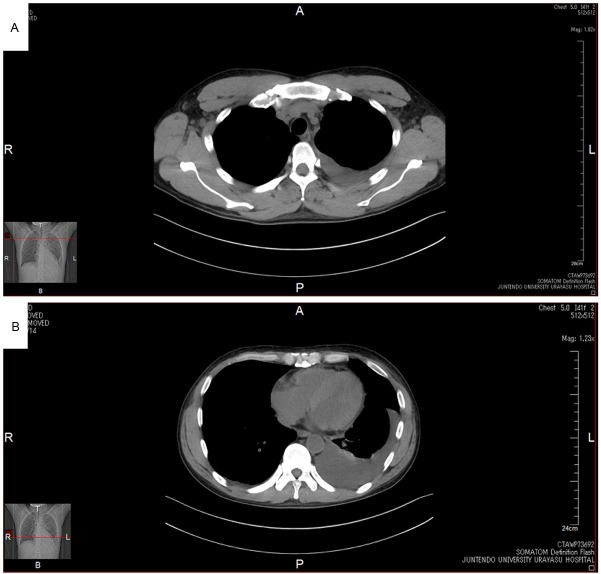
A, B. Chest CT revealed left-dominant bilateral pleural effusion, but no thymoma.
Figure 5
Figure 5
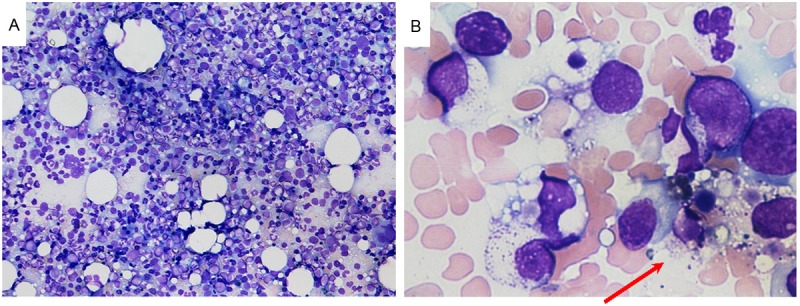
A. Bone marrow examination (smear; ×40) revealed a hyperplastic bone marrow and recovery of erythroblasts with an M/E ratio of 2.6. B. Bone marrow examination (smear; ×600) showed hemophagocytosis (red arrow).

References

    1. Davis LJ, Kennedy AC, Baikie AG, Brown A. Haemolytic anaemias of various types treated with ACTH and cortisone; report of ten cases, including one of acquired type in which erythropoietic arrest occurred during a crisis. Glasgow Med J. 1952;33:263–85. - PMC - PubMed
    1. Eisemann G, Dameshek W. Splenectomy for pure red-cell hypoplastic (aregenerative) anemia associated with autoimmune hemolytic disease; report of a case. N Engl J Med. 1954;251:1044–1048. - PubMed
    1. Seip M. Aplastic crisis in a case of immuno-hemolytic anemia. Acta Med Scand. 1955;153:137–42. - PubMed
    1. Bove JR. Combined erythroid hypoplasia and symptomatic hemolytic anemia; report of a case. N Engl J Med. 1956;255:135–136. - PubMed
    1. Hennemann HH, Falck I. [Combinations of aplastic with hemolytic syndromes] . Acta Haematol. 1957;18:219–228. German. - PubMed

MeSH terms