Current management and outcome of chronic type B aortic dissection: results with open and endovascular repair since the advent of thoracic endografting
- PMID: 24967165
- PMCID: PMC4052409
- DOI: 10.3978/j.issn.2225-319X.2014.05.07
Current management and outcome of chronic type B aortic dissection: results with open and endovascular repair since the advent of thoracic endografting
Abstract
Background: Thoracic endovascular aortic repair (TEVAR) has become the preferred treatment for chronic type B aortic dissection (CTBAD) at our institution. However, it remains incapable of treating all patients with CTBAD. The present study aims to review our contemporary results with open and endovascular CTBAD repairs since the advent of thoracic endografting.
Methods: The records of all patients undergoing index repair of CTBAD (chronic DeBakey type IIIA, IIIB and repaired type I) at our institution between June 2005 and December 2013, were retrospectively reviewed.
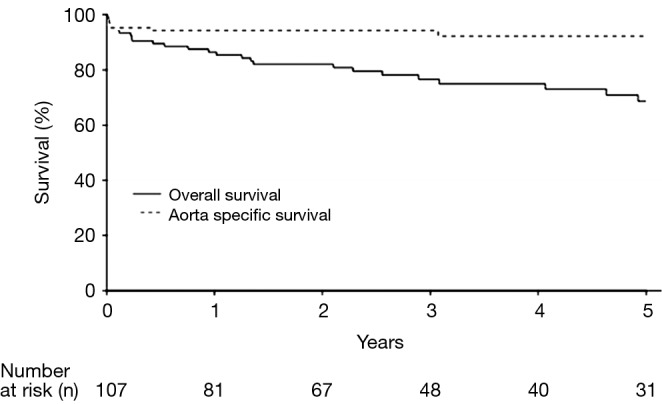
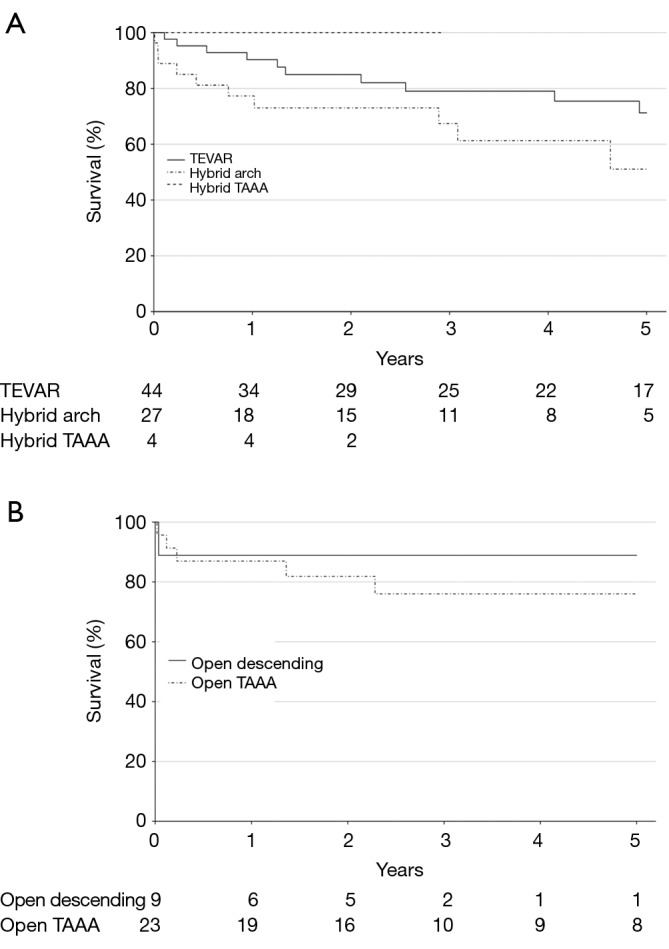
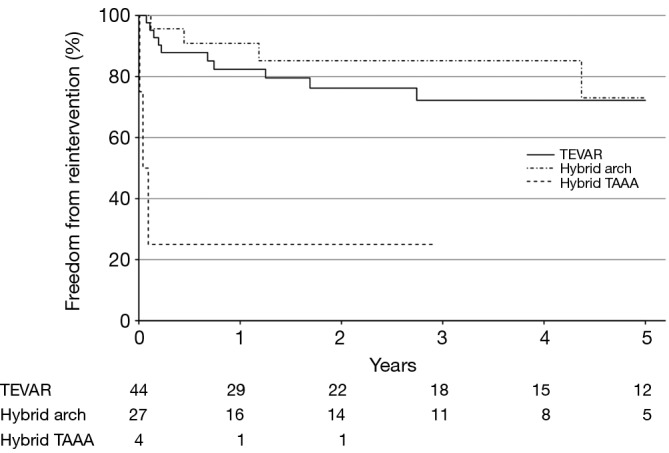
Results: A total of 107 patients underwent CTBAD repair, of whom 70% (n=75) underwent endovascular-based procedures [44 TEVAR, 27 hybrid arch and four hybrid thoracoabdominal aortic aneurysm (TAAA) repair] and 30% (n=32) underwent open procedures (nine open descending and 23 open TAAA). Connective tissue disease (CTD), prior aortic surgery and DeBakey dissection type were strongly associated with the choice of operation. The rates of stroke, paraplegia and operative mortality following endovascular-based repairs were 0%, 0% and 4% (n=3), respectively. Adverse neurologic events were higher following open repair, and rates of stroke, paraplegia, and operative mortality were 16% (n=5), 9% (n=3), and 6% (n=2), respectively. However, 1- and 5-year survival rates were similar for endovascular-based repairs (86% and 65%, respectively), and open repairs (88% and 79%, respectively). Over a median follow-up interval of 34 months, the rate of descending aortic reintervention was 24% (n=18) following endovascular-based repairs and 0% following open repairs (P=0.001). Forty-four percent (n=8) of descending aortic reinterventions were required to treat stent graft complications (five endoleak, two stent graft collapse and one stent graft-induced new entry tear) and the remainder were required to treat metachronous pathology (n=2) or progressive aneurysmal disease related to persistent distal fenestrations (n=8).
Conclusions: Endovascular repair of CTBAD was associated with excellent procedural and survival outcomes, but at the expense of further reinterventions. Open repair remains relevant for patients who are not candidates for endovascular repair and was associated with higher procedural morbidity but similar overall survival and fewer reinterventions.
Keywords: Aortic dissection; aortic surgery; outcomes.
Figures
References
-
- Parsa CJ, Schroder JN, Daneshmand MA, et al. Midterm results for endovascular repair of complicated acute and chronic type B aortic dissection. Ann Thorac Surg 2010;89:97-102; discussion 102-4 - PubMed
-
- Svensson LG, Kouchoukos NT, Miller DC, et al. Expert consensus document on the treatment of descending thoracic aortic disease using endovascular stent-grafts. Ann Thorac Surg 2008;85:S1-41 - PubMed
-
- Coady MA, Ikonomidis JS, Cheung AT, et al. Surgical management of descending thoracic aortic disease: open and endovascular approaches: a scientific statement from the American Heart Association. Circulation 2010;121:2780-804 - PubMed
-
- Hanna JM, Andersen ND, Aziz H, et al. Results with selective preoperative lumbar drain placement for thoracic endovascular aortic repair. Ann Thorac Surg 2013;95:1968-74; discussion 1974-5. - PubMed
LinkOut - more resources
Full Text Sources