doi: 10.1371/journal.ppat.1004139.
eCollection 2014 Jun.
Catching fire: Candida albicans, macrophages, and pyroptosis
Affiliations
- PMID: 24967821
- PMCID: PMC4072798
- DOI: 10.1371/journal.ppat.1004139
Item in Clipboard
Catching fire: Candida albicans, macrophages, and pyroptosis
PLoS Pathog.
.
No abstract available
Conflict of interest statement
The authors have declared that no competing interests exist.
Figures
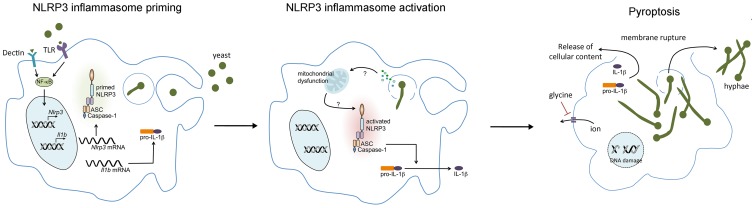
Upon encountering C. albicans, pattern recognition receptors (PRR) on the macrophage, such as TLR2 and Dectin 1 and 2, activate NF-κB, leading to the transcription and translation of NLRP3 and pro-IL-1β. Phagocytosis of C. albicans yeast forms triggers hyphal formation which may result in lysosomal rupture. NLRP3 inflammasome activation is then triggered through an as-yet-undefined mechanism. Although morphogenesis appears to be necessary for inflammasome activation, it is not sufficient. Activation of the NLRP3 inflammasome results in activation of the cysteine protease caspase-1, which mediates the processing and secretion of pro-IL-1β and pro-IL-18. Caspase-1 activation also induces pyroptotic cell death of the macrophage, resulting in cell swelling, DNA fragmentation, and the lytic release of intracellular inflammatory contents. Osmotic lysis of the macrophage during pyroptosis can be inhibited by the addition of extracellular glycine.
References
-
- Moran GP, Coleman D, Sullivan D (2012) An introduction to the medically important Candida species. In: Calderone R, Clancy CJ, editors. Candida and Candidiasis. 2nd edition. Washington, D.C.: ASM Press. pp. 11–25.
-
- Seider K, Heyken A, Luttich A, Miramon P, Hube B (2010) Interaction of pathogenic yeasts with phagocytes: survival, persistence and escape. Curr Opin Microbiol 13: 392–400. - PubMed
-
- Filler SG (2006) Candida-host cell receptor-ligand interactions. Curr Opin Microbiol 9: 333–339. - PubMed
Publication types
MeSH terms
Substances
Grants and funding
LinkOut - more resources
Full Text Sources
Other Literature Sources
Medical