. 2014 Jun 25;15(7):11204-19.
doi: 10.3390/ijms150711204.

PSNO: predicting cysteine S-nitrosylation sites by incorporating various sequence-derived features into the general form of Chou's PseAAC

Affiliations

PSNO: predicting cysteine S-nitrosylation sites by incorporating various sequence-derived features into the general form of Chou's PseAAC

Jian Zhang et al. Int J Mol Sci. .

Abstract

S-nitrosylation (SNO) is one of the most universal reversible post-translational modifications involved in many biological processes. Malfunction or dysregulation of SNO leads to a series of severe diseases, such as developmental abnormalities and various diseases. Therefore, the identification of SNO sites (SNOs) provides insights into disease progression and drug development. In this paper, a new bioinformatics tool, named PSNO, is proposed to identify SNOs from protein sequences. Firstly, we explore various promising sequence-derived discriminative features, including the evolutionary profile, the predicted secondary structure and the physicochemical properties. Secondly, rather than simply combining the features, which may bring about information redundancy and unwanted noise, we use the relative entropy selection and incremental feature selection approach to select the optimal feature subsets. Thirdly, we train our model by the technique of the k-nearest neighbor algorithm. Using both informative features and an elaborate feature selection scheme, our method, PSNO, achieves good prediction performance with a mean Mathews correlation coefficient (MCC) value of about 0.5119 on the training dataset using 10-fold cross-validation. These results indicate that PSNO can be used as a competitive predictor among the state-of-the-art SNOs prediction tools. A web-server, named PSNO, which implements the proposed method, is freely available at http://59.73.198.144:8088/PSNO/.


Figures
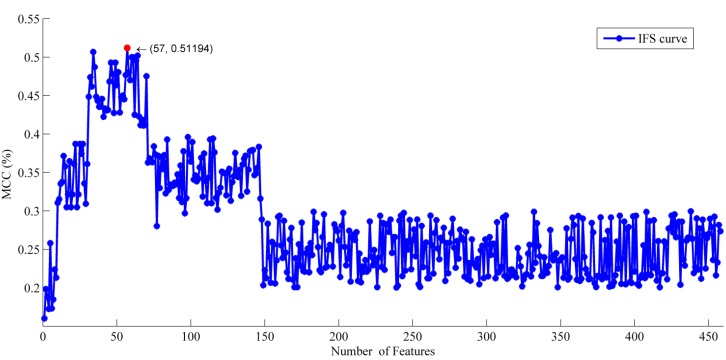
Figure 1
Figure 1
The IFS curve of 458 features for the training dataset. The x-axis and y-axis indicatesthe mean Mathews correlation coefficient (MCC) and number of features, respectively. When the number of selected features is 57, the mean MCC reaches the maximum, 0.51194.
Figure 2
Figure 2
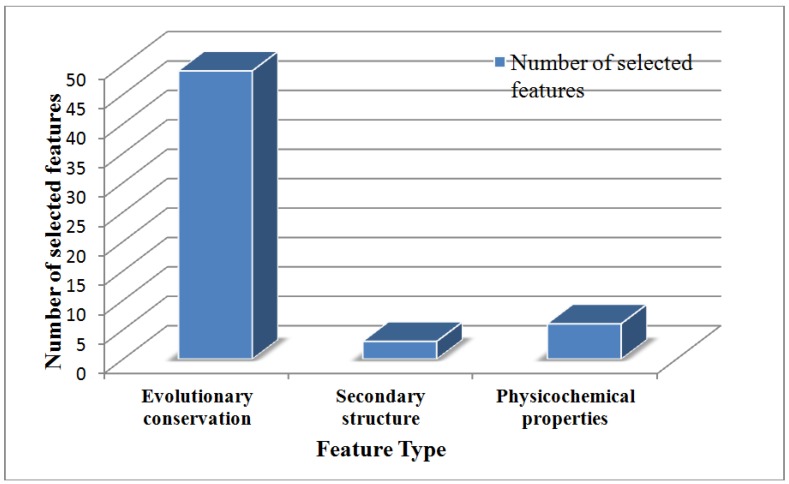
The distribution of each feature type in the final optimal feature subset. The x-axis and y-axis indicate the feature type and the number of selected features, respectively. Of the 57 optimal features, 48 belong to the evolutionary conservation score, three to the predicted secondary structure and six to the physicochemical properties.
Figure 3
Figure 3
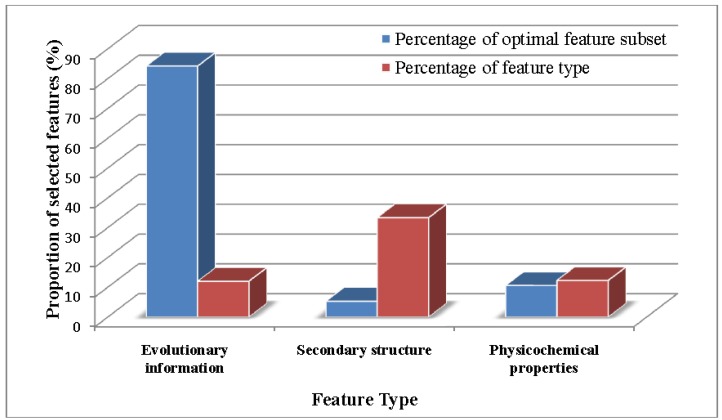
The proportion of each type of feature in the optimal feature subset. The x-axis and y-axis indicate the feature type and the proportion of the selected features, respectively. The blue blocks represent the percentage of the selected features accounting for the whole optimal feature subsets, and the red ones represent the percentage of the selected features accounting for the corresponding feature type.
Figure 4
Figure 4
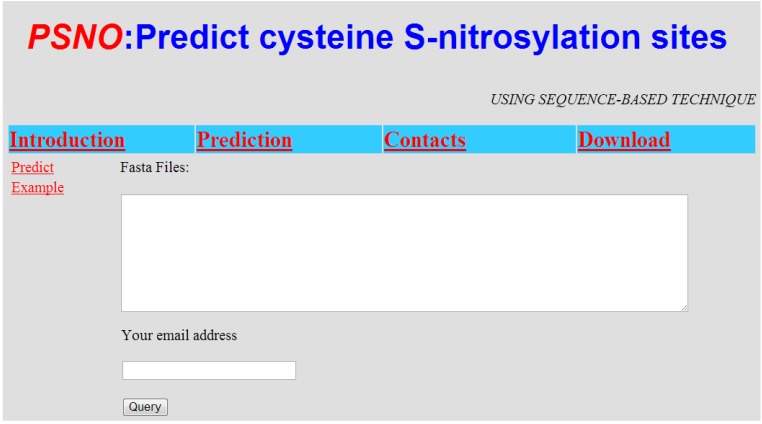
The home page of the PSNO web server.
Figure 5
Figure 5
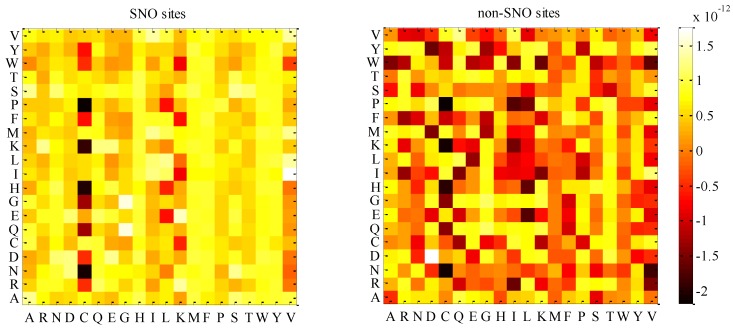
The heat maps of the preference of evolutionary conservation in S-nitrosylation sites (SNOs) and non-SNOs.The yellow color indicates the higher probability of appearance of evolutionary conservation, while the black color indicates less appearance.
Figure 6
Figure 6
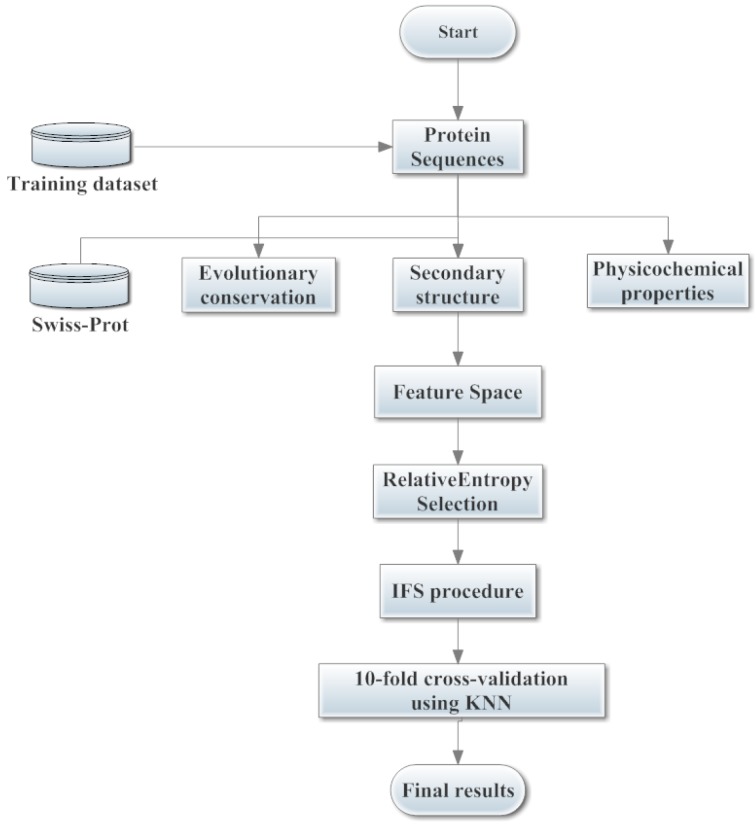
The system architecture of the proposed model. Three different types of sequence-derived features, i.e., evolutionary conservation, secondary structure and physicochemical properties, are generated and constructed as the feature space. Relative entropy selection and the incremental feature selection (IFS) procedure are adopted to select the optimal feature subset. The final results are obtained by using 10-fold cross-validation based on the k-nearest neighbor (KNN) and the selected optimal feature subsets.

References

    1. Foster M.W., Douglas T.H., Jonathan S.S. Protein S-nitrosylation in health and disease: A current perspective. Trends Mol. Med. 2009;15:391–404. doi: 10.1016/j.molmed.2009.06.007. - DOI - PMC - PubMed
    1. Foster M.W., Timothy J.M., Jonathan S.S. S-nitrosylation in health and disease. Trends Mol. Med. 2003;9:160–168. doi: 10.1016/S1471-4914(03)00028-5. - DOI - PubMed
    1. Aranda E., López-Pedrera C., de La Haba-Rodriguez R.J., Rodriguez-Ariza A. Nitric oxide and cancer: The emerging role of S-nitrosylation. Curr. Mol. Med. 2012;12:50–67. doi: 10.2174/156652412798376099. - DOI - PubMed
    1. Uehara T., Nakamura T., Yao D., Shi Z.Q., Gu Z., Ma Y., Lipton S.A. S-nitrosylated protein-disulphide isomerase links protein misfolding to neurodegeneration. Nature. 2006;441:513–517. doi: 10.1038/nature04782. - DOI - PubMed
    1. Nakamura T., Cieplak P., Cho D.H., Godzik A., Lipton S.A. S-nitrosylation of Drp1 links excessive mitochondrial fission to neuronal injury in neurodegeneration. Mitochondrion. 2006;10:573–578. - PMC - PubMed

Publication types

LinkOut - more resources