Review
. 2014 Jun 25;15(7):11324-49.
doi: 10.3390/ijms150711324.

Endothelial dysfunction in chronic inflammatory diseases

Affiliations
Review

Endothelial dysfunction in chronic inflammatory diseases

Curtis M Steyers 3rd et al. Int J Mol Sci. .

Abstract

Chronic inflammatory diseases are associated with accelerated atherosclerosis and increased risk of cardiovascular diseases (CVD). As the pathogenesis of atherosclerosis is increasingly recognized as an inflammatory process, similarities between atherosclerosis and systemic inflammatory diseases such as rheumatoid arthritis, inflammatory bowel diseases, lupus, psoriasis, spondyloarthritis and others have become a topic of interest. Endothelial dysfunction represents a key step in the initiation and maintenance of atherosclerosis and may serve as a marker for future risk of cardiovascular events. Patients with chronic inflammatory diseases manifest endothelial dysfunction, often early in the course of the disease. Therefore, mechanisms linking systemic inflammatory diseases and atherosclerosis may be best understood at the level of the endothelium. Multiple factors, including circulating inflammatory cytokines, TNF-α (tumor necrosis factor-α), reactive oxygen species, oxidized LDL (low density lipoprotein), autoantibodies and traditional risk factors directly and indirectly activate endothelial cells, leading to impaired vascular relaxation, increased leukocyte adhesion, increased endothelial permeability and generation of a pro-thrombotic state. Pharmacologic agents directed against TNF-α-mediated inflammation may decrease the risk of endothelial dysfunction and cardiovascular disease in these patients. Understanding the precise mechanisms driving endothelial dysfunction in patients with systemic inflammatory diseases may help elucidate the pathogenesis of atherosclerosis in the general population.


Figures
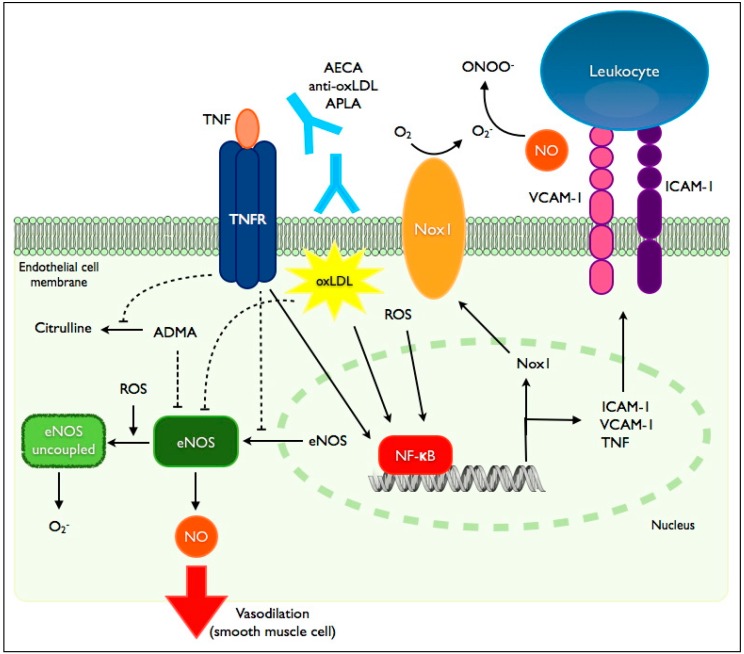
Figure 1
Figure 1
Mediators of endothelial dysfunction in inflammatory diseases. TNF-α (tumor necrosis factor-α) exerts its effects on the endothelium through its receptor, TNFR. Binding of TNFR by TNF-α leads to diminished eNOS (endothelial nitric oxide synthase) protein expression via suppression of promoter activity and destabilization of its mRNA. TNFR suppresses eNOS activity by preventing the degradation of its endogenous inhibitor, ADMA (asymmetric dimethylarginine). TNFR signaling also induces the transcription factor NF-κB leading to enhanced expression of intercellular adhesion molecules (ICAM-1: intercellular adhesion molecule-1; VCAM-1: vascular cell adhesion molecule-1), TNF-α and Nox1 (NADPH-oxidase-1). NF-κB induction is also mediated by oxidized low density lipoprotein (oxLDL), reactive oxygen species (ROS) and binding of various autoantibodies (AECA: anti-endothelial cell antibodies; APLA: antiphospholipid antibodies; anti-oxLDL: anti-oxidized LDL antibodies). eNOS uncoupling, mediated in part by ROS, is associated with reduced NO (nitric oxide) production and enhanced generation of ROS. eNOS activity is also suppressed by oxLDL.
Figure 2
Figure 2
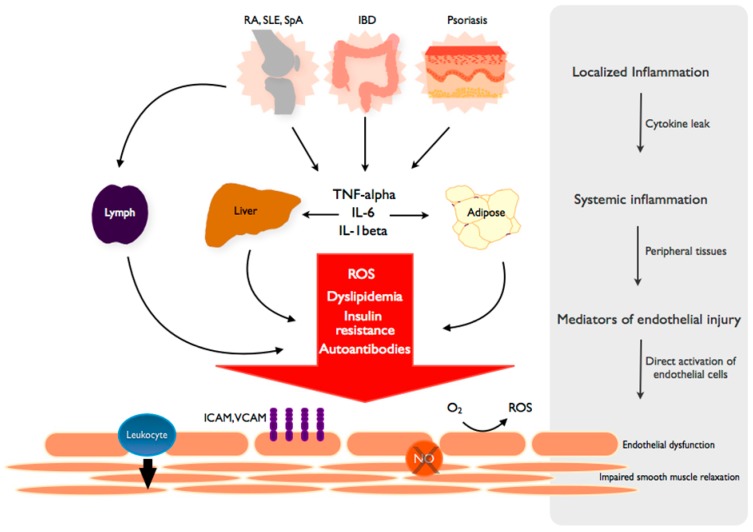
From local inflammation to systemic endothelial dysfunction. TNF and inflammatory cytokines spread from the primary, disease-specific site of local inflammation into the systemic circulation to propagate a systemic inflammatory response. The byproducts of systemic inflammation, including reactive oxygen species (ROS), lipid abnormalities and other metabolic derangements are dependent on peripheral tissues such as the liver and adipose. These mediators elicit independent and complementary effects on the endothelium, leading to a state of endothelial dysfunction characterized by increased adhesion molecule expression (VCAM, ICAM), leukocyte diapedesis, ROS production and decreased NO (nitric oxide)-mediated smooth muscle relaxation and vascular dilation. Autoantibodies are generated in a disease-specific manner and induce similar changes in endothelial function.

References

    1. Murdaca G., Colombo B.M., Cagnati P., Gulli R., Spano F., Puppo F. Endothelial dysfunction in rheumatic autoimmune diseases. Atherosclerosis. 2012;224:309–317. doi: 10.1016/j.atherosclerosis.2012.05.013. - DOI - PubMed
    1. Prati C., Demougeot C., Guillot X., Godfrin-Valnet M., Wendling D. Endothelial dysfunction in joint disease. Jt. Bone Spine. 2014 doi: 10.1016/j.jbspin.2014.01.014. - DOI - PubMed
    1. Nikpour M., Gladman D.D., Urowitz M.B. Premature coronary heart disease in systemic lupus erythematosus: What risk factors do we understand? Lupus. 2013;22:1243–1250. doi: 10.1177/0961203313493031. - DOI - PubMed
    1. Peters M.J., van der Horst-Bruinsma I.E., Dijkmans B.A., Nurmohamed M.T. Cardiovascular risk profile of patients with spondylarthropathies, particularly ankylosing spondylitis and psoriatic arthritis. Semin. Arthritis Rheum. 2004;34:585–592. doi: 10.1016/j.semarthrit.2004.07.010. - DOI - PubMed
    1. Mathieu S., Motreff P., Soubrier M. Spondyloarthropathies: an independent cardiovascular risk factor? Jt. Bone Spine. 2010;77:542–545. doi: 10.1016/j.jbspin.2010.05.001. - DOI - PubMed

Publication types

MeSH terms

Substances