


Moving away from Ritonavir, Abacavir, Tenofovir, and Efavirenz (RATE)--agents that concern prescribers and patients: a feasibility study and call for a trial
- PMID: 24968324
- PMCID: PMC4072535
- DOI: 10.1371/journal.pone.0099530
Moving away from Ritonavir, Abacavir, Tenofovir, and Efavirenz (RATE)--agents that concern prescribers and patients: a feasibility study and call for a trial
Abstract
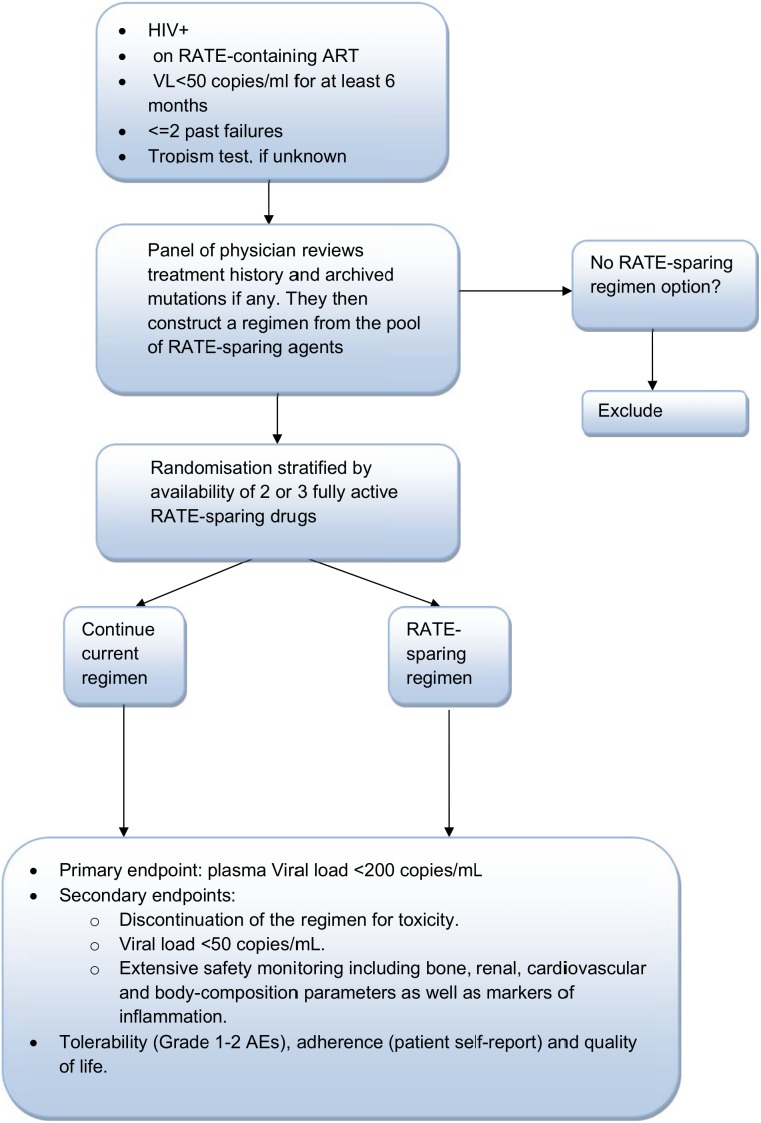
Objectives: Regimens sparing RATE (ritonavir, abacavir, tenofovir, efavirienz) agents might have better long-term safety. We conducted a feasibility exercise to assess the potential for a randomised trial evaluating RATE-sparing regimens.
Design: Observational.
Methods: We first calculated RATE-sparing options available to an average patient receiving RATE agents. We reviewed treatment history and all resistance assays from patients attending the St. Vincent's Hospital (Sydney) clinic and receiving ≥2 RATE agents (n = 120). A viable RATE-sparing regimen with 2 or 3 fully-active agents was constructed from the following six 'safer' agents: rilpivirine or etravirine; atazanavir; raltegravir; maraviroc; and lamivudine. Activity for each drug was predicted as 1 (full-activity), 0.5 or 0 (no activity) using the Stanford mutation database. The utility of maraviroc was calculated assuming both maraviroc activity and inactivity where unknown. The analysis was restricted to regimens for which supporting evidence was identified in the literature or conference proceedings. Finally, we calculated the proportion of patients in the nationally representative Australian HIV Observational Database (AHOD) cohort receiving ≥2 RATE agents (n = 1473) to measure the potential population-level uptake of RATE-sparing agents.
Results: Assuming full maraviroc activity, 117(97.5%) and 107(89.2%) individuals had at least one option with 2 or 3 active RATE-sparing agents, respectively. Assuming no maraviroc activity this decreased to 113(94.2%) and 104(86.7%), respectively. In AHOD, 837(56.8%) patients were receiving ≥2 RATE agents.
Conclusion: Feasible treatment switch options sparing RATE agents exist for the majority of patients. Understanding the pros and cons of switching stable patients onto new RATE-sparing regimens requires evidence derived from randomised controlled trials.
Conflict of interest statement
Figures
References
-
- Thompson MA, Aberg JA, Hoy JF, Telenti A, Benson C, et al. (2012) Antiretroviral treatment of adult HIV infection: 2012 recommendations of the International Antiviral Society-USA panel. JAMA 308: 387–402. - PubMed
-
- Costagliola D, Lang S, Mary-Krause M, Boccara F (2010) Abacavir and cardiovascular risk: reviewing the evidence. Curr HIV/AIDS Rep 7: 127–133. - PubMed
-
- Hill A, Sawyer W (2009) Effects of nucleoside reverse transcriptase inhibitor backbone on the efficacy of first-line boosted highly active antiretroviral therapy based on protease inhibitors: meta-regression analysis of 12 clinical trials in 5168 patients. HIV Med 10: 527–535. - PubMed
-
- Calza L (2012) Renal toxicity associated with antiretroviral therapy. HIV Clin Trials 13: 189–211. - PubMed
Publication types
MeSH terms
Substances
Grants and funding
LinkOut - more resources
Full Text Sources
Other Literature Sources
Medical
Miscellaneous
